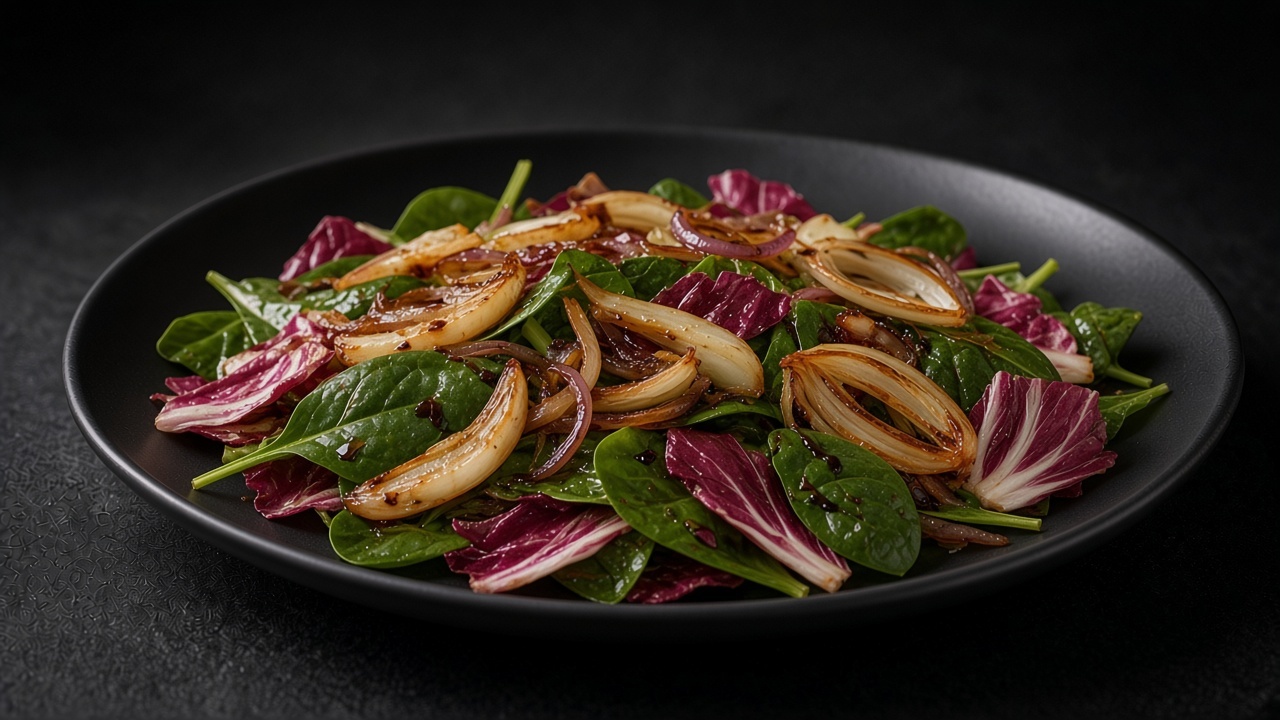

Wilted Spinach and Radicchio Salad with Balsamic Fennel
Inspired by techniques from America's Test Kitchen.
Sliced onion and fennel are browned until sweet, then deglazed with balsamic vinegar and poured warm over spinach and radicchio so the greens wilt just slightly. The bitter radicchio, sweet caramelised vegetables and sharp vinegar balance each other in a salad that eats more like a side dish.
Always check the labels of the products you use.
Method
- 1
Toss the greens. In a large bowl, toss the spinach and radicchio together.
- 2
Cook the onion and fennel. Heat the olive oil in a large frying pan over medium-high heat until shimmering. Add the onion, fennel and salt and cook, stirring occasionally, until the vegetables are softened and browned at the edges, 6 to 8 minutes.
- 3
Deglaze with vinegar. Stir in the balsamic vinegar and pepper to taste and cook until syrupy, about 30 seconds.
- 4
Combine and serve. Scrape the warm fennel mixture into the bowl with the spinach and radicchio. Toss until the greens wilt slightly, about 1 minute, and serve immediately.
Storage
Best served immediately, while the spinach and radicchio are only just wilted. Leftovers keep refrigerated in an airtight container for up to 1 day but will continue to soften. Cool leftovers in a shallow container and refrigerate within 2 hours (within 1 hour on a day above 32°C).
EU nutrition claims
- Low saturated fat: 1.1 g saturated fat per 100 g, 9.7% of energy (limits ≤ 1.5 g and ≤ 10%)
- Low sugars: 3.3 g sugars per 100 g (limit ≤ 5 g)
- Source of fibre: 2 g fibre per 100 kcal (needs ≥ 1.5 g)
Per 100 g of the finished dish, worked out from the nutrition per serving and the lowest likely cooked weight (about 132 g a serving), so the true values are, if anything, lower. Thresholds from the Annex to EU Regulation (EC) No 1924/2006. How we decide
Free sugars
0 g per serving
0 % of the 50 g daily maximum · 0 % of the ideal 25 g
Free sugars under 50 g a day, ideally about 25 g, based on WHO free-sugar guidance (not endorsed by WHO). The share shown is the share of one serving. WHO
Equipment
- chef's knife
- chopping board
- mandoline or sharp knife for thin slicing
- large frying pan
- large bowl
- tongs
Nutrition per serving (estimated values)
| Per serving | Amount |
|---|---|
| Energy | 139 kcal |
| Protein | 2.5 g |
| Carbohydrate | 9.7 g |
| of which sugars | 4.4 g |
| of which free sugars | 0 g |
| Fat | 10.7 g |
| of which saturates | 1.5 g |
| Fibre | 2.8 g |
| Salt | 0.71 g |
Protein per 100 kcal
1.8 g High Protein needs ≥ 5 g (20% of energy)
Calculated from USDA FoodData Central ingredient values