 Velvet
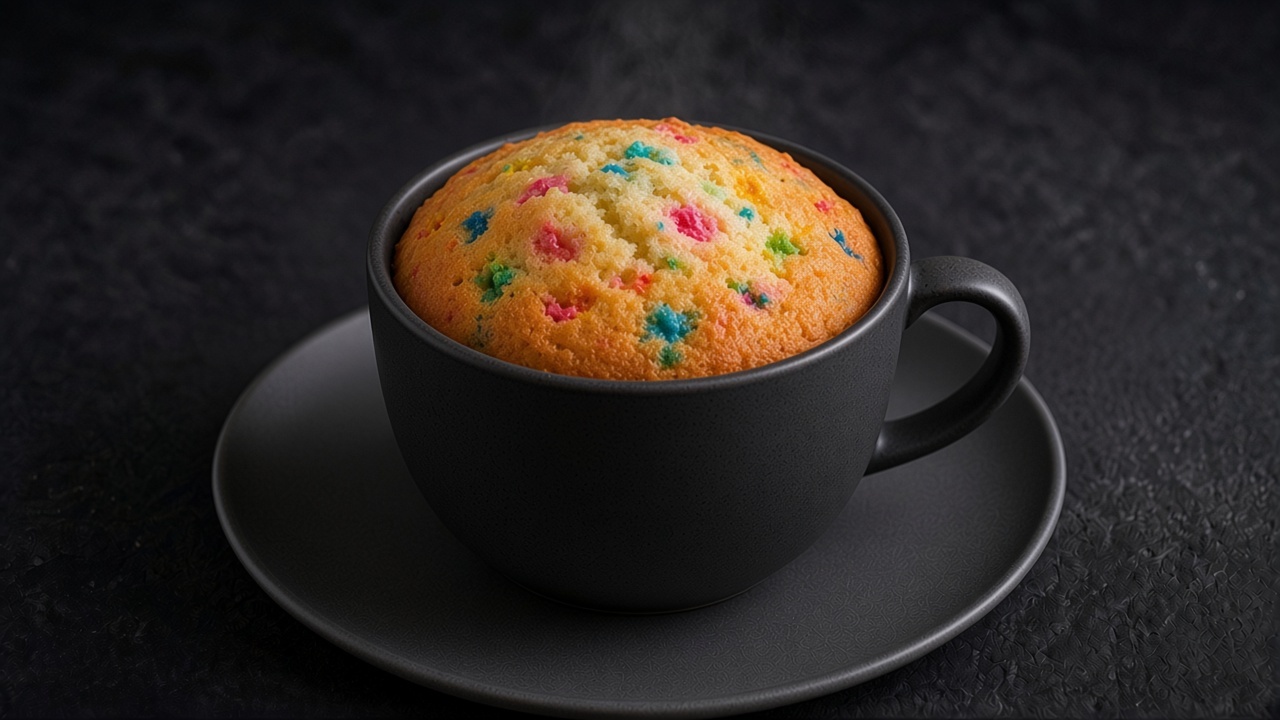
Vanilla Mug Cake
Inspired by techniques from King Arthur.
A single-serving vanilla cake stirred together right in a mug and microwaved in under a minute, with a splash of vinegar reacting against the baking soda to help it rise. It satisfies a sweet craving fast, with no oven and no full-size cake to deal with.
Always check the labels of the products you use.
Method
- 1
Mix the dry ingredients. Combine the flour, salt, baking soda, baking powder and sugar in a 170-230 ml microwave-safe mug, bowl or ramekin.
- 2
Stir in the wet ingredients. Add the oil, water, vinegar and alcohol-free vanilla extract and stir until no dry streaks remain and the batter is smooth. Scatter the sprinkles over the top, if using.
- 3
Microwave the cake. Microwave on high for 40 seconds, then check the centre: if more than a small, roughly 1 cm circle in the middle still looks wet, microwave in 5-10 second bursts until just set. In a 1000-watt microwave the cake is usually done in 40-50 seconds total.
- 4
Cool and serve. Let the cake stand for a couple of minutes before eating - it is very hot straight out of the microwave. Top with a dollop of whipped cream or a small scoop of ice cream if you like.
Storage
Mug cakes are best made fresh and eaten warm straight from the microwave; they do not keep well once cold. If you must hold one, cover and store at room temperature for up to a day, then warm it through for 10-15 seconds in the microwave before eating.
Free sugars
13 g per serving
26 % of the 50 g daily maximum · 52 % of the ideal 25 g
Free sugars under 50 g a day, ideally about 25 g (WHO). The share shown is the share of one serving. WHO
Equipment
- 170-230 ml microwave-safe mug, bowl or ramekin
- measuring spoons
- kitchen scale (optional)
- fork or small whisk
- microwave
Nutrition per serving (estimated values)
| Per serving | Amount |
|---|---|
| Energy | 256 kcal |
| Protein | 3.7 g |
| Carbohydrate | 33.5 g |
| of which sugars | 13.3 g |
| of which free sugars | 13 g |
| Fat | 12.7 g |
| of which saturates | 1 g |
| Fibre | 3 g |
| Salt | 0.8 g |
Protein per 100 kcal
1.4 g High Protein needs ≥ 5 g (20% of energy)
Calculated from USDA FoodData Central ingredient values