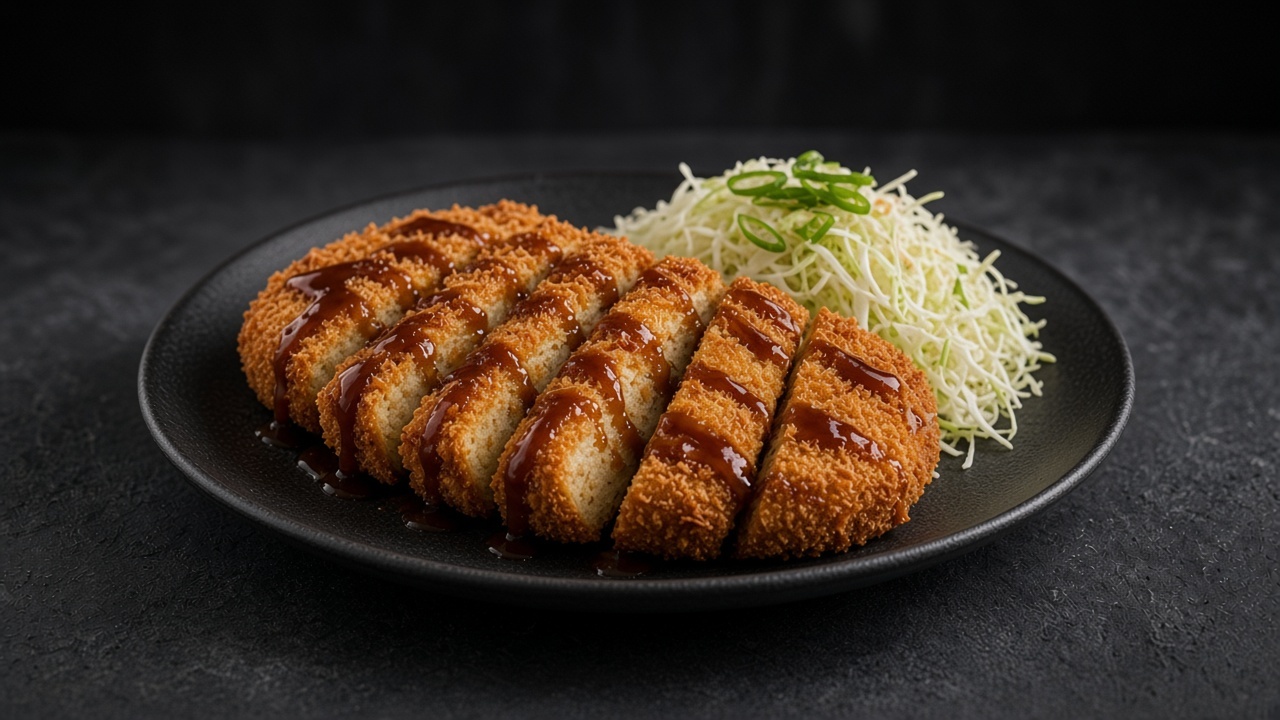

Tofu Katsu with Crunchy Cabbage Salad
Inspired by techniques from America's Test Kitchen.
Slabs of extra-firm tofu dipped in a soy-seasoned egg wash and coated in crushed panko, then shallow-fried until deep golden and crisp. They are served with a lemony salted cabbage salad and a drizzle of tangy-sweet tonkatsu sauce.
Always check the labels of the products you use.
Method
- 1
Make the salad. Combine the cabbage, spring onions, lemon juice and ¼ tsp salt in a bowl. Squeeze and massage with your hands for about 1 min, until the cabbage is slightly wilted. Set a wire rack in a rimmed baking tray and line half of it with three layers of kitchen paper.
- 2
Coat the tofu. Whisk the eggs, soy sauce, flour and 1 tsp salt in a shallow dish. Lightly crush the panko in a large food bag with a rolling pin and tip into a second shallow dish. Pat the tofu dry with kitchen paper. Dip each slab in the egg mixture, letting the excess drip off, then coat all over with panko, pressing gently so it sticks. Put on the unlined side of the rack.
- 3
Fry. Heat the oil in a 30 cm non-stick frying pan over medium-high heat until shimmering. Add the tofu and fry for about 3 min per side, until deep golden brown. Move to the lined side of the rack.
- 4
Serve. Season the salad with salt to taste. Serve the tofu drizzled with tonkatsu sauce, with extra sauce on the side.
Storage
Best eaten straight away. Refrigerate leftover tofu for up to 2 days and reheat in a hot oven until crisp and piping hot. Cool leftovers in a shallow container and refrigerate within 2 hours (within 1 hour on a day above 32°C).
Why this label?
16.4 g protein for 307 kcal = 5.3 g per 100 kcal, so protein gives about 21% of the energy. High Protein needs at least 20% (5 g per 100 kcal), the condition in the Annex to EU Regulation (EC) No 1924/2006. How we decide
EU nutrition claims
- Low saturated fat: 1 g saturated fat per 100 g, 7% of energy (limits ≤ 1.5 g and ≤ 10%)
- Source of fibre: 1.7 g fibre per 100 kcal (needs ≥ 1.5 g)
Per 100 g of the finished dish, worked out from the nutrition per serving and the lowest likely cooked weight (about 229 g a serving), so the true values are, if anything, lower. Thresholds from the Annex to EU Regulation (EC) No 1924/2006. How we decide
Free sugars
6.7 g per serving
13.4 % of the 50 g daily maximum · 26.8 % of the ideal 25 g
Free sugars under 50 g a day, ideally about 25 g, based on WHO free-sugar guidance (not endorsed by WHO). The share shown is the share of one serving. WHO
Equipment
- large bowl
- wire rack set in a rimmed baking tray
- kitchen paper
- 2 shallow dishes
- whisk
- large food bag
- rolling pin
- 30 cm non-stick frying pan
- fish slice
Nutrition per serving Calculated from USDA FoodData Central
| Per serving | Amount |
|---|---|
| Energy | 307 kcal |
| Protein | 16.4 g |
| Carbohydrate | 29.7 g |
| of which sugars | 12.3 g |
| of which free sugars | 6.7 g |
| Fat | 15.3 g |
| of which saturates | 2.4 g |
| Fibre | 5.1 g |
| Salt | 2.97 g |
Protein per 100 kcal
5.3 g meets High Protein (≥ 5 g, 20% of energy)
Calculated from USDA FoodData Central ingredient values