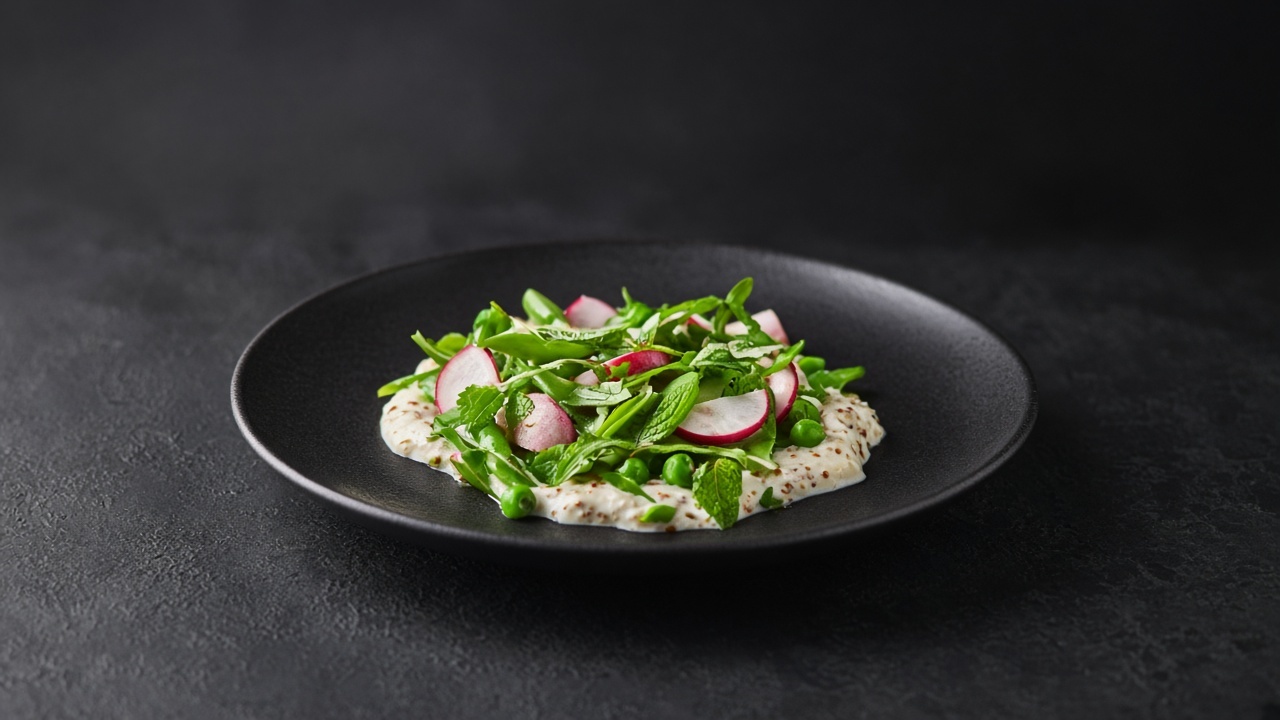

Spring Pea Salad with Yoghurt-Mustard Dressing
Inspired by techniques from America's Test Kitchen.
Briefly blanched sugar snap peas and shelled fresh peas are piled with raw snow peas, radish, rocket and mint over a tangy yoghurt and Dijon dressing spread across the platter. Composing it this way, instead of tossing everything together, keeps the peas and leaves crisp while the dressing stays underneath to be mixed in at the table.
Always check the labels of the products you use.
Method
- 1
Set up. Mince the garlic and combine it right away with 30 ml of the lemon juice in a medium bowl; set aside. Fill a large bowl halfway with ice and water and nestle a colander into the ice bath. Line a large plate with a double layer of kitchen paper.
- 2
Blanch the peas. Bring a medium saucepan of water to the boil. Add the sugar snap peas and the blanching salt and cook until bright green and crisp-tender, about 1 minute. Lift the snap peas into the colander in the ice bath. Add the shelled peas to the boiling water and cook until bright green and tender, about 1 1/2 minutes, then transfer to the colander with the snap peas. Once the peas are chilled, lift the colander from the ice bath and spread the peas on the prepared plate to dry.
- 3
Make the dressing. Whisk the 60 ml olive oil, yoghurt, mustard, pepper and 3 g fine salt into the garlic-lemon mixture until combined. Spread the dressing evenly over the bottom of a large shallow bowl or platter.
- 4
Finish and serve. In a separate large bowl, toss the rocket, snow peas, radishes, mint and chilled peas with the remaining 5 ml lemon juice, the pinch of salt and the remaining 15 ml oil until evenly coated. Pile the salad on top of the dressing and serve right away, mixing the salad into the dressing as you serve.
Storage
Best served right away, mixed together at the table. Leftover dressed salad can be kept in an airtight container in the fridge for up to a day, though the peas and leaves will soften. Cool leftovers in a shallow container and refrigerate within 2 hours (within 1 hour on a day above 32°C).
EU nutrition claims
- Low sugars: 4.3 g sugars per 100 g (limit ≤ 5 g)
- Source of fibre: 1.7 g fibre per 100 kcal (needs ≥ 1.5 g)
Per 100 g of the finished dish, worked out from the nutrition per serving and the lowest likely cooked weight (about 121 g a serving), so the true values are, if anything, lower. Thresholds from the Annex to EU Regulation (EC) No 1924/2006. How we decide
Free sugars
0 g per serving
0 % of the 50 g daily maximum · 0 % of the ideal 25 g
Free sugars under 50 g a day, ideally about 25 g, based on WHO free-sugar guidance (not endorsed by WHO). The share shown is the share of one serving. WHO
Equipment
- chef's knife
- chopping board
- medium saucepan
- colander
- large bowl (for the ice bath)
- spider skimmer or slotted spoon
- kitchen paper
- whisk
- large shallow bowl or platter
Nutrition per serving (estimated values)
| Per serving | Amount |
|---|---|
| Energy | 221 kcal |
| Protein | 5.3 g |
| Carbohydrate | 11.1 g |
| of which sugars | 5.2 g |
| of which free sugars | 0 g |
| Fat | 18 g |
| of which saturates | 2.6 g |
| Fibre | 3.8 g |
| Salt | 0.84 g |
Protein per 100 kcal
2.4 g High Protein needs ≥ 5 g (20% of energy)
Calculated from USDA FoodData Central ingredient values