 Velvet
Sea Bass with Garlic, Ginger and Soy Sauce
Inspired by techniques from Bon Appétit.
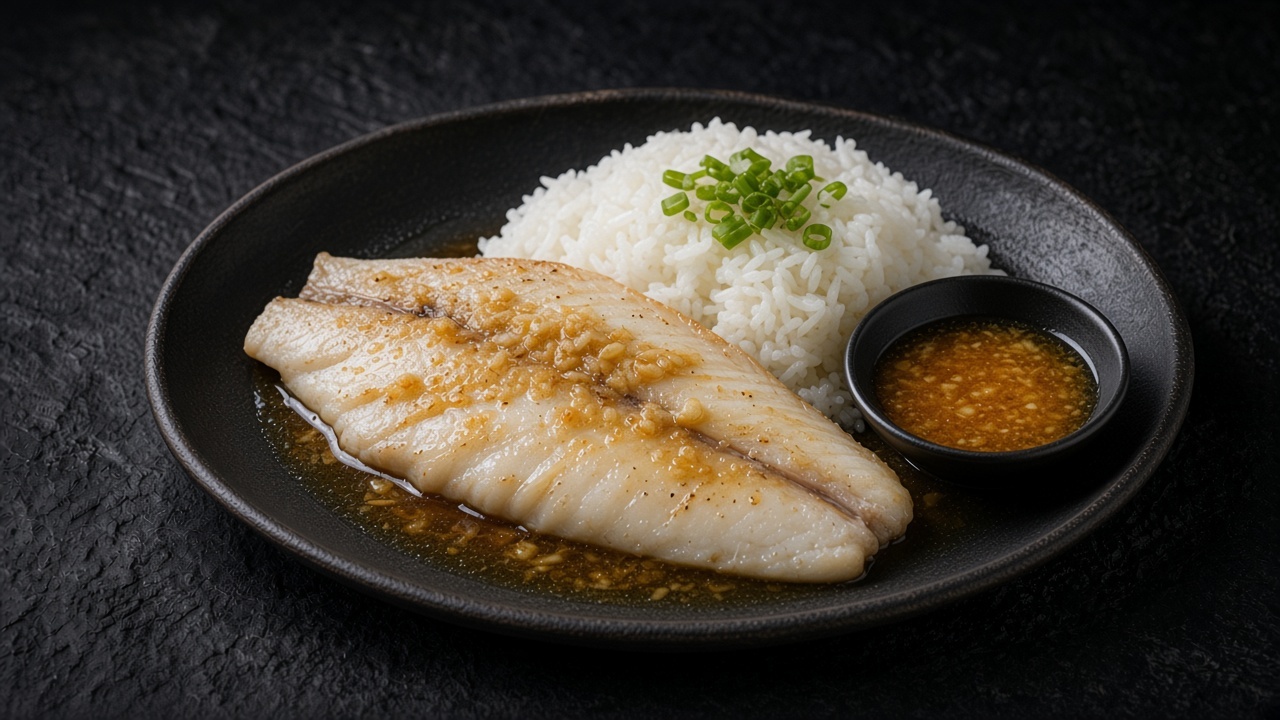
Sea bass fillets brushed with a quick glossy sauce of garlic, ginger, soy, cider vinegar and stock, then cooked under a hot grill in about 6 minutes. Served with rice, spring onion and the rest of the sauce on the side.
Always check the labels of the products you use.
Method
- 1
Mix the stock. Stir the stock and cornflour together in the small bowl until the cornflour dissolves.
- 2
Make the sauce. Heat the oil in the saucepan over high heat. Add the garlic and ginger and stir-fry for about 30 sec, until fragrant. Add the vinegar, soy sauce, sugar and the stock mixture and boil, stirring constantly, for about 1 min, until the sauce thickens and turns glossy. Take off the heat and season with the pepper.
- 3
Brush the fish. Heat the grill to high with a shelf about 10 cm below the element. Lay the fillets on the baking tray and brush a little sauce over both sides.
- 4
Grill. Grill for about 3 min, then turn carefully with the fish slice and grill about 3 min more, until the flesh is opaque, flakes easily and reads 63 °C in the thickest part.
- 5
Serve. Put a fillet on each plate with the rice alongside, scatter over the spring onion and serve the rest of the sauce separately.
Storage
Best eaten straight away. Refrigerate leftover fish and sauce separately, covered, up to 2 days and reheat gently until piping hot (74 °C). Cool leftovers in a shallow container and refrigerate within 2 hours (within 1 hour on a day above 32°C).
Why it's healthy
38.5 g protein for 477 kcal = 8.1 g per 100 kcal, so protein gives about 32% of the energy. High Protein needs at least 20% (5 g per 100 kcal), the EU condition. How we decide
EU nutrition claims
- Low fat: 3 g fat per 100 g (limit ≤ 3 g)
- Low saturated fat: 0.6 g saturated fat per 100 g, 4% of energy (limits ≤ 1.5 g and ≤ 10%)
- Low sugars: 0.7 g sugars per 100 g (limit ≤ 5 g)
Per 100 g of the finished dish, worked out from the nutrition per serving and the lowest likely cooked weight (about 374 g a serving), so the true values are, if anything, lower. Thresholds from the Annex to EU Regulation (EC) No 1924/2006. How we decide
Free sugars
Free sugars: 2 g per serving
4 % of the 50 g daily maximum · 8 % of the ideal 25 g
Free sugars under 50 g a day, ideally about 25 g (WHO). The share shown is the share of one serving. who.int/publications/i/item/9789241549028
Equipment
- small bowl
- fine grater or chef's knife
- chopping board
- heavy medium saucepan
- wooden spoon
- pastry brush
- oven grill (broiler)
- rimmed baking tray
- fish slice
- instant-read thermometer
Nutrition per serving (estimated values)
| Per serving | Amount |
|---|---|
| Energy | 477 kcal |
| Protein | 38.5 g |
| Carbohydrate | 52.3 g |
| of which sugars | 2.5 g |
| of which free sugars | 2 g |
| Fat | 11.2 g |
| of which saturates | 2.1 g |
| Fibre | 1.1 g |
| Salt | 1.74 g |
Protein per 100 kcal
8.1 g meets High Protein (≥ 5 g, 20% of energy)
Calculated from USDA FoodData Central ingredient values