 Velvet
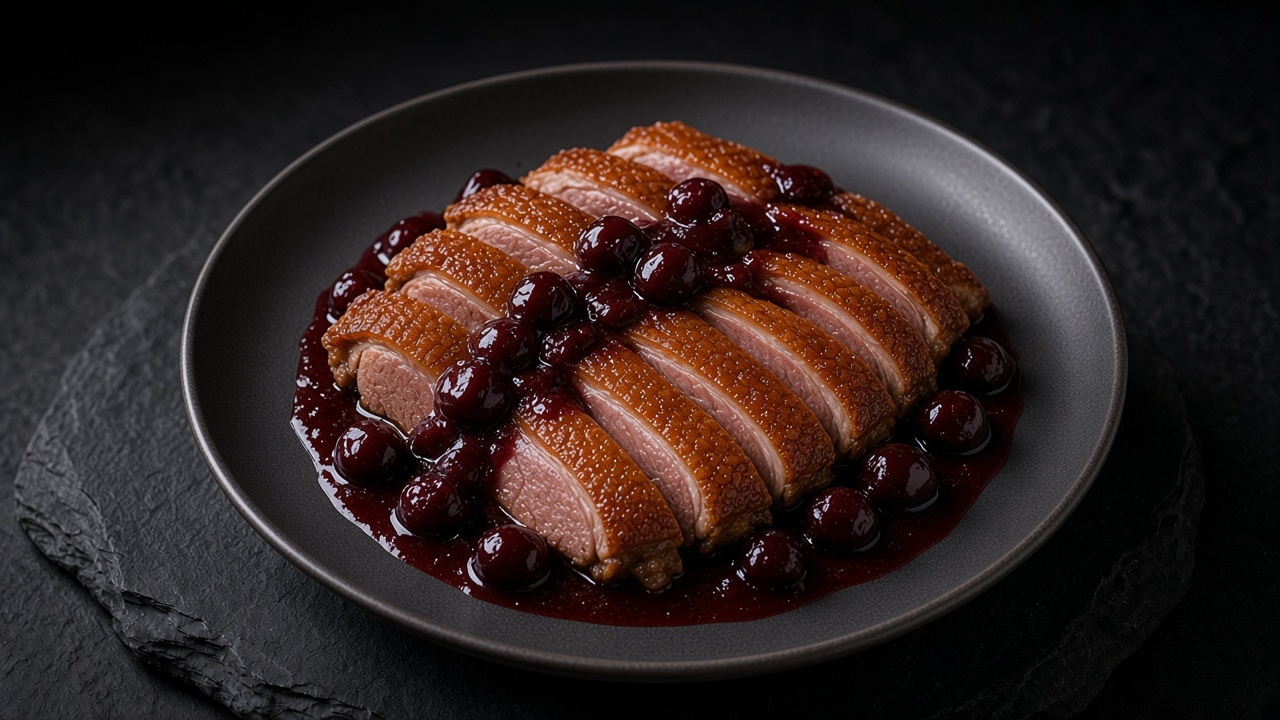
Roast Duck with Cherry Sauce
Inspired by techniques from America's Test Kitchen.
A whole duck is dry-brined overnight, simmered to render its fat, then roasted twice over a V-rack for crisp, deep golden skin and moist meat. A tart-sweet maple and cherry sauce, built in the same pan juices' spirit, cuts through the richness.
Always check the labels of the products you use.
Method
- 1
Trim and score the duck. Pull any large pads of fat out of the cavity by hand. Using kitchen shears, snip off the excess neck skin, the tail and the first two segments of each wing, leaving just the drumette. With the duck breast side up, score the skin and fat in a tight crosshatch, cuts about 2 cm apart, using just the tip of a sharp knife - cut only through the skin and fat, never into the meat below. Flip the duck breast side down and cut parallel slits, also about 2 cm apart, through the skin and fat of each thigh (no crosshatch here).
- 2
Salt and chill uncovered. Rub 1 tsp of the fine salt into the cavity, ½ tsp into the breast (working it well into the scored slits), and the remaining 1½ tsp over the rest of the skin. Overlap the cavity skin by at least 1 cm and pin it shut with a sturdy toothpick. Set the duck on a large plate and refrigerate uncovered for 6-12 hours - the open fridge air dries the skin so it crisps later.
- 3
Poach to render the fat. Set the duck breast side up in a large Dutch oven and add water, about 1.4 litres, until at least half of the thighs are submerged but most of the breast stays clear. Bring to a boil, then turn down to a vigorous simmer and cook uncovered until a thermometer pushed into the thickest part of a drumstick, right to the bone, reads 63-71°C, 45 minutes to 1 hour 5 minutes. About 20 minutes in, set a rack in the lower-middle of the oven and heat it to 220°C (200°C fan). Stir the maple syrup and soy sauce together for the baste.
- 4
First roast, skin side out. Lift the pot off the heat. Crumple a 50 cm length of foil into a loose ball, flatten it a little in a roasting pan, and set a V-rack on top; spray the rack with vegetable oil. Lift the duck from the pot with tongs and a spatula, let it drain, and set it breast side up on the rack. Brush the breast and drumstick tops with about a third of the baste, then flip the duck and brush the rest over its back and sides. Pour the poaching liquid into a bowl to cool (skim and keep the fat and stock for another use if you like). Roast until the back is deep golden and the breast reads 60-66°C, about 20 minutes.
- 5
Finish breast side up and rest. Flip the duck breast side up again and keep roasting until the breast reads 71-74°C, 15-25 minutes more. Move it to a carving board and rest for 20 minutes before carving.
- 6
Make the cherry sauce. While the duck rests, whisk the sauce's maple syrup, vinegar, soy sauce, cornstarch and the ¼ tsp pepper together in a small saucepan. Add the thyme sprig and bring to a simmer over medium-high heat, stirring constantly, then keep stirring for about 2 minutes more until it thickens. Stir in the cherries and cook, stirring now and then, for 3-5 minutes, until the sauce has the consistency of maple syrup. Discard the thyme, taste, and season with the extra salt and pepper as needed.
- 7
Carve and serve. Transfer the sauce to a serving bowl. Carve the duck and serve right away, passing the cherry sauce on the side.
Storage
Best carved and served right away for the crispest skin. Refrigerate leftover duck and sauce separately, covered, for up to 3 days; recrisp the duck skin-side down in a dry pan and warm the sauce in a small saucepan until piping hot. Cool leftovers in a shallow container and refrigerate within 2 hours (within 1 hour on a day above 32°C).
Why it's healthy
36.7 g protein for 732 kcal = 5 g per 100 kcal, so protein gives about 20% of the energy. High Protein needs at least 20% (5 g per 100 kcal), the EU condition. How we decide
Free sugars
12.1 g per serving
24.2 % of the 50 g daily maximum · 48.4 % of the ideal 25 g
Free sugars under 50 g a day, ideally about 25 g (WHO). The share shown is the share of one serving. WHO
Equipment
- kitchen shears
- sharp paring or boning knife
- sturdy toothpicks
- large plate
- large Dutch oven (at least 7.5 litres)
- instant-read thermometer
- small bowl
- aluminium foil
- V-rack and roasting pan
- vegetable oil spray
- tongs and a wide metal spatula
- large heatproof bowl
- carving board
- small saucepan
- whisk
Nutrition per serving (estimated values)
| Per serving | Amount |
|---|---|
| Energy | 732 kcal |
| Protein | 36.7 g |
| Carbohydrate | 24.8 g |
| of which sugars | 20.3 g |
| of which free sugars | 12.1 g |
| Fat | 53.3 g |
| of which saturates | 18.2 g |
| Fibre | 1.5 g |
| Salt | 5.54 g |
Protein per 100 kcal
5 g meets High Protein (≥ 5 g, 20% of energy)
Calculated from USDA FoodData Central ingredient values