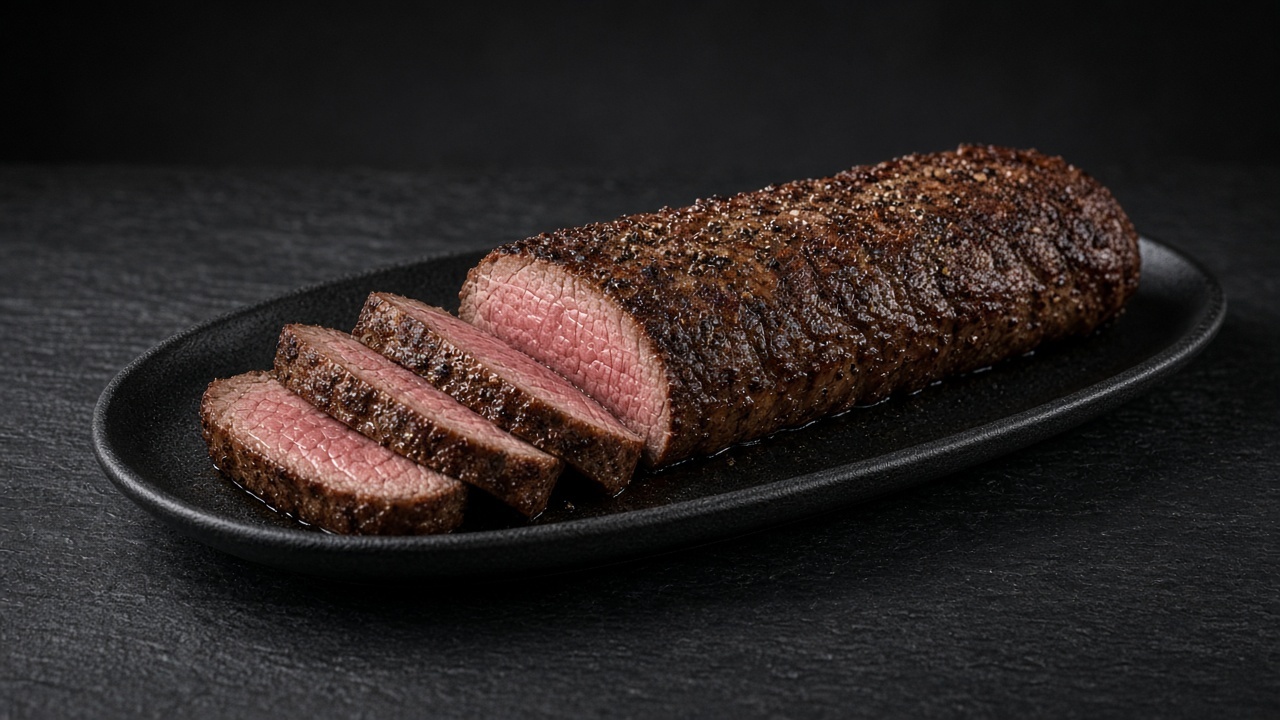

Roast Beef Tenderloin
Inspired by techniques from America's Test Kitchen.
A whole beef tenderloin has its silver skin nicked, is tied into an even shape and roasted hot and fast, so the tapered ends and thick centre finish at a range of pink to medium doneness. It's an easy roast for a crowd that needs only salt, pepper and oil to taste like what it is.
Based on the listed ingredients, none of the 14 major EU allergens. Always check product labels.
Method
- 1
Temper and tie the roast. Take the tenderloin out of the refrigerator 2-3 hours before roasting. Using a paring knife, nick the silver skin on the side opposite the tail with shallow slashes at 4 cm intervals. Tuck the tail end under by about 15 cm so the roast cooks evenly, then tie it crosswise with kitchen twine, knotting at 4 cm intervals.
- 2
Oil and season. Adjust the oven rack to the upper-middle position and heat the oven to 220 °C (200 °C fan). Set the meat on a sheet of cling film and rub it all over with the olive oil. Sprinkle with the salt and pepper, then lift the cling film up and around the meat and press to help the seasoning stick.
- 3
Roast. Unwrap the tenderloin onto a wire rack set in a shallow roasting pan. Roast until an instant-read thermometer inserted into the thickest part registers about 52 °C, around 45 minutes; the meat will range from medium-rare to medium in different parts of the roast.
- 4
Rest and carve. Let the roast stand for about 30 minutes before carving. Cut into slices about 1.3 cm thick, arrange on a platter and serve with a sauce of your choice.
Storage
Can be wrapped in cling film, refrigerated for up to 2 days, then sliced and served chilled. Cool leftovers in a shallow container and refrigerate within 2 hours (within 1 hour on a day above 32°C).
Why this label?
41 g protein for 537 kcal = 7.6 g per 100 kcal, so protein gives about 31% of the energy. High Protein needs at least 20% (5 g per 100 kcal), the condition in the Annex to EU Regulation (EC) No 1924/2006. How we decide
EU nutrition claims
- Sugar-free: 0 g sugars per 100 g (limit ≤ 0.5 g)
Per 100 g of the finished dish, worked out from the nutrition per serving and the lowest likely cooked weight (about 116 g a serving), so the true values are, if anything, lower. Thresholds from the Annex to EU Regulation (EC) No 1924/2006. How we decide
Free sugars
0 g per serving
0 % of the 50 g daily maximum · 0 % of the ideal 25 g
Free sugars under 50 g a day, ideally about 25 g, based on WHO free-sugar guidance (not endorsed by WHO). The share shown is the share of one serving. WHO
Equipment
- paring knife
- kitchen twine
- cling film
- wire rack
- shallow roasting pan
- instant-read thermometer
- carving knife and board
Nutrition per serving (estimated values)
| Per serving | Amount |
|---|---|
| Energy | 537 kcal |
| Protein | 41 g |
| Carbohydrate | 0.6 g |
| of which sugars | 0 g |
| of which free sugars | 0 g |
| Fat | 40.1 g |
| of which saturates | 17.8 g |
| Fibre | 0.3 g |
| Salt | 0.99 g |
Protein per 100 kcal
7.6 g meets High Protein (≥ 5 g, 20% of energy)
Calculated from USDA FoodData Central ingredient values