 Velvet
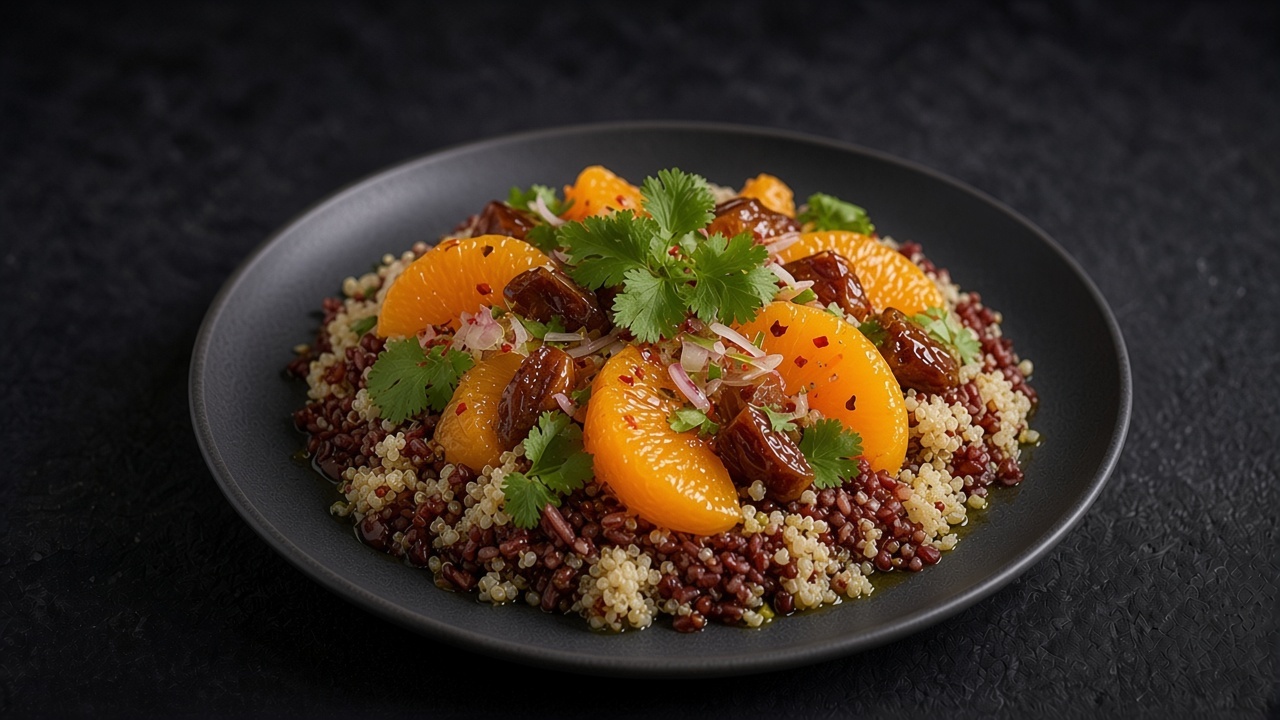
Red Rice and Quinoa Salad with Orange and Dates
Inspired by techniques from America's Test Kitchen.
Red rice and white quinoa tossed with orange segments, chopped dates and fresh cilantro in a lime and olive oil dressing. The chewy grains and soft dates give each mouthful texture, while citrus and a little chilli balance the sweetness.
Always check the labels of the products you use.
Method
- 1
Start the rice. Bring the water to a boil in the large pot over high heat. Stir in the red rice and the 3 tsp salt for the cooking water. Boil for 15 min, stirring occasionally.
- 2
Add the quinoa. Add the quinoa to the same pot and keep boiling for 12-14 min, until both grains are tender. Taste a few grains of rice to check that the centres have softened before draining.
- 3
Drain and cool. Drain the grains thoroughly through the fine-mesh sieve and spread them across the rimmed baking sheet. Drizzle with 30 ml of the lime juice and leave until completely cool, about 20 min.
- 4
Segment the oranges. Meanwhile, cut the peel and white pith from the oranges. Hold each orange over the small bowl and use the paring knife to cut between the membranes, letting the segments and juice fall into the bowl. Halve the segments crosswise. Measure 30 ml of the collected juice, squeezing the membranes if needed to reach that amount.
- 5
Whisk the dressing. In the large mixing bowl, whisk the 30 ml orange juice with the remaining 15 ml lime juice, shallot, minced cilantro and red pepper flakes. Slowly pour in the olive oil while whisking continuously. Season with the starting ¼ tsp salt and ¼ tsp black pepper, then taste.
- 6
Toss and serve. Add the cooled rice and quinoa, dates, orange segments and whole cilantro leaves to the dressing. Toss until evenly coated, then taste again and add a little more salt or pepper if needed. Serve straight away.
Storage
Refrigerate covered for up to 1 day and serve cold. Cool leftovers in a shallow container and refrigerate within 2 hours (within 1 hour on a day above 32°C).
Why it's healthy
- Total fat: 28.8 % of energy (limit ≤ 30%)
- Saturated fat: 4 % of energy (limit < 10%)
- Free sugars: 0.7 % of energy (limit < 10%)
- Salt: 0.42 g (limit ≤ 1.7 g)
- Fibre or fruit & veg: 5.9 g fibre / 83 g veg (limit ≥ 4.5 g fibre or 80 g fruit & veg)
Per serving, worked out from the nutrition table against our WHO-based rule. Not endorsed by WHO.
EU nutrition claims
- Source of fibre: 1.6 g fibre per 100 kcal (needs ≥ 1.5 g)
Per 100 g of the finished dish, worked out from the nutrition per serving and the lowest likely cooked weight (about 69 g a serving), so the true values are, if anything, lower. Thresholds from the Annex to EU Regulation (EC) No 1924/2006. How we decide
Free sugars
Free sugars: 0.6 g per serving
1.2 % of the 50 g daily maximum · 2.4 % of the ideal 25 g
Free sugars under 50 g a day, ideally about 25 g (WHO). The share shown is the share of one serving. who.int/publications/i/item/9789241549028
Equipment
- large pot, at least 6 litres
- wooden spoon
- fine-mesh sieve
- rimmed baking sheet
- chef's knife
- paring knife
- chopping board
- small bowl
- large mixing bowl
- whisk
- measuring jug
- measuring spoons
- kitchen scales
Nutrition per serving (estimated values)
| Per serving | Amount |
|---|---|
| Energy | 359 kcal |
| Protein | 6.3 g |
| Carbohydrate | 61 g |
| of which sugars | 22.7 g |
| of which free sugars | 0.6 g |
| Fat | 11.5 g |
| of which saturates | 1.6 g |
| Fibre | 5.9 g |
| Salt | 0.42 g |
Protein per 100 kcal
1.8 g High Protein needs ≥ 5 g (20% of energy)
Calculated from USDA FoodData Central ingredient values