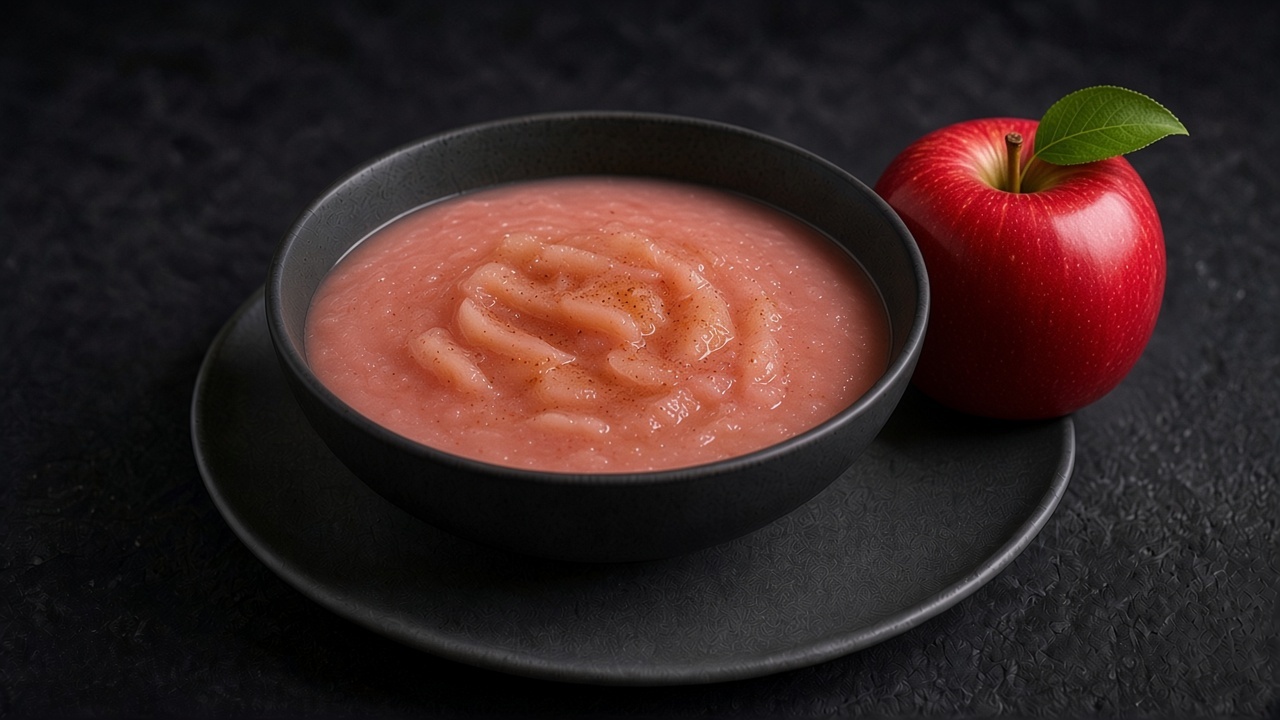
 Velvet
McIntosh Applesauce
Inspired by techniques from America's Test Kitchen.
Soft McIntosh apples make a gently sweet applesauce with a pinch of cinnamon. Cooking the peels and cores separately and pressing their pulp into the mashed fruit brings back their pink colour and apple flavour.
None of the 14 major EU allergens. Always check the labels of the products you use.
Method
- 1
Prepare the apples. Wash the apples, then peel and core them, keeping all the peels and cores for the small saucepan. Set the peeled apple flesh aside while you start cooking the trimmings.
- 2
Cook the peels and cores. Add 235 ml of the water to the peels and cores and bring to the boil over medium-high heat. Lower the heat to medium, cover and cook for about 15 min, mashing occasionally with the potato masher, until the mixture is deep pink and the cores have broken down.
- 3
Cook the apple flesh. Meanwhile, quarter the peeled apples and put them in the large saucepan with the sugar, salt, cinnamon and remaining 120 ml water. Bring to the boil over medium-high heat, then reduce to medium and cover. Cook for about 15 min, stirring occasionally with the rubber spatula, until every piece is soft and roughly half the fruit has collapsed.
- 4
Mash and strain. Mash the cooked apple flesh with the potato masher to the texture you like. Set the fine-mesh strainer over the large saucepan and pour in the cooked peels and cores. Stir and press them against the mesh with the rubber spatula to push the soft pulp into the applesauce, then discard the solids left in the strainer.
- 5
Taste and serve. Stir the strained pulp through the mashed apples. Taste and add more sugar if needed, 1 tsp at a time, stirring after each addition. Serve warm, at room temperature or chilled; the batch makes about 950 ml, enough for 8 portions of roughly 120 ml.
Storage
Refrigerate covered for up to 1 week and serve chilled, at room temperature or gently warmed. Cool leftovers in a shallow container and refrigerate within 2 hours (within 1 hour on a day above 32°C).
EU nutrition claims
- Low fat: 0.3 g fat per 100 g (limit ≤ 3 g)
- Low saturated fat: 0 g saturated fat per 100 g, 0% of energy (limits ≤ 1.5 g and ≤ 10%)
- Low salt: 0.07 g salt per 100 g (limit ≤ 0.3 g)
- Source of fibre: 2 g fibre per 100 kcal (needs ≥ 1.5 g)
Per 100 g of the finished dish, worked out from the nutrition per serving and the lowest likely cooked weight (about 74 g a serving), so the true values are, if anything, lower. Thresholds from the Annex to EU Regulation (EC) No 1924/2006. How we decide
Free sugars
Free sugars: 6.2 g per serving
12.4 % of the 50 g daily maximum · 24.8 % of the ideal 25 g
Free sugars under 50 g a day, ideally about 25 g (WHO). The share shown is the share of one serving. who.int/publications/i/item/9789241549028
Equipment
- vegetable peeler
- paring knife
- chopping board
- small saucepan with a lid
- large saucepan with a lid
- potato masher
- fine-mesh strainer
- heatproof rubber spatula
Nutrition per serving (estimated values)
| Per serving | Amount |
|---|---|
| Energy | 94 kcal |
| Protein | 0.4 g |
| Carbohydrate | 24.7 g |
| of which sugars | 20.8 g |
| of which free sugars | 6.2 g |
| Fat | 0.2 g |
| of which saturates | 0 g |
| Fibre | 1.9 g |
| Salt | 0.05 g |
Protein per 100 kcal
0.4 g High Protein needs ≥ 5 g (20% of energy)
Calculated from USDA FoodData Central ingredient values