 Velvet
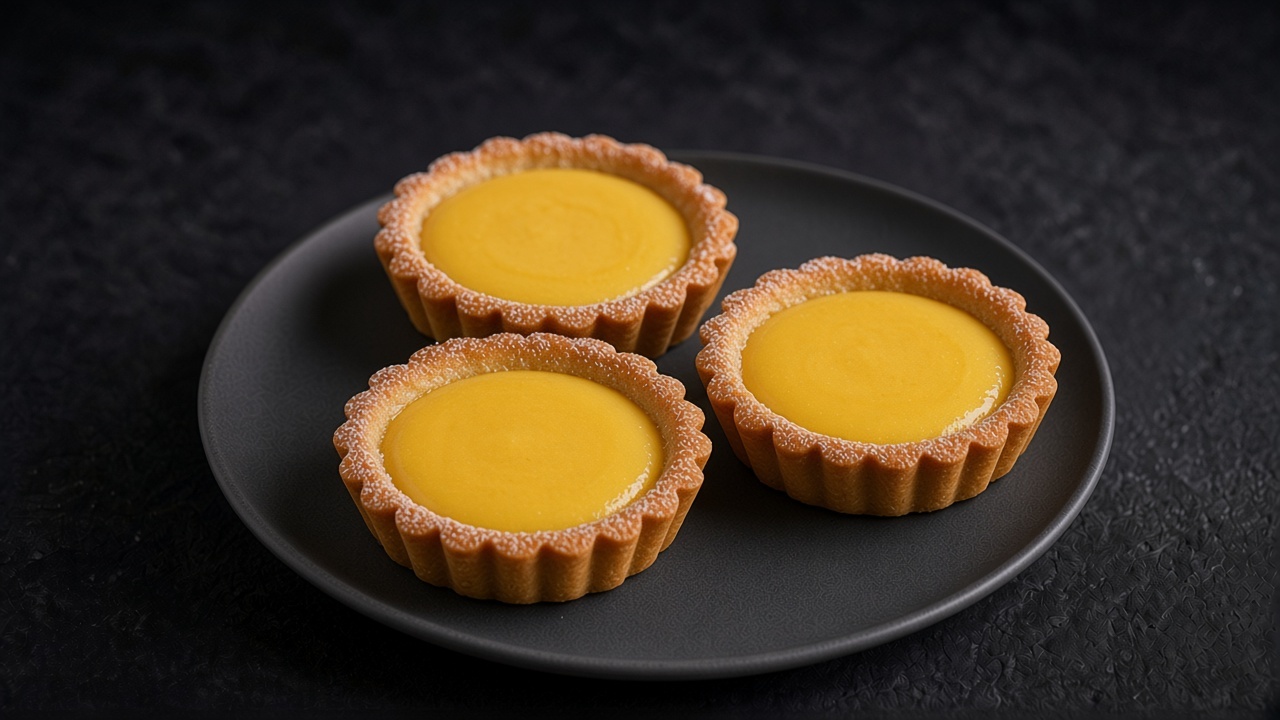
Lemon Tartlets
Inspired by techniques from America's Test Kitchen.
Six individual lemon tartlets with crisp, buttery shells and a smooth, bright filling. A simple pressed crust needs no rolling, while gently cooking and straining the lemon filling gives it a silky texture before a short final bake.
Always check the labels of the products you use.
Method
- 1
Prepare the tins and dough. Set oven shelves in the middle and lowest positions and heat to 180 °C (160 °C fan). Lightly spray the six tartlet tins with the oil. Whisk the flour, crust sugar and ¾ tsp salt together in a bowl, then stir in the melted butter with a wooden spoon until a dough forms.
- 2
Press in the crusts. Divide the dough into 6 equal portions. For each tin, press two-thirds of a portion across the base with your fingers, then press the rest up the fluted sides. Smooth the base and sides to an even thickness.
- 3
Bake the shells. Line each shell with a double layer of foil, folding it over the rim to protect the edges, and fill with baking weights. Put the tins on a wire rack inside a rimmed baking sheet. Bake on the lowest shelf for about 25 min, until the edges start to turn golden. Carefully lift out the foil and weights, rotate the sheet and bake for 10-15 min more, until the shells are golden brown and feel firm. Set aside briefly; they need to be warm when filled.
- 4
Cook the lemon filling. Whisk the whole eggs and yolks together in a medium saucepan. Whisk in the filling sugar, followed by the measured zest, lemon juice and ¼ tsp salt. Add the butter pieces and cook over medium-low heat, stirring constantly with a heatproof spatula, until slightly thickened and 77 °C on a thermometer, about 5 min. Immediately strain through a fine-mesh sieve into a heatproof bowl, then stir in the chilled cream.
- 5
Fill and finish baking. Leave the warm shells on the rack in the baking sheet and divide the warm filling evenly between them. Bake on the middle shelf, the upper of the two prepared shelves, for about 10 min, rotating the sheet halfway through. The filling should look glossy and opaque, with a slight wobble in the centre when the sheet is gently shaken.
- 6
Cool and unmould. Leave the tartlets on the rack in the sheet until completely cool, about 2 hours. Remove the outer rings, ease a thin metal spatula between each tartlet and its base, and carefully slide onto serving plates. Sift the icing sugar lightly over the tops and serve. Allow the full cooling time in addition to the preparation and cooking times.
Storage
Best on the day they are baked, once fully cooled. Refrigerate leftovers covered for up to 3 days; the crust softens as it stands. Dust with icing sugar just before serving. Cool leftovers in a shallow container and refrigerate within 2 hours (within 1 hour on a day above 32°C).
Free sugars
Free sugars: 51.1 g per serving
102.2 % of the 50 g daily maximum · 204.4 % of the ideal 25 g
Free sugars under 50 g a day, ideally about 25 g (WHO). The share shown is the share of one serving. who.int/publications/i/item/9789241549028
Equipment
- oven
- six 10 cm fluted tartlet tins with removable bases
- digital kitchen scales
- measuring spoons and measuring jug
- fine grater
- paring knife and chopping board
- citrus juicer
- mixing bowl and heatproof bowl
- whisk
- wooden spoon
- aluminium foil
- baking weights
- wire rack that fits inside a rimmed baking sheet
- rimmed baking sheet
- oven gloves
- medium saucepan
- heatproof spatula
- instant-read thermometer
- fine-mesh sieve
- thin metal spatula
- serving plates
Nutrition per serving (estimated values)
| Per serving | Amount |
|---|---|
| Energy | 858 kcal |
| Protein | 12.8 g |
| Carbohydrate | 89.9 g |
| of which sugars | 51.7 g |
| of which free sugars | 51.1 g |
| Fat | 51 g |
| of which saturates | 28.9 g |
| Fibre | 1.4 g |
| Salt | 1.11 g |
Protein per 100 kcal
1.5 g High Protein needs ≥ 5 g (20% of energy)
Calculated from USDA FoodData Central ingredient values