 Velvet
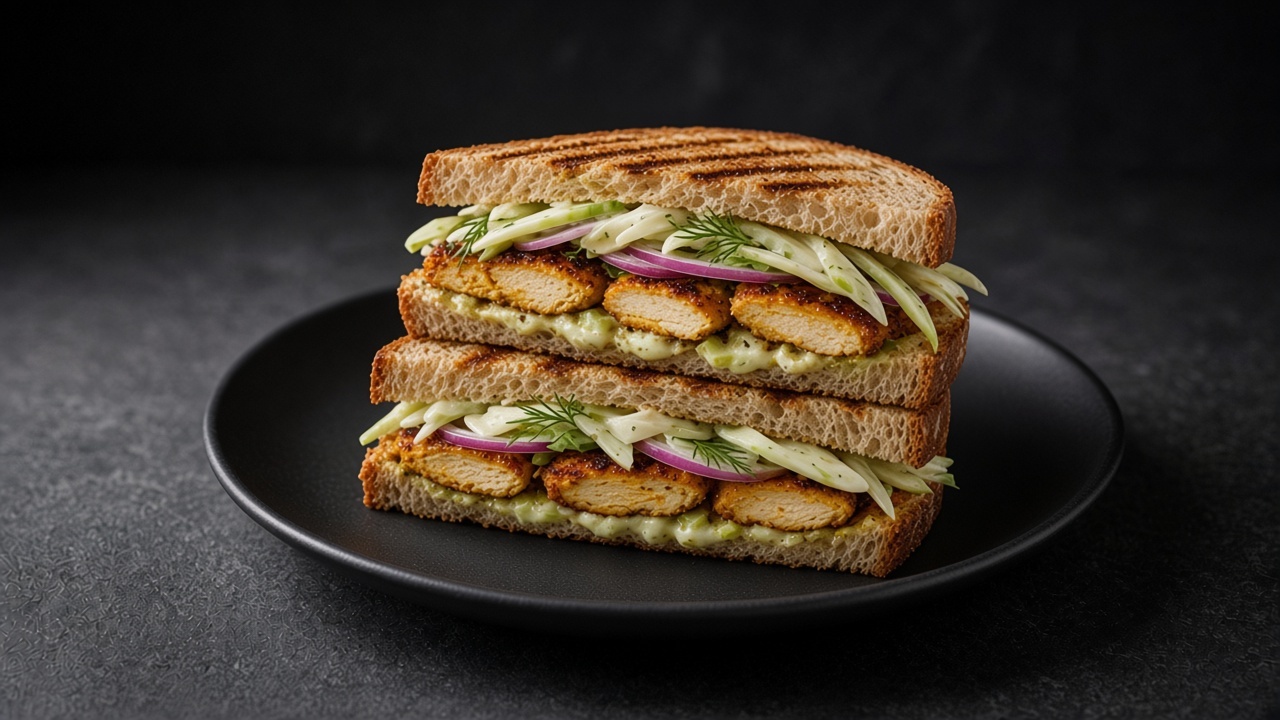
Curried Chicken Sandwich with Celery and Fennel Slaw
Inspired by techniques from Bon Appétit.
Curry-brined chicken is grilled and tucked into toasted country bread with celery and fennel slaw, red onion and dill. The lightly creamy, lemony slaw brings crunch and freshness to the spiced chicken and olive-oil toast.
Always check the labels of the products you use.
Method
- 1
Brine the chicken. Mix the buttermilk, salt, curry powder, cumin, turmeric and pepper in the resealable bag. Add the four chicken pieces, seal and turn the bag until the chicken is coated all over. Refrigerate for at least 4 hours; this can be done up to 1 day ahead.
- 2
Heat the grill and make the slaw. Prepare the barbecue for medium-high heat. In the bowl, toss the celery and fennel with the yogurt, lemon juice, celery seeds and 15 g mayonnaise. Mix in the salt and pepper, taste and adjust a little at a time, then set aside while you grill.
- 3
Grill the chicken. Lift the chicken from the brine and discard the used liquid. Grill for 5-7 min on each side, until browned outside and opaque through the centre, with the thickest part of each piece reaching 74 °C. Transfer to a clean plate with clean tongs.
- 4
Toast the bread. Brush both sides of the bread slices with the olive oil. Grill for about 2 min on each side, until golden and toasted with lightly charred edges. Spread the inward-facing sides with the remaining mayonnaise.
- 5
Build the sandwiches. Divide the chicken, slaw, red onion and dill between four slices of toast. Cover with the remaining slices and serve straight away, while the bread is crisp and the chicken is hot.
Storage
Best assembled just before eating. Refrigerate cooked chicken covered for up to 3 days and the slaw separately for up to 2 days; toast fresh bread when serving. Reheat chicken to 74 °C before assembling, or serve it cold. Cool leftovers in a shallow container and refrigerate within 2 hours (within 1 hour on a day above 32°C).
Why it's healthy
35.3 g protein for 574 kcal = 6.1 g per 100 kcal, so protein gives about 25% of the energy. High Protein needs at least 20% (5 g per 100 kcal), the EU condition. How we decide
EU nutrition claims
- Low sugars: 3.4 g sugars per 100 g (limit ≤ 5 g)
Per 100 g of the finished dish, worked out from the nutrition per serving and the lowest likely cooked weight (about 174 g a serving), so the true values are, if anything, lower. Thresholds from the Annex to EU Regulation (EC) No 1924/2006. How we decide
Free sugars
Free sugars: 0.1 g per serving
0.2 % of the 50 g daily maximum · 0.4 % of the ideal 25 g
Free sugars under 50 g a day, ideally about 25 g (WHO). The share shown is the share of one serving. who.int/publications/i/item/9789241549028
Equipment
- chef's knife
- chopping board
- kitchen scales and measuring spoons
- large resealable food bag
- barbecue
- medium mixing bowl
- mixing spoon
- long-handled tongs
- instant-read thermometer
- pastry brush
- clean plate
- spreading knife
Nutrition per serving (estimated values)
| Per serving | Amount |
|---|---|
| Energy | 574 kcal |
| Protein | 35.3 g |
| Carbohydrate | 46.1 g |
| of which sugars | 5.9 g |
| of which free sugars | 0.1 g |
| Fat | 27.4 g |
| of which saturates | 4.4 g |
| Fibre | 3.5 g |
| Salt | 2 g |
Protein per 100 kcal
6.1 g meets High Protein (≥ 5 g, 20% of energy)
Calculated from USDA FoodData Central ingredient values