 Velvet
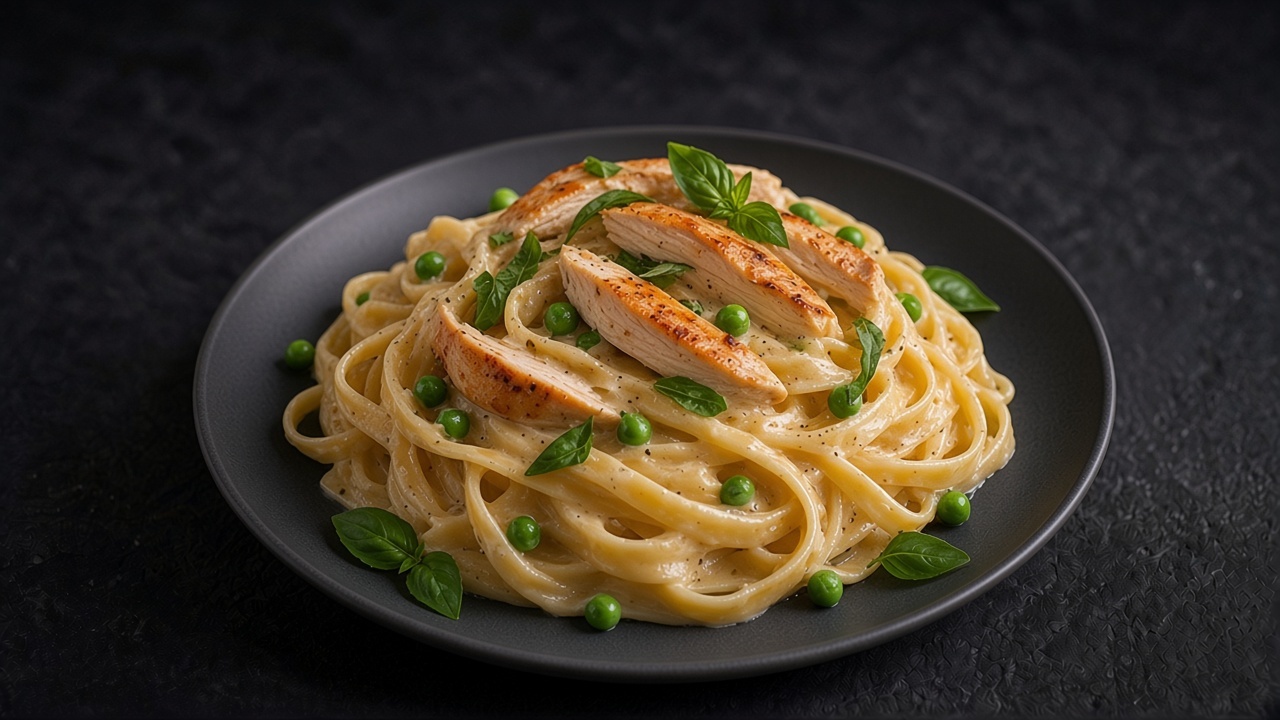
Creamy Chicken Fettuccine with Lemon and Peas
Inspired by techniques from America's Test Kitchen.
Strips of chicken breast brown quickly, then a garlic and lemon cream sauce comes together in the same skillet while the fettuccine cooks. Everything meets in one pot with peas, Parmesan and basil, and the lemon keeps the rich cream sauce tasting bright rather than heavy.
Always check the labels of the products you use.
Method
- 1
Bring the water to a boil. Fill a large pot with about 3.8 litres of water and set it over high heat to boil while you prepare everything else.
- 2
Brown the chicken. Pat the chicken strips dry with paper towels and season with the fine salt and pepper. Melt the butter in a large nonstick skillet over medium-high heat and cook the chicken, stirring occasionally, until no longer pink and opaque all the way through, about 3 minutes (74 °C on an instant-read thermometer). Transfer to a plate.
- 3
Make the lemon cream sauce. Add the garlic to the same skillet and cook, stirring, until fragrant, about 30 seconds. Pour in the cream, lemon zest and lemon juice and simmer, stirring now and then, until the sauce thickens slightly, 3-5 minutes. Take off the heat, cover and keep warm.
- 4
Cook the fettuccine and peas. Stir the tablespoon of fine salt and the fettuccine into the boiling water and cook until just short of al dente. Add the peas and cook until bright green, about 1 minute more. Scoop out and reserve about 120 ml of the starchy cooking water, then drain the pasta and peas and return them to the pot.
- 5
Toss and serve. Add the lemon cream sauce, Parmesan, basil and the reserved chicken to the pot. Toss everything together over low heat, splashing in the reserved pasta water as needed until the sauce coats the pasta loosely. Season with more salt and pepper to taste and serve right away.
Storage
Best eaten right away, since the sauce thickens and the pasta keeps absorbing it as it sits. Refrigerate covered for up to 3 days and reheat gently in a saucepan or skillet with a splash of water or milk to loosen the sauce, stirring until piping hot. Cool leftovers in a shallow container and refrigerate within 2 hours (within 1 hour on a day above 32°C).
Why it's healthy
50.4 g protein for 996 kcal = 5.1 g per 100 kcal, so protein gives about 20% of the energy. High Protein needs at least 20% (5 g per 100 kcal), the EU condition. How we decide
EU nutrition claims
- Low sugars: 2.7 g sugars per 100 g (limit ≤ 5 g)
Per 100 g of the finished dish, worked out from the nutrition per serving and the lowest likely cooked weight (about 326 g a serving), so the true values are, if anything, lower. Thresholds from the Annex to EU Regulation (EC) No 1924/2006. How we decide
Free sugars
0.2 g per serving
0.4 % of the 50 g daily maximum · 0.8 % of the ideal 25 g
Free sugars under 50 g a day, ideally about 25 g (WHO). The share shown is the share of one serving. WHO
Equipment
- large pot
- large nonstick skillet
- tongs
- chef's knife
- cutting board
- fine grater
- citrus juicer (optional)
- colander
- ladle or heatproof jug
- instant-read thermometer
Nutrition per serving (estimated values)
| Per serving | Amount |
|---|---|
| Energy | 996 kcal |
| Protein | 50.4 g |
| Carbohydrate | 102.9 g |
| of which sugars | 8.7 g |
| of which free sugars | 0.2 g |
| Fat | 42.1 g |
| of which saturates | 24 g |
| Fibre | 7.1 g |
| Salt | 3.74 g |
Protein per 100 kcal
5.1 g meets High Protein (≥ 5 g, 20% of energy)
Calculated from USDA FoodData Central ingredient values