 Velvet
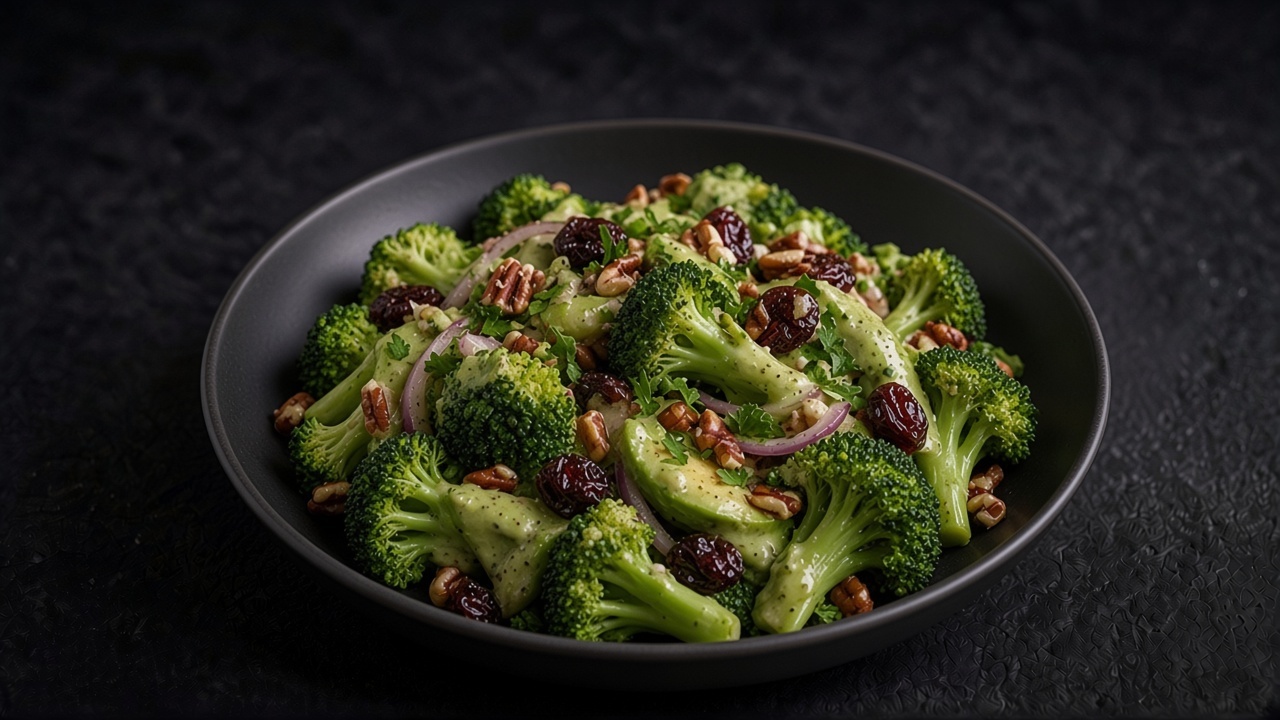
Broccoli Salad with Avocado Dressing
Inspired by techniques from America's Test Kitchen.
Lightly blanched broccoli, crisp shallot, toasted pecans and plump dried cherries are tossed in a smooth avocado dressing brightened with orange juice and white wine vinegar. It is a creamy, mayonnaise-free take on broccoli salad that keeps every ingredient whole-food and dairy-free.
Always check the labels of the products you use.
Method
- 1
Toast the pecans. Toast the pecans in a dry skillet over medium heat, shaking the pan often, until fragrant and a shade darker, 4-5 minutes. Tip onto a board to cool, then chop coarse.
- 2
Soak the cherries. Bring about 2.75 litres of water to the boil in a large pot and fill a large bowl halfway with ice and water. Ladle out 120 ml of the boiling water, pour it over the cherries in a small bowl, cover and let stand 5 minutes, then drain.
- 3
Blanch the broccoli. Add the broccoli stalks to the boiling water and cook 1 minute, then add the florets and cook until just tender, about 1 minute more. Drain, drop into the ice bath and leave until completely cold, about 5 minutes. Drain again and spin dry in a salad spinner, or pat thoroughly dry with a towel.
- 4
Blend the dressing. In a food processor, blend the avocado, olive oil, vinegar, garlic, orange zest and juice, salt and pepper until smooth, scraping down the sides as needed. Scrape the dressing into a large serving bowl.
- 5
Toss and serve. Add the broccoli, drained cherries, toasted pecans, shallot and parsley to the bowl and toss to coat evenly. Season with more salt and pepper to taste, and serve right away.
Storage
Best eaten the day it's made: the avocado dressing is brightest right after blending and will darken and separate on standing. Refrigerate leftovers in an airtight container for up to 1 day. Cool leftovers in a shallow container and refrigerate within 2 hours (within 1 hour on a day above 32°C).
EU nutrition claims
- Low saturated fat: 1.2 g saturated fat per 100 g, 7.2% of energy (limits ≤ 1.5 g and ≤ 10%)
- Source of fibre: 2.7 g fibre per 100 kcal (needs ≥ 1.5 g)
Per 100 g of the finished dish, worked out from the nutrition per serving and the lowest likely cooked weight (about 222 g a serving), so the true values are, if anything, lower. Thresholds from the Annex to EU Regulation (EC) No 1924/2006. How we decide
Free sugars
12.7 g per serving
25.4 % of the 50 g daily maximum · 50.8 % of the ideal 25 g
Free sugars under 50 g a day, ideally about 25 g (WHO). The share shown is the share of one serving. WHO
Equipment
- large pot (Dutch oven)
- large bowl (for the ice bath)
- small bowl
- salad spinner
- small skillet
- food processor
- fine grater (for zesting)
- citrus juicer (optional)
- chef's knife
- cutting board
- large serving bowl
Nutrition per serving (estimated values)
| Per serving | Amount |
|---|---|
| Energy | 338 kcal |
| Protein | 7.4 g |
| Carbohydrate | 33.8 g |
| of which sugars | 17.2 g |
| of which free sugars | 12.7 g |
| Fat | 22.1 g |
| of which saturates | 2.7 g |
| Fibre | 9.1 g |
| Salt | 0.89 g |
Protein per 100 kcal
2.2 g High Protein needs ≥ 5 g (20% of energy)
Calculated from USDA FoodData Central ingredient values