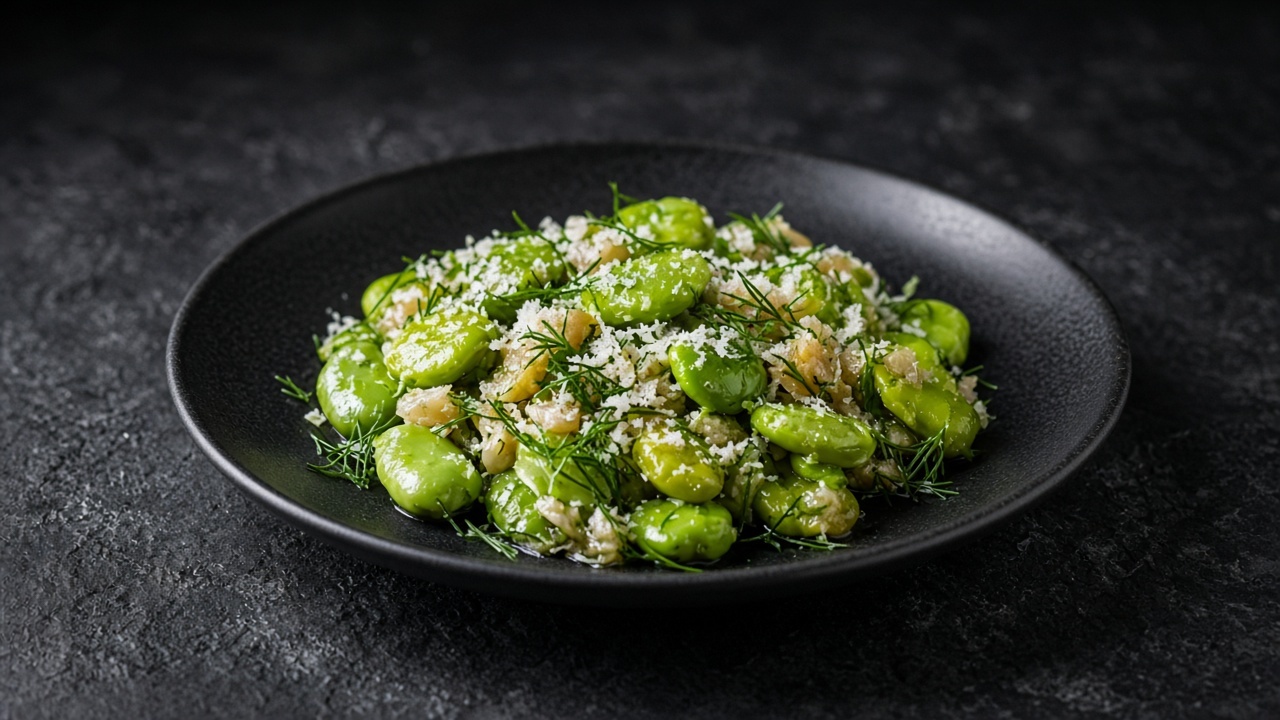

Broad Beans with Dill Butter
Inspired by techniques from Serious Eats.
Fresh shelled broad beans are boiled until just tender, then tossed in butter that has been softened with shallots and finished with parmesan and plenty of fresh dill. It is a quick, bright side dish that lets the beans' sweetness come through under a light, savoury coating.
Always check the labels of the products you use.
Method
- 1
Blanch the beans. Bring the water to a boil in a large saucepan and salt it generously. Add the broad beans and boil until just tender, about 5 minutes. Drain in a colander and rinse thoroughly under cold water to stop the cooking.
- 2
Soften the shallots. Melt the butter in a large straight-sided frying pan over medium-low heat. Stir in the shallots, salt generously, and cook, stirring, until very soft and fragrant, about 5 minutes.
- 3
Coat the beans. Add the beans to the pan and stir to coat them in the butter. Cook for 1 minute, then add the parmesan and stir until it melts and clings to the beans.
- 4
Finish with dill. Remove the pan from the heat and stir in the dill. Season with more salt to taste and a little lemon juice if you'd like extra brightness. Serve immediately.
Storage
Best served right away while the butter is warm and the beans are hot. Refrigerate leftovers in an airtight container for up to 3 days and reheat gently in a pan. Cool leftovers in a shallow container and refrigerate within 2 hours (within 1 hour on a day above 32°C).
EU nutrition claims
- Source of protein: 3.2 g protein per 100 kcal, about 13% of energy (needs ≥ 12%)
- Low sugars: 1.7 g sugars per 100 g (limit ≤ 5 g)
- Source of fibre: 2 g fibre per 100 kcal (needs ≥ 1.5 g)
Per 100 g of the finished dish, worked out from the nutrition per serving and the lowest likely cooked weight (about 150 g a serving), so the true values are, if anything, lower. Thresholds from the Annex to EU Regulation (EC) No 1924/2006. How we decide
Free sugars
0.1 g per serving
0.2 % of the 50 g daily maximum · 0.4 % of the ideal 25 g
Free sugars under 50 g a day, ideally about 25 g, based on WHO free-sugar guidance (not endorsed by WHO). The share shown is the share of one serving. WHO
Equipment
- large saucepan
- colander
- chef's knife
- chopping board
- large straight-sided frying pan
- wooden spoon
Nutrition per serving (estimated values)
| Per serving | Amount |
|---|---|
| Energy | 285 kcal |
| Protein | 9.2 g |
| Carbohydrate | 19.8 g |
| of which sugars | 2.5 g |
| of which free sugars | 0.1 g |
| Fat | 19.8 g |
| of which saturates | 11.9 g |
| Fibre | 5.8 g |
| Salt | 1.42 g |
Protein per 100 kcal
3.2 g High Protein needs ≥ 5 g (20% of energy)
Calculated from USDA FoodData Central ingredient values