 Velvet
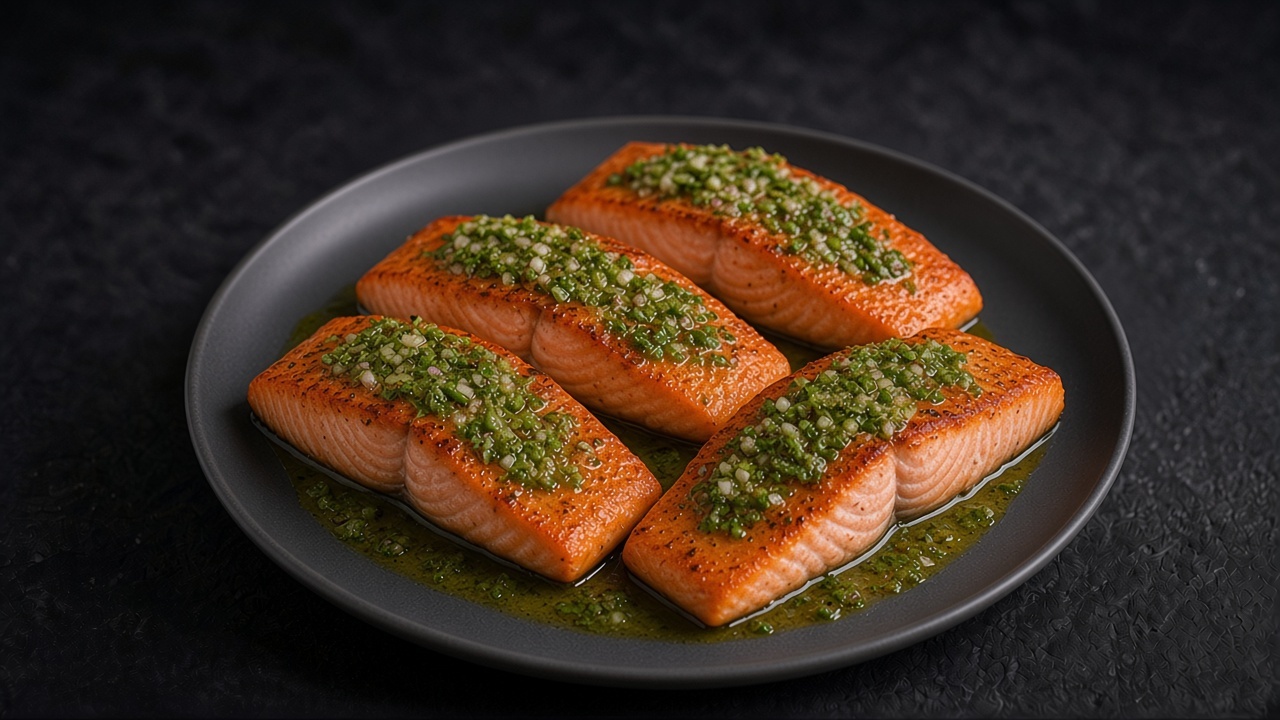
Baked Salmon with Lime Vinaigrette
Inspired by techniques from America's Test Kitchen.
Skin-on salmon baked on a preheated tray, then topped with a fresh lime, coriander and jalapeño vinaigrette. The hot metal gives the skin a head start while a low oven keeps the flesh tender, and the sharp dressing balances the rich fish.
Always check the labels of the products you use.
Method
- 1
Heat the tray and score the skin. Set a rack in the lowest oven position, put the baking sheet on it and heat to 260 °C (240 °C fan). With the salmon skin side up on the board, make 4 or 5 shallow slits in each piece, about 2.5 cm apart. Cut only through the skin, keeping the flesh intact.
- 2
Season the salmon. Blot the salmon dry with paper towels, rub all over with 15 ml of the olive oil and season with ½ tsp of the fine salt and ¼ tsp of the pepper.
- 3
Bake gently. Turn the oven down to 135 °C (115 °C fan). Using oven gloves, take out the hot tray and lay the salmon on it skin side down. Return to the oven and roast for 9-13 min, until the thickest part reads 52 °C for a a moist, slightly translucent centre. For the USDA safe minimum, continue to 63 °C, when the flesh is opaque and flakes easily; this will take longer.
- 4
Whisk the vinaigrette. Meanwhile, whisk the coriander, remaining 45 ml olive oil, lime juice, shallot, jalapeño, garlic and sugar together in the bowl. Add the remaining ¼ tsp salt and ¼ tsp pepper, whisk again and taste. Adjust the seasoning a small pinch at a time if needed.
- 5
Serve. Lift the salmon onto the serving platter with the fish spatula, spoon the vinaigrette over the top and serve straight away.
Storage
Best eaten straight from the oven. Refrigerate leftovers covered for up to 2 days and eat cold or reheat gently until piping hot throughout (74 °C). Cool leftovers in a shallow container and refrigerate within 2 hours (within 1 hour on a day above 32°C).
Why it's healthy
35.2 g protein for 490 kcal = 7.2 g per 100 kcal, so protein gives about 29% of the energy. High Protein needs at least 20% (5 g per 100 kcal), the EU condition. How we decide
EU nutrition claims
- Low sugars: 1 g sugars per 100 g (limit ≤ 5 g)
Per 100 g of the finished dish, worked out from the nutrition per serving and the lowest likely cooked weight (about 172 g a serving), so the true values are, if anything, lower. Thresholds from the Annex to EU Regulation (EC) No 1924/2006. How we decide
Free sugars
Free sugars: 0.7 g per serving
1.4 % of the 50 g daily maximum · 2.8 % of the ideal 25 g
Free sugars under 50 g a day, ideally about 25 g (WHO). The share shown is the share of one serving. who.int/publications/i/item/9789241549028
Equipment
- oven
- rimmed metal baking sheet
- oven gloves
- chef's knife
- chopping board
- paper towels
- kitchen scales
- measuring jug and spoons
- small bowl
- whisk
- instant-read thermometer
- wide fish spatula
- serving platter and spoon
Nutrition per serving (estimated values)
| Per serving | Amount |
|---|---|
| Energy | 490 kcal |
| Protein | 35.2 g |
| Carbohydrate | 4.1 g |
| of which sugars | 1.8 g |
| of which free sugars | 0.7 g |
| Fat | 36.5 g |
| of which saturates | 7.1 g |
| Fibre | 0.7 g |
| Salt | 1.35 g |
Protein per 100 kcal
7.2 g meets High Protein (≥ 5 g, 20% of energy)
Calculated from USDA FoodData Central ingredient values