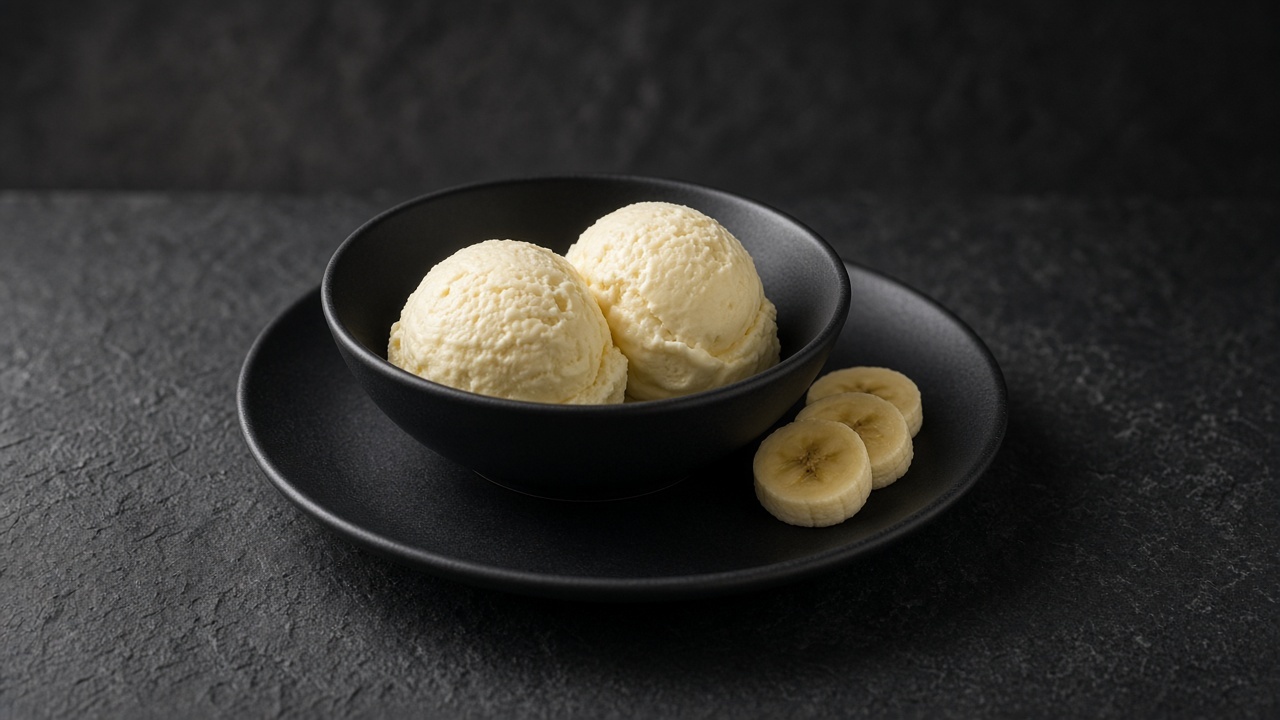

Whipped Banana Ice Cream
Inspired by techniques from Serious Eats.
Frozen banana slices are whipped in a food processor with a splash of milk until they turn thick and creamy, with no churning, cooking or added sugar required. A touch of vanilla, lemon juice and salt sharpen the banana flavour without masking it.
Always check the labels of the products you use.
Method
- 1
Freeze the bananas. Peel the bananas, place them in a large freezer bag, and press out the excess air. Freeze until completely solid, at least 8 hours.
- 2
Soften and slice. Let the frozen bananas sit at room temperature until slightly softened, about 15 min, then slice into 1.3 cm-thick rounds.
- 3
Blend. Put the banana slices, milk, vanilla and lemon juice (if using) and salt in a food processor. Process until smooth and creamy, about 5 min, stopping to scrape down the sides of the bowl as needed; the mixture will look crumbly before it turns smooth.
- 4
Serve or firm up. Serve straight away for a soft, whipped texture, or transfer to an airtight container and freeze until firm, at least 2 hours, for a scoopable ice cream.
Storage
Serve immediately for a soft texture, or freeze in an airtight container until firm, at least 2 hours. Best eaten within about 5 days, as longer freezing makes the texture icier.
Why this label?
- Total fat: 5.6 % of energy (limit ≤ 30%)
- Saturated fat: 2.4 % of energy (limit < 10%)
- Free sugars: 0 % of energy (limit < 10%)
- Salt: 0.18 g (limit ≤ 0.28 g)
- Fibre or fruit & veg: 3.1 g fibre / 120 g veg (limit ≥ 1.4 g fibre or 80 g fruit & veg)
Per serving, worked out from the nutrition table against our rule based on the WHO healthy diet guidance. Not endorsed by WHO.
EU nutrition claims
- Low fat: 1.2 g fat per 100 g (limit ≤ 3 g)
- Low saturated fat: 0.5 g saturated fat per 100 g, 2.4% of energy (limits ≤ 1.5 g and ≤ 10%)
- Source of fibre: 2.8 g fibre per 100 kcal (needs ≥ 1.5 g)
Per 100 g of the finished dish, worked out from the nutrition per serving and the lowest likely cooked weight (about 56 g a serving), so the true values are, if anything, lower. Thresholds from the Annex to EU Regulation (EC) No 1924/2006. How we decide
Free sugars
0 g per serving
0 % of the 50 g daily maximum · 0 % of the ideal 25 g
Free sugars under 50 g a day, ideally about 25 g, based on WHO free-sugar guidance (not endorsed by WHO). The share shown is the share of one serving. WHO
Equipment
- freezer bag
- chef's knife
- chopping board
- food processor
- airtight container
Nutrition per serving (estimated values)
| Per serving | Amount |
|---|---|
| Energy | 112 kcal |
| Protein | 1.6 g |
| Carbohydrate | 27.7 g |
| of which sugars | 15.2 g |
| of which free sugars | 0 g |
| Fat | 0.7 g |
| of which saturates | 0.3 g |
| Fibre | 3.1 g |
| Salt | 0.18 g |
Protein per 100 kcal
1.4 g High Protein needs ≥ 5 g (20% of energy)
Calculated from USDA FoodData Central ingredient values