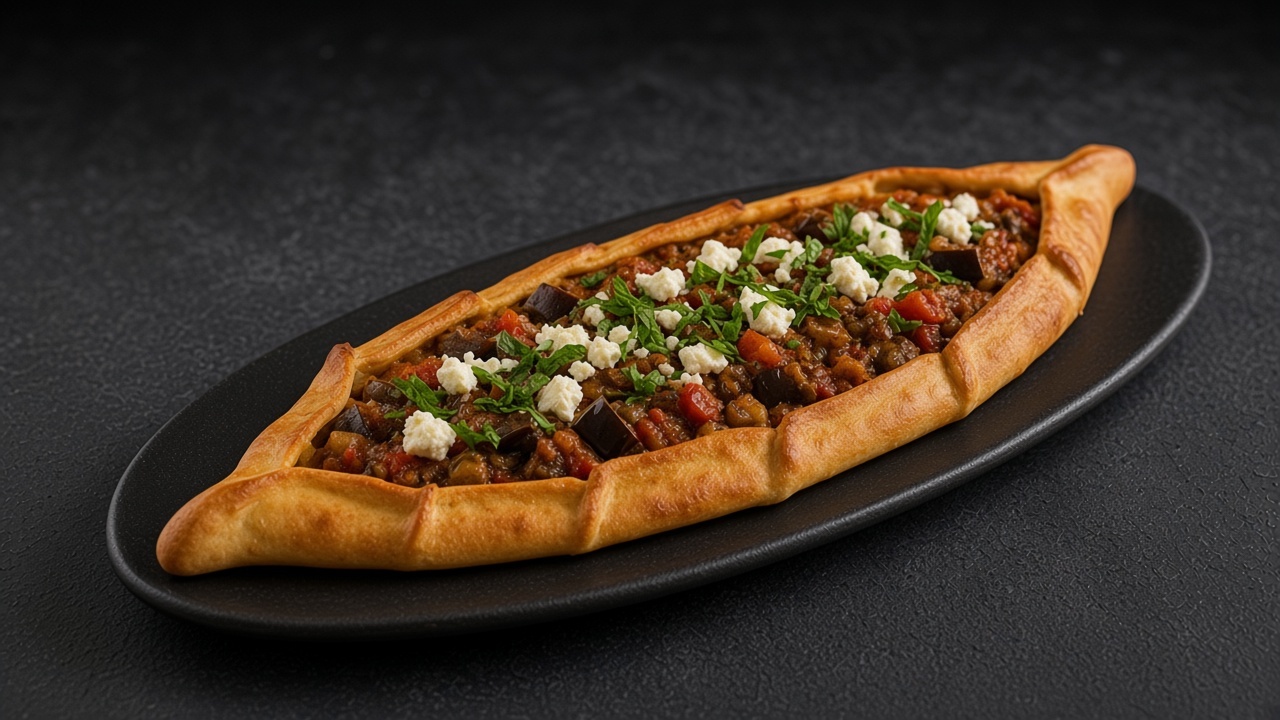

Turkish Pide with Aubergine, Tomato and Feta
Inspired by techniques from America's Test Kitchen.
Boat-shaped Turkish flatbreads made from a slow, cold-proved dough, filled with a thick, smoky aubergine, red pepper and tomato mixture and crumbled feta. They bake on a very hot stone until crisp and golden, then get a scatter of fresh mint.
Always check the labels of the products you use.
Method
- 1
Mix the dough. Pulse the flour, sugar and yeast in a food processor about 5 times to combine. With the motor running, slowly pour in the ice-cold water and process for about 10 sec, until no dry flour remains. Leave to rest for 10 min.
- 2
Knead and chill. Add 1 tbsp oil and 1½ tsp salt and process for 30-60 sec, until the dough forms a satiny, sticky ball that clears the sides. Knead briefly on a lightly oiled worktop into a smooth ball, put it seam side down in a lightly oiled large bowl, cover tightly with cling film and refrigerate for at least 24 hours or up to 3 days.
- 3
Cook the filling. Pulse the tomatoes and their juice in the food processor about 12 times, until coarsely ground. Heat 2 tbsp oil in a 30 cm non-stick frying pan over medium-high heat until shimmering. Add the aubergine, red pepper and ½ tsp salt and cook, stirring now and then, for 5-7 min, until soft and starting to brown. Stir in the garlic, chilli flakes and paprika and cook for about 30 sec, until fragrant.
- 4
Reduce. Add the tomatoes, bring to a simmer and cook, stirring now and then, for about 10 min, until very thick and reduced to about 830 ml. Off the heat, stir in 4 tbsp mint and season with salt and pepper to taste. Leave to cool completely.
- 5
Shape the balls. An hour before baking, put a baking stone on a shelf 10 cm below the grill element and heat the oven to 260 °C (240 °C fan). Press the dough down, halve it, then cut each half into 3 pieces of about 135 g. Shape each into a smooth ball by stretching the dough around your thumbs and pinching the edges together underneath. Space 8 cm apart, cover loosely with oiled cling film and rest for 1 hour.
- 6
Roll. Cut six 40 x 15 cm pieces of baking paper. Coat a dough ball generously in flour and press and roll it on a well-floured worktop into a 35 x 14 cm oval. Lay it on a piece of baking paper and reshape if needed; if the dough springs back, rest it for 10-20 min and try again. Repeat with 2 more balls.
- 7
Fill and shape. Brush the ovals with oil, then spread each with 120 ml of the aubergine filling and 2 tbsp crumbled feta (about 28 g), leaving a 2 cm border. Fold the long edges over the filling into a canoe shape and pinch the ends together to seal. Brush the outside edges with oil and slide onto a pizza peel, still on the baking paper.
- 8
Bake. Slide the pide, on their baking paper, onto the stone at least 2.5 cm apart. Bake for 10-15 min, until golden brown and crisp at the edges. Move to a wire rack, discard the baking paper and cool for 5 min. Scatter each with 1 tsp mint, slice and serve. Repeat with the remaining dough and toppings.
Storage
Best eaten fresh. Refrigerate leftovers for up to 2 days and reheat in a hot oven until piping hot. The dough keeps in the fridge for up to 3 days before baking. Cool leftovers in a shallow container and refrigerate within 2 hours (within 1 hour on a day above 32°C).
Free sugars
1.3 g per serving
2.6 % of the 50 g daily maximum · 5.2 % of the ideal 25 g
Free sugars under 50 g a day, ideally about 25 g, based on WHO free-sugar guidance (not endorsed by WHO). The share shown is the share of one serving. WHO
Equipment
- food processor
- large bowl or lidded container
- cling film
- 30 cm non-stick frying pan
- baking stone
- pizza peel
- baking paper
- rolling pin
- pastry brush
- wire rack
- sharp knife
Nutrition per serving Calculated from USDA FoodData Central
| Per serving | Amount |
|---|---|
| Energy | 538 kcal |
| Protein | 15.8 g |
| Carbohydrate | 71.6 g |
| of which sugars | 8.1 g |
| of which free sugars | 1.3 g |
| Fat | 21.5 g |
| of which saturates | 5.9 g |
| Fibre | 7.2 g |
| Salt | 3.14 g |
Protein per 100 kcal
2.9 g High Protein needs ≥ 5 g (20% of energy)
Calculated from USDA FoodData Central ingredient values