 Velvet
Tomato, Spinach, Carrot and Celery Juice
Inspired by techniques from America's Test Kitchen.
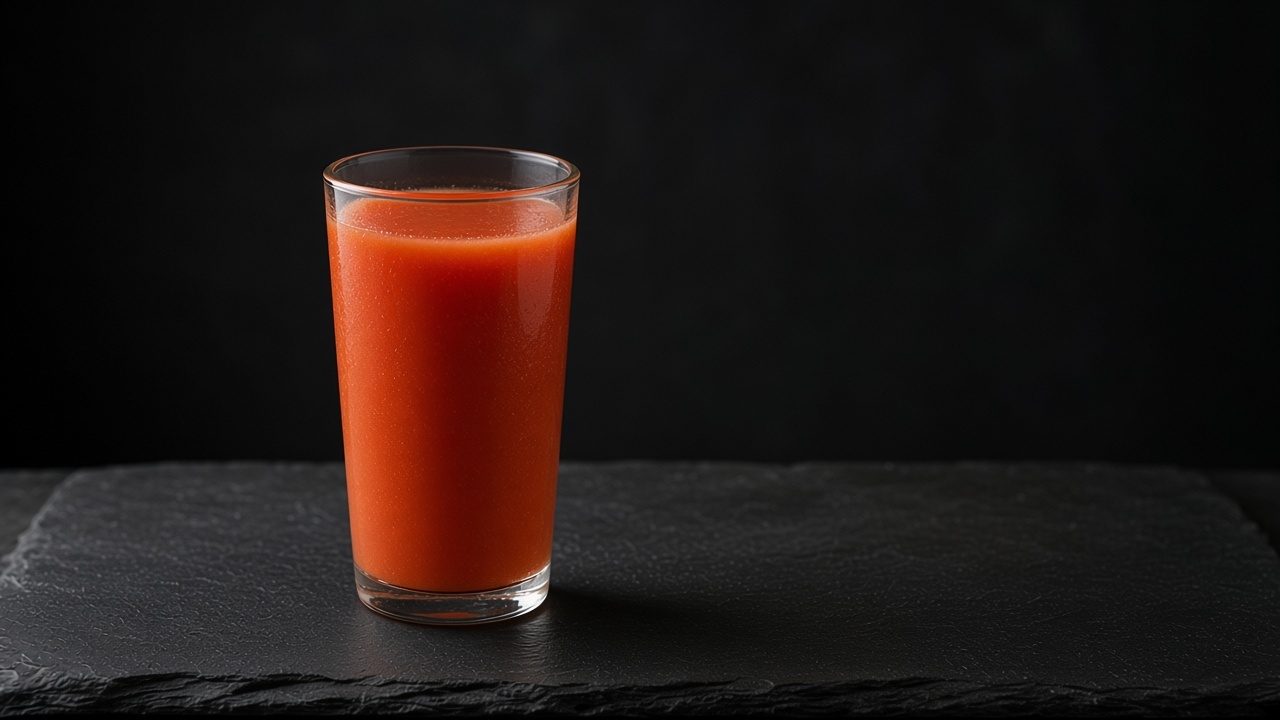
A fresh, savoury vegetable juice pressed from ripe tomato, spinach, peppery watercress, carrot and celery. Bright, lightly salty and nothing like the bottled kind.
Always check the labels of the products you use.
Method
- 1
Wash the vegetables. Wash the tomato, spinach, watercress, carrot and celery well and drain. Cut the tomato and carrot to fit your juicer's feed tube.
- 2
Juice the tomato. With the juicer on low speed, press the tomato through into the glass or jug.
- 3
Juice the greens and roots. Switch to high speed and press through the spinach, watercress, carrot and celery, in that order; the firm carrot and celery push the last of the leaves through.
- 4
Season and serve. Sprinkle in the salt, if using, stir well and drink straight away.
Storage
Best drunk immediately. If needed, refrigerate in a sealed jar for up to 24 hours and stir before drinking.
Why it's healthy
4.5 g protein for 81 kcal = 5.6 g per 100 kcal, so protein gives about 22% of the energy. High Protein needs at least 20% (5 g per 100 kcal), the EU condition. How we decide
EU nutrition claims
- Low fat: 0.3 g fat per 100 ml (limit ≤ 1.5 g)
- Low saturated fat: 0 g saturated fat per 100 ml, 1.1% of energy (limits ≤ 0.75 g and ≤ 10%)
- Low salt: 0.29 g salt per 100 ml (limit ≤ 0.3 g)
Per 100 ml of the finished dish, worked out from the nutrition per serving and the lowest likely cooked weight (about 288 ml a serving), so the true values are, if anything, lower. Thresholds from the Annex to EU Regulation (EC) No 1924/2006. How we decide
Free sugars
Free sugars: 0 g per serving
0 % of the 50 g daily maximum · 0 % of the ideal 25 g
Free sugars under 50 g a day, ideally about 25 g (WHO). The share shown is the share of one serving. who.int/publications/i/item/9789241549028
Equipment
- juicer
- chopping board
- knife
- colander
- glass or storage jug
- long spoon
Nutrition per serving (estimated values)
| Per serving | Amount |
|---|---|
| Energy | 81 kcal |
| Protein | 4.5 g |
| Carbohydrate | 16.9 g |
| of which sugars | 8.6 g |
| of which free sugars | 0 g |
| Fat | 0.8 g |
| of which saturates | 0.1 g |
| Fibre | 6 g |
| Salt | 0.84 g |
Protein per 100 kcal
5.6 g meets High Protein (≥ 5 g, 20% of energy)
Calculated from USDA FoodData Central ingredient values