 Velvet
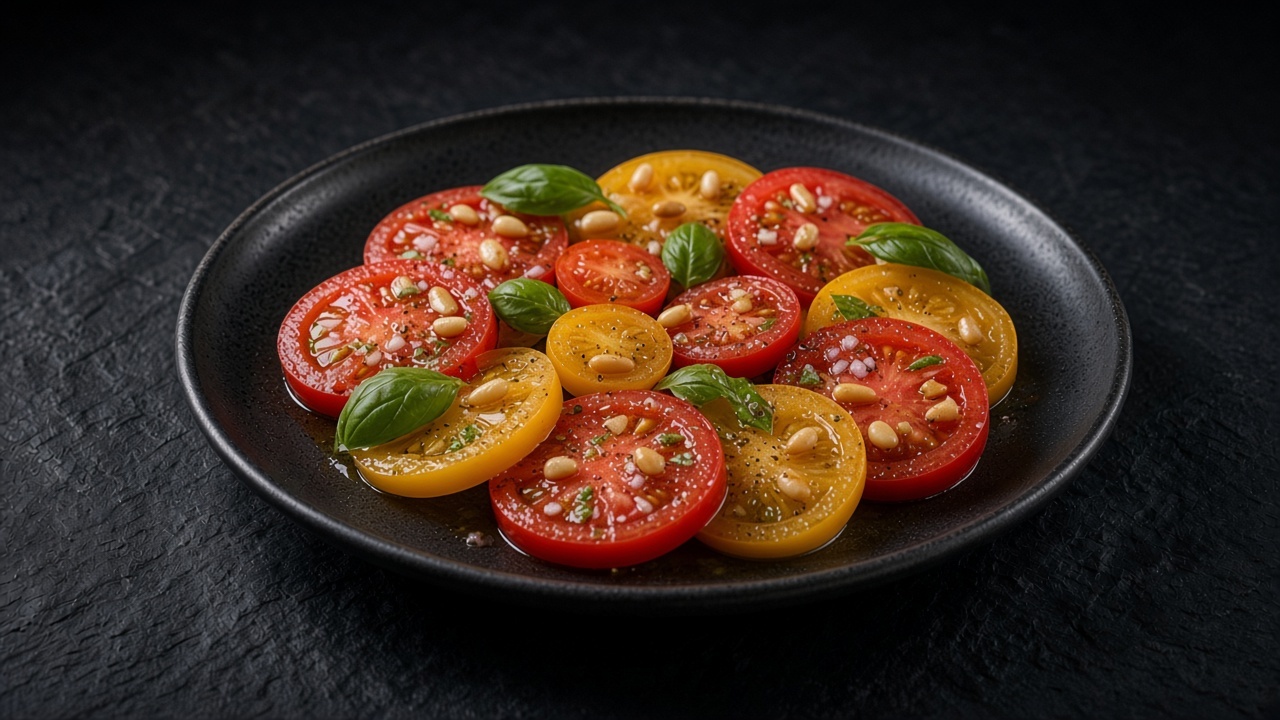
Tomato Salad with Shallot, Pine Nuts and Basil
Inspired by techniques from America's Test Kitchen.
Ripe sliced tomatoes dressed simply with olive oil, finely chopped shallot and a few drops of lemon, then finished with toasted pine nuts and torn basil. A ten-minute salad that lives or dies by the tomatoes, so make it at the height of summer.
None of the 14 major EU allergens. Always check the labels of the products you use.
Method
- 1
Toast the pine nuts. Put the pine nuts in the dry frying pan over medium-low heat and stir often for 3-4 min, until golden and fragrant. Tip them straight onto a plate; left in the hot pan they keep browning and turn bitter.
- 2
Slice the tomatoes. Core the tomatoes and slice them 6 mm thick with the serrated knife, which cuts through the skin without squashing the flesh. Lay the slices overlapping on the platter.
- 3
Make the dressing. Whisk the oil, shallot, lemon juice, salt and pepper in the small bowl. The salt draws out a little tomato juice, which mixes with the oil into a light dressing.
- 4
Dress and serve. Spoon the dressing over the tomatoes, then scatter over the pine nuts and basil. Serve straight away, at room temperature.
Storage
Best eaten within an hour of dressing. Leftovers can be refrigerated covered for up to 1 day, though the tomatoes soften; bring back to room temperature before eating. Cool leftovers in a shallow container and refrigerate within 2 hours (within 1 hour on a day above 32°C).
EU nutrition claims
- Low saturated fat: 1 g saturated fat per 100 g, 9.6% of energy (limits ≤ 1.5 g and ≤ 10%)
- Low sugars: 3.2 g sugars per 100 g (limit ≤ 5 g)
- Source of fibre: 1.5 g fibre per 100 kcal (needs ≥ 1.5 g)
Per 100 g of the finished dish, worked out from the nutrition per serving and the lowest likely cooked weight (about 153 g a serving), so the true values are, if anything, lower. Thresholds from the Annex to EU Regulation (EC) No 1924/2006. How we decide
Free sugars
Free sugars: 0 g per serving
0 % of the 50 g daily maximum · 0 % of the ideal 25 g
Free sugars under 50 g a day, ideally about 25 g (WHO). The share shown is the share of one serving. who.int/publications/i/item/9789241549028
Equipment
- small dry frying pan
- serrated knife
- chopping board
- small plate
- large serving platter
- small bowl
- whisk
Nutrition per serving (estimated values)
| Per serving | Amount |
|---|---|
| Energy | 150 kcal |
| Protein | 2.2 g |
| Carbohydrate | 7.8 g |
| of which sugars | 4.9 g |
| of which free sugars | 0 g |
| Fat | 13.3 g |
| of which saturates | 1.6 g |
| Fibre | 2.3 g |
| Salt | 0.75 g |
Protein per 100 kcal
1.5 g High Protein needs ≥ 5 g (20% of energy)
Calculated from USDA FoodData Central ingredient values