 Velvet
Tomato and Parmesan Risotto
Inspired by techniques from Bon Appétit.
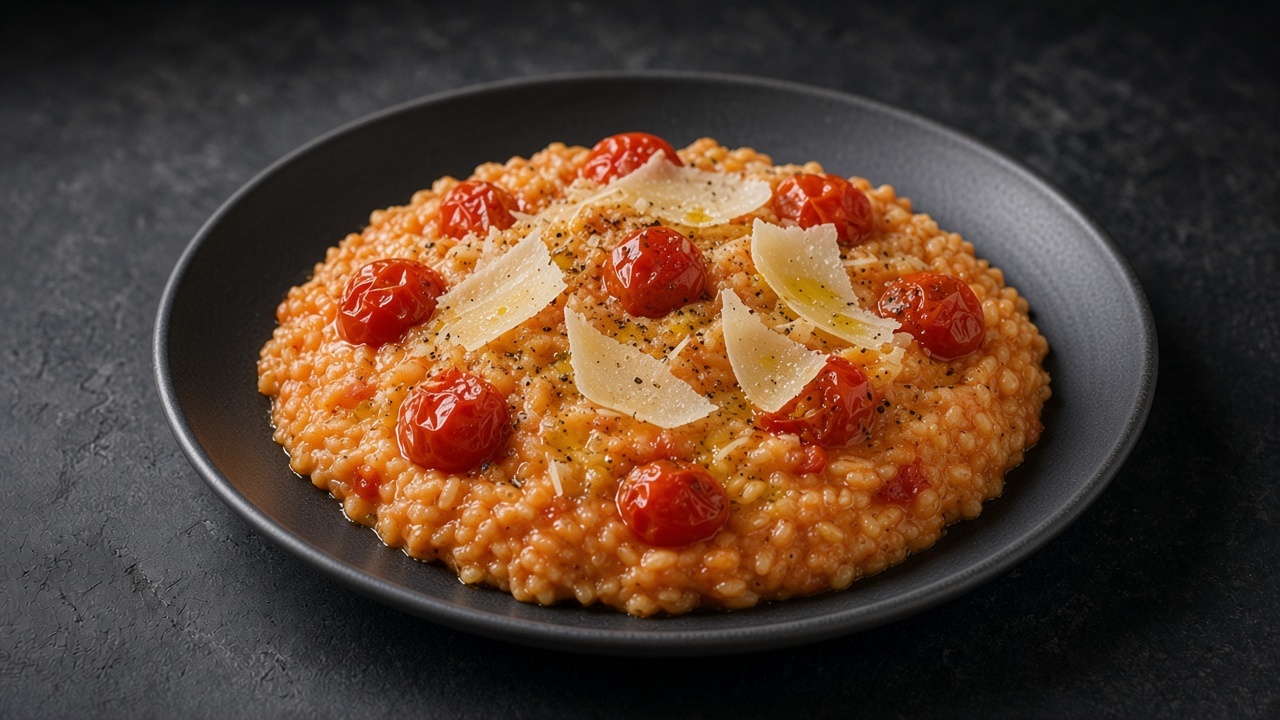
A creamy risotto built on softly golden onion, a little browned tomato purée and bursting cherry tomatoes, with the stock added in three generous pours rather than ladle by ladle. Butter and Parmesan stirred in at the end make it rich and glossy.
Always check the labels of the products you use.
Method
- 1
Warm the stock. Bring the stock to a simmer in the medium saucepan, then keep it warm over low heat. Hot stock keeps the rice simmering steadily instead of stalling every time you add more.
- 2
Build the base. Heat the oil in the large saucepan over medium heat. Add the onion and cook 8-10 min, stirring often, until very soft and golden. Add the garlic and cook 1 min. Stir in the tomato purée and cook about 2 min, until it darkens and starts to catch on the pan, which deepens its flavour. Add the cherry tomatoes and nutmeg, if using, and cook about 2 min, until some tomatoes start to burst.
- 3
Toast the rice. Stir in the rice and the salt, turn the heat to medium-low and cook about 3 min, stirring, until some grains look translucent at the edges.
- 4
Add the stock. Ladle in about 480 ml of the hot stock and simmer, stirring often, 8-10 min until it is all absorbed. Add another 480 ml and keep stirring often for 12-15 min, until the rice is tender with only a slight bite and most of the liquid has gone. Frequent stirring rubs starch off the grains, which is what makes risotto creamy.
- 5
Finish. Add the butter, the grated Parmesan and the last of the stock and stir constantly for about 4 min, until the risotto looks loose and very creamy. Taste and add salt if needed. Serve in warm bowls topped with Parmesan shavings, plenty of pepper and a drizzle of oil.
Storage
Best eaten straight away. Refrigerate covered up to 1 day; reheat with a splash of stock, stirring, until piping hot (74 °C). Cool leftovers in a shallow container and refrigerate within 2 hours (within 1 hour on a day above 32°C).
EU nutrition claims
- Source of protein: 3.7 g protein per 100 kcal, about 15% of energy (needs ≥ 12%)
- Low sugars: 1.5 g sugars per 100 g (limit ≤ 5 g)
Per 100 g of the finished dish, worked out from the nutrition per serving and the lowest likely cooked weight (about 302 g a serving), so the true values are, if anything, lower. Thresholds from the Annex to EU Regulation (EC) No 1924/2006. How we decide
Free sugars
Free sugars: 0 g per serving
0 % of the 50 g daily maximum · 0 % of the ideal 25 g
Free sugars under 50 g a day, ideally about 25 g (WHO). The share shown is the share of one serving. who.int/publications/i/item/9789241549028
Equipment
- medium saucepan
- large heavy-based saucepan
- wooden spoon
- ladle
- fine grater
- vegetable peeler
Nutrition per serving (estimated values)
| Per serving | Amount |
|---|---|
| Energy | 449 kcal |
| Protein | 16.6 g |
| Carbohydrate | 52 g |
| of which sugars | 4.5 g |
| of which free sugars | 0 g |
| Fat | 20.1 g |
| of which saturates | 7.7 g |
| Fibre | 2.6 g |
| Salt | 1.45 g |
Protein per 100 kcal
3.7 g High Protein needs ≥ 5 g (20% of energy)
Calculated from USDA FoodData Central ingredient values