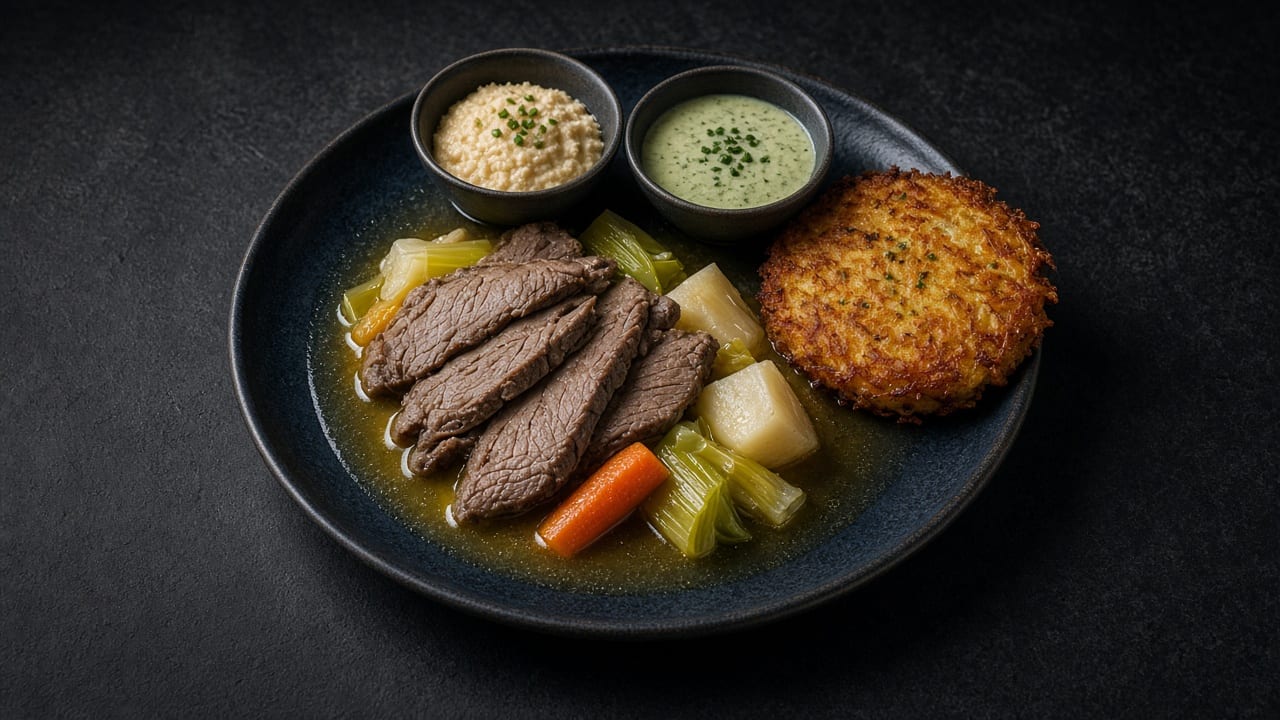
Austrian Simmered Beef with Apple-Horseradish and Chive Sauce
Inspired by techniques from NYT Cooking and Serious Eats.
A whole piece of beef rump cap is simmered for hours in a vegetable broth until tender, then sliced and served with its vegetables, buttered potatoes, and both a piquant apple-horseradish relish and a cool chive soured cream sauce.
Always check the labels of the products you use.
Method
- 1
Char the onion. Set the onion halves cut side down in a dry frying pan over high heat for 5-6 minutes until deeply blackened. Charring the onion like this gives the finished broth a deeper golden colour and a roasted, savoury edge it wouldn't get from a raw onion.
- 2
Start the broth. Put the beef into the stockpot with the cold water and bring it slowly to a simmer over medium heat, skimming off all the grey foam that rises during the first 10-15 minutes. Starting from cold water and skimming carefully keeps the finished broth clear rather than cloudy.
- 3
Add the vegetables and simmer. Add the charred onion, carrots, parsnip, celeriac, leek, celery, peppercorns, bay leaves, parsley stalks and salt to the pot. Keep the broth at a bare simmer, with just a few bubbles breaking the surface, partly covered, for 2 hours 30 minutes to 3 hours, until a skewer slides into the beef with little resistance. A hard boil would toughen the meat and cloud the broth, so patience at a gentle simmer is what makes this dish work.
- 4
Make the apple-horseradish. While the beef simmers, toss the grated apple with the lemon juice straight away, which stops it browning, then stir in the horseradish and sugar. Chill until needed.
- 5
Make the chive sauce. Stir the soured cream, chives, milk, salt and pepper together in a bowl, then chill alongside the apple-horseradish. The milk loosens the soured cream just enough to make a spoonable sauce rather than a thick dollop.
- 6
Cook the potatoes. About 25 minutes before the beef is ready, boil the potatoes in unsalted water until tender, then drain and toss with the butter and chives. Timing them to finish just as the beef is ready means everything reaches the table hot together.
- 7
Rest and carve the beef. Lift the beef out of the broth and rest it under foil for 10 minutes before carving. Resting lets the juices settle back through the meat after hours of gentle simmering, so it slices more cleanly.
- 8
Serve. Strain the broth and cut the carrots, parsnip and celeriac into bite-sized pieces. Slice the beef 1 cm thick against the grain, lay it in warmed shallow bowls with the vegetables, ladle over a little hot broth, and serve with the potatoes and both sauces.
Storage
Refrigerate leftover beef, vegetables and broth separately in covered containers for up to 3 days; the broth also freezes well for up to 3 months. Reheat the beef and broth together gently until piping hot throughout (74°C), and serve the sauces freshly stirred rather than reheated. Cool leftovers in a shallow container and refrigerate within 2 hours (within 1 hour on a day above 32°C).
Why it's healthy
61.2 g protein for 603 kcal = 10.1 g per 100 kcal. Our High Protein label needs at least 10 g per 100 kcal. How we decide
Equipment
- large stockpot (at least 6 litres)
- heavy frying pan
- slotted spoon or skimmer
- fine sieve
- metal skewer
- saucepan for the potatoes
- carving board and sharp knife
- 2 small bowls
Nutrition per serving (estimated values)
| Per serving | Amount |
|---|---|
| Energy | 603 kcal |
| Protein | 61.2 g |
| Carbohydrate | 45.8 g |
| of which sugars | 11.1 g |
| of which free sugars | 0.4 g |
| Fat | 19.1 g |
| of which saturates | 8.4 g |
| Fibre | 7.2 g |
| Salt | 2.37 g |
Protein per 100 kcal
10.1 g meets the High Protein rule (≥ 10 g)
Calculated from USDA FoodData Central ingredient values