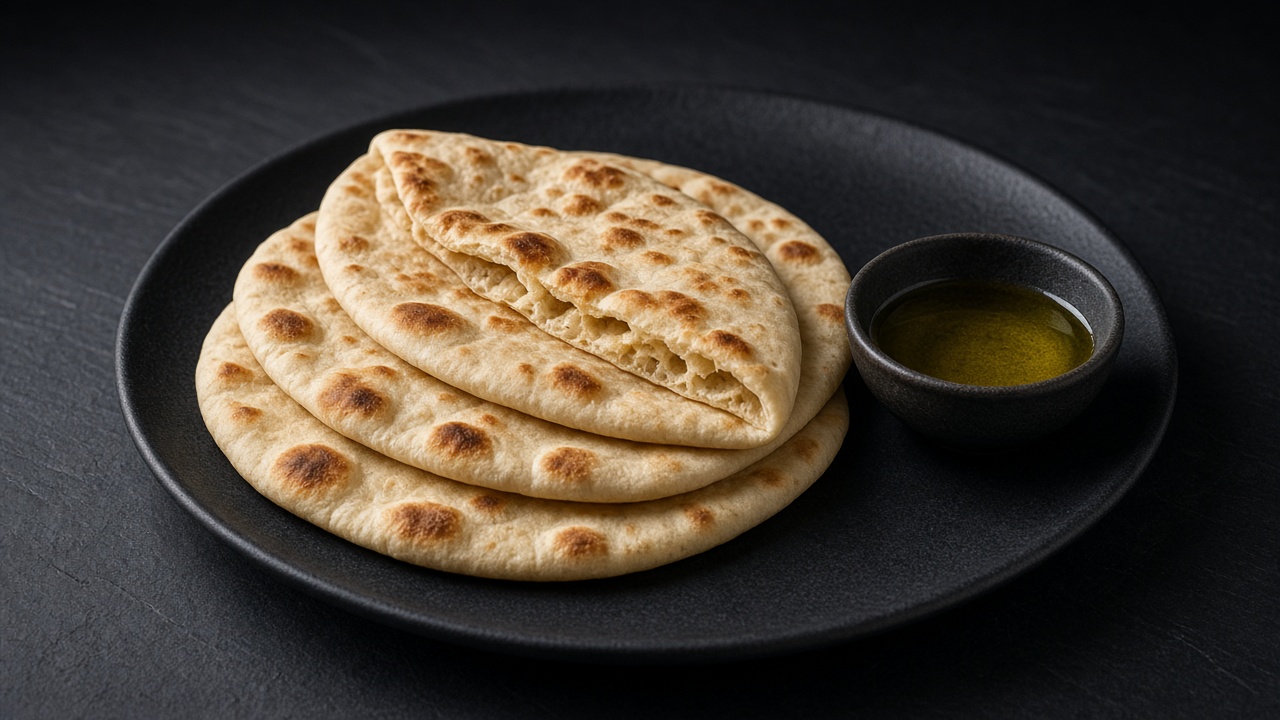
Soft Yoghurt Pan Flatbreads with Olive Oil
Inspired by techniques from King Arthur Baking and America's Test Kitchen.
Soft, pillowy flatbreads enriched with yoghurt and cooked quickly on a hot pan, ready to tear and dip into good olive oil.
Always check the labels of the products you use.
Method
- 1
Mix the dough. Stir the flour, yeast, caster sugar and salt together in a large bowl, then add the yoghurt, warm water and 2 tbsp olive oil and bring everything together into a soft, slightly tacky dough. The yoghurt's acidity and fat soften the crumb, giving a more tender bite than a plain water dough.
- 2
Knead until smooth. Knead by hand for 8-10 minutes, or 5 minutes in a stand mixer, until the dough feels smooth, springy and no longer sticky on the surface. This develops the gluten network that traps gas and gives the bread its stretch.
- 3
First rise. Cover the bowl and leave it somewhere warm for 1-1½ hours, until the dough has doubled in size and feels light and puffy. The long rise lets the yeast build plenty of gas, which is what gives these flatbreads their open, pillowy texture.
- 4
Divide into balls. Tip the dough onto the worktop and divide it into 8 pieces of about 90g each, then roll each piece into a smooth, taut ball. Even pieces mean every flatbread cooks and puffs at roughly the same rate in the pan.
- 5
Rest before rolling. Cover the balls and leave them for 15 minutes before rolling. This short rest relaxes the gluten, so the rounds roll out easily instead of springing back thinner in the middle.
- 6
Roll out. On a lightly floured surface, roll each ball into an oval or round about 18cm across and 4-5mm thick. Rolling thin and even helps the centre cook through at the same rate as the edges, without drying out.
- 7
Heat the pan. Heat a dry, heavy frying pan or flat griddle over medium-high heat for 3 minutes, until the surface reaches around 220°C, then brush it very lightly with oil. A properly hot pan sears the dough the instant it lands, kick-starting the burst of steam that puffs the bread.
- 8
Cook each flatbread. Cook one flatbread at a time for 1-1½ minutes, until bubbles rise across the top and the underside turns golden with brown freckles, then flip and cook for 1 minute more until puffed and spotted. Press any pale, stubborn bubbles with a spatula so they make full contact with the pan and cook through evenly.
- 9
Keep them soft. Stack the hot breads inside a folded tea towel as each one comes off the pan. Trapping their steam this way keeps the crumb soft and pliable, rather than letting the surface dry out and turn leathery.
- 10
Serve warm. Serve the flatbreads warm, with the remaining olive oil poured into a small bowl alongside for dipping. They're best eaten freshly cooked, while still soft and faintly steaming.
Storage
Keep cooled flatbreads wrapped at room temperature for up to 2 days, or freeze for up to 1 month. Refresh frozen or day-old breads for 5 minutes in a 180°C oven until warmed through and soft again. Cool leftovers in a shallow container and refrigerate within 2 hours (within 1 hour on a day above 32°C).
Equipment
- large bowl
- cling film
- digital scales
- rolling pin
- heavy frying pan or flat griddle (at least 24 cm)
- pastry brush
- clean tea towel
Nutrition per serving (estimated values)
| Per serving | Amount |
|---|---|
| Energy | 295 kcal |
| Protein | 6.6 g |
| Carbohydrate | 37.5 g |
| of which sugars | 1.1 g |
| of which free sugars | 0.5 g |
| Fat | 13 g |
| of which saturates | 2 g |
| Fibre | 1.4 g |
| Salt | 0.93 g |
Protein per 100 kcal
2.2 g High Protein needs ≥ 10 g
Calculated from USDA FoodData Central ingredient values