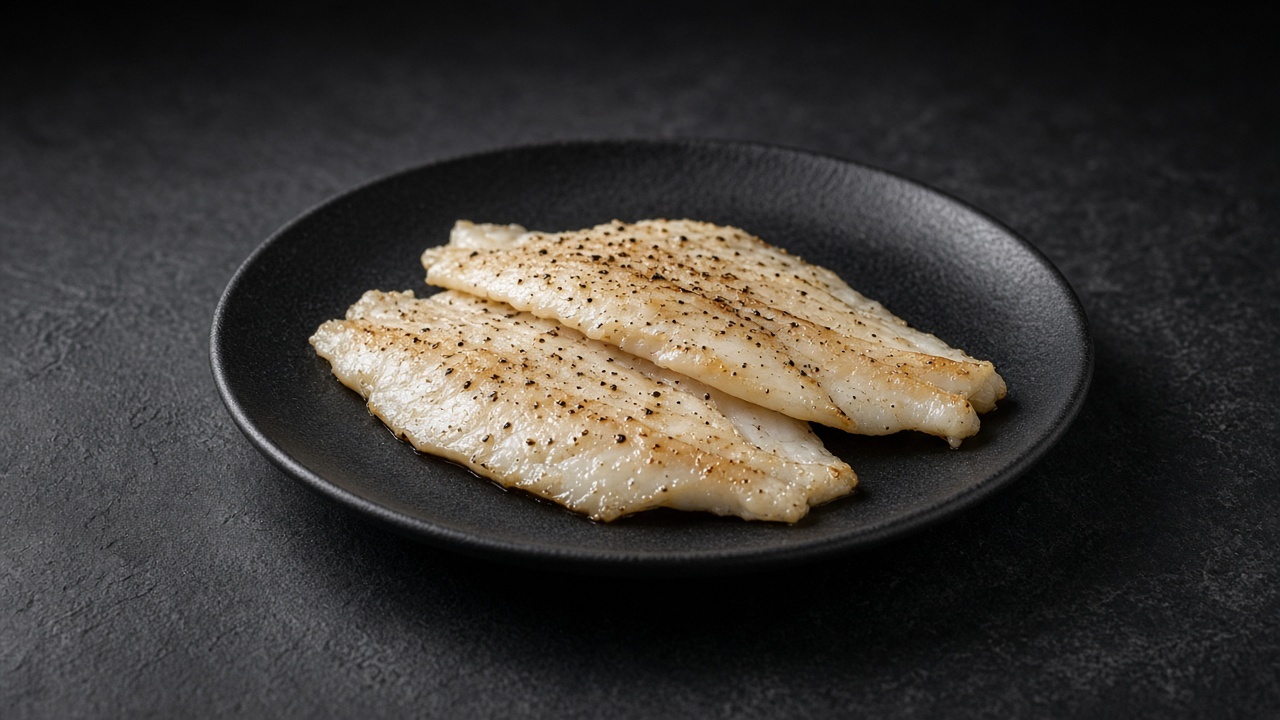

Sautéed Thin Fish Fillets
Inspired by techniques from America's Test Kitchen.
Delicate, thin white fish fillets such as flounder or sole, seasoned simply and seared fast in butter or oil until golden on one side. The pan is pulled off the heat partway through so the fish finishes gently in residual warmth instead of drying out.
Always check the labels of the products you use.
Method
- 1
Heat the pan. Set one large frying pan (or two medium frying pans) over medium heat until a drop of water flicked onto the surface beads up and skitters instead of vanishing straight away, 2-3 min.
- 2
Add the fat. Raise the heat to medium-high and add the butter and/or oil to the pan (half in each pan if using two).
- 3
Season and add the fish. Season both sides of the fillets with the salt and pepper. Once the butter's foam has died down, or the oil shimmers, lay the fillets in the pan skin side up.
- 4
Brown the first side. Cook until golden brown, 2-3 min, shaking the pan gently now and then so the fillets don't stick.
- 5
Turn and finish off the heat. Turn the fillets with the fish spatula. If a fillet is very thin, turn the heat off immediately and let the pan's residual heat finish cooking it. If a fillet is a little thicker, cook 1 min more over medium-high heat, then turn the heat off and let residual heat finish it, until opaque throughout and just flaking, about 63 °C. Serve immediately.
Storage
Best eaten the moment it comes out of the pan. Refrigerate any leftovers within 2 hours and eat within 2 days, reheated gently or flaked cold into a salad. Cool leftovers in a shallow container and refrigerate within 2 hours (within 1 hour on a day above 32°C).
Why this label?
21.2 g protein for 170 kcal = 12.5 g per 100 kcal, so protein gives about 50% of the energy. High Protein needs at least 20% (5 g per 100 kcal), the condition in the Annex to EU Regulation (EC) No 1924/2006. How we decide
EU nutrition claims
- Sugar-free: 0 g sugars per 100 g (limit ≤ 0.5 g)
Per 100 g of the finished dish, worked out from the nutrition per serving and the lowest likely cooked weight (about 151 g a serving), so the true values are, if anything, lower. Thresholds from the Annex to EU Regulation (EC) No 1924/2006. How we decide
Free sugars
0 g per serving
0 % of the 50 g daily maximum · 0 % of the ideal 25 g
Free sugars under 50 g a day, ideally about 25 g, based on WHO free-sugar guidance (not endorsed by WHO). The share shown is the share of one serving. WHO
Equipment
- large frying pan (or two medium frying pans)
- kitchen paper
- fish spatula
- instant-read thermometer
Nutrition per serving (estimated values)
| Per serving | Amount |
|---|---|
| Energy | 170 kcal |
| Protein | 21.2 g |
| Carbohydrate | 0.2 g |
| of which sugars | 0 g |
| of which free sugars | 0 g |
| Fat | 9 g |
| of which saturates | 4.3 g |
| Fibre | 0.1 g |
| Salt | 1.99 g |
Protein per 100 kcal
12.5 g meets High Protein (≥ 5 g, 20% of energy)
Calculated from USDA FoodData Central ingredient values