 Velvet
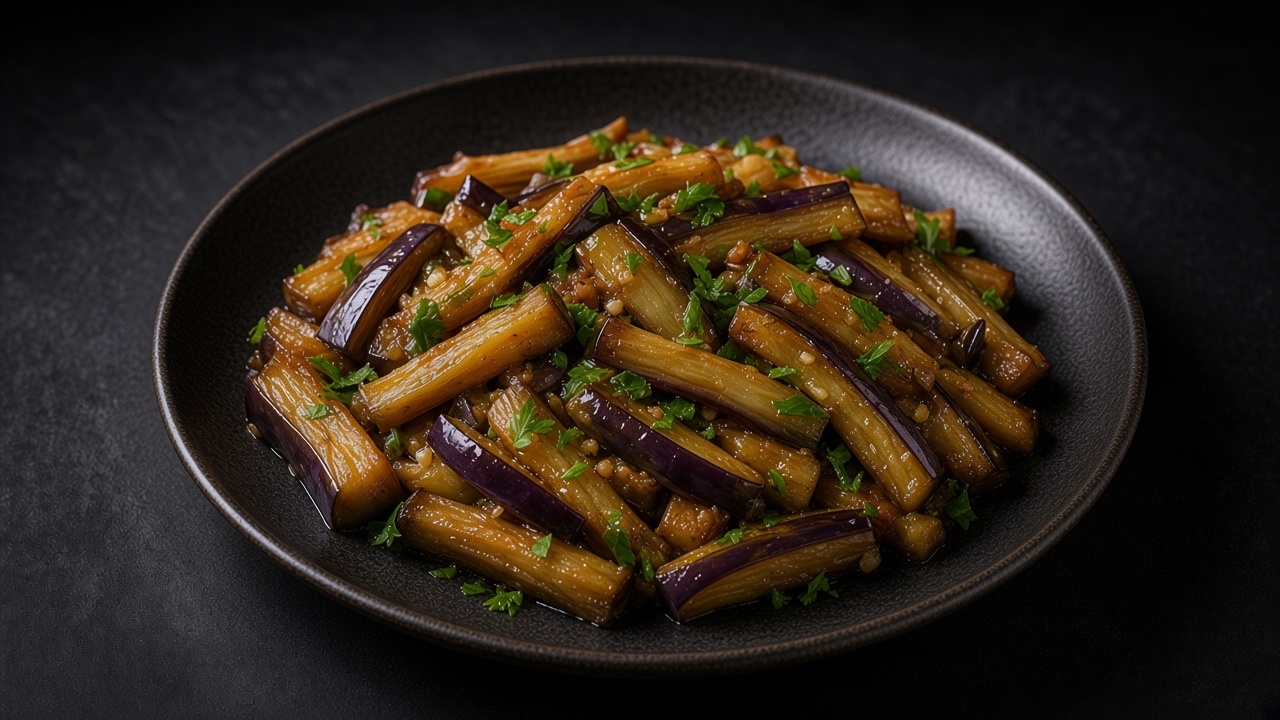
Sautéed Eggplant with Garlic and Parsley
Inspired by techniques from America's Test Kitchen.
Eggplant (aubergine) strips salted, rinsed and pressed firm, then sautéed in olive oil until tender and lightly browned, finished with garlic and fresh parsley. Salting and pressing first means the eggplant needs only a little oil and turns silky instead of greasy.
None of the 14 major EU allergens. Always check the labels of the products you use.
Method
- 1
Cut and salt. Cut off the stem and base of each eggplant. Cut crosswise into 2 cm slices, then cut the slices into 2 cm wide strips. Toss the strips with the salt in the colander and set it over the bowl or in the sink. Leave at least 1 hr 30 min, ideally 2-3 hr, stirring a couple of times; the salt draws out bitter juices and collapses the spongy flesh so it soaks up less oil.
- 2
Rinse and press. Rinse the strips under cold running water, rubbing them lightly to wash off the salt, and shake the colander to drain. Lay them 2-3 cm apart on a triple layer of paper towels and cover with another triple layer. Press each strip firmly with your palms until it looks green and translucent and feels firm and leathery; repeat on fresh towels if needed. They can be refrigerated for up to 3 hr at this point.
- 3
Brown. Heat the oil in the frying pan over medium-high heat until it shimmers and smells fragrant. Add the eggplant and cook, stirring, for about 3 min, until the strips start to brown.
- 4
Cook until tender. Turn the heat down to medium-low and cook, stirring now and then, for 15-20 min, until the eggplant is completely tender and lightly browned.
- 5
Finish. Stir in the pepper and garlic and cook for about 2 min, just until the garlic smells sweet. Take the pan off the heat, stir in the parsley, taste for seasoning and serve.
Storage
Serve hot or at room temperature. Refrigerate covered up to 3 days; eat at room temperature or warm through in a frying pan. Cool leftovers in a shallow container and refrigerate within 2 hours (within 1 hour on a day above 32°C).
EU nutrition claims
- Low saturated fat: 0.9 g saturated fat per 100 g, 9.2% of energy (limits ≤ 1.5 g and ≤ 10%)
- Low sugars: 4.5 g sugars per 100 g (limit ≤ 5 g)
- Low salt: 0.27 g salt per 100 g (limit ≤ 0.3 g)
- High fibre: 4.4 g fibre per 100 kcal (needs ≥ 3 g)
Per 100 g of the finished dish, worked out from the nutrition per serving and the lowest likely cooked weight (about 165 g a serving), so the true values are, if anything, lower. Thresholds from the Annex to EU Regulation (EC) No 1924/2006. How we decide
Free sugars
Free sugars: 0 g per serving
0 % of the 50 g daily maximum · 0 % of the ideal 25 g
Free sugars under 50 g a day, ideally about 25 g (WHO). The share shown is the share of one serving. who.int/publications/i/item/9789241549028
Equipment
- chef's knife
- chopping board
- colander
- large bowl
- paper towels
- 30 cm heavy-based frying pan
- wooden spoon
Nutrition per serving (estimated values)
| Per serving | Amount |
|---|---|
| Energy | 147 kcal |
| Protein | 2.3 g |
| Carbohydrate | 13.5 g |
| of which sugars | 7.5 g |
| of which free sugars | 0 g |
| Fat | 10.5 g |
| of which saturates | 1.5 g |
| Fibre | 6.5 g |
| Salt | 0.45 g |
Protein per 100 kcal
1.6 g High Protein needs ≥ 5 g (20% of energy)
Calculated from USDA FoodData Central ingredient values