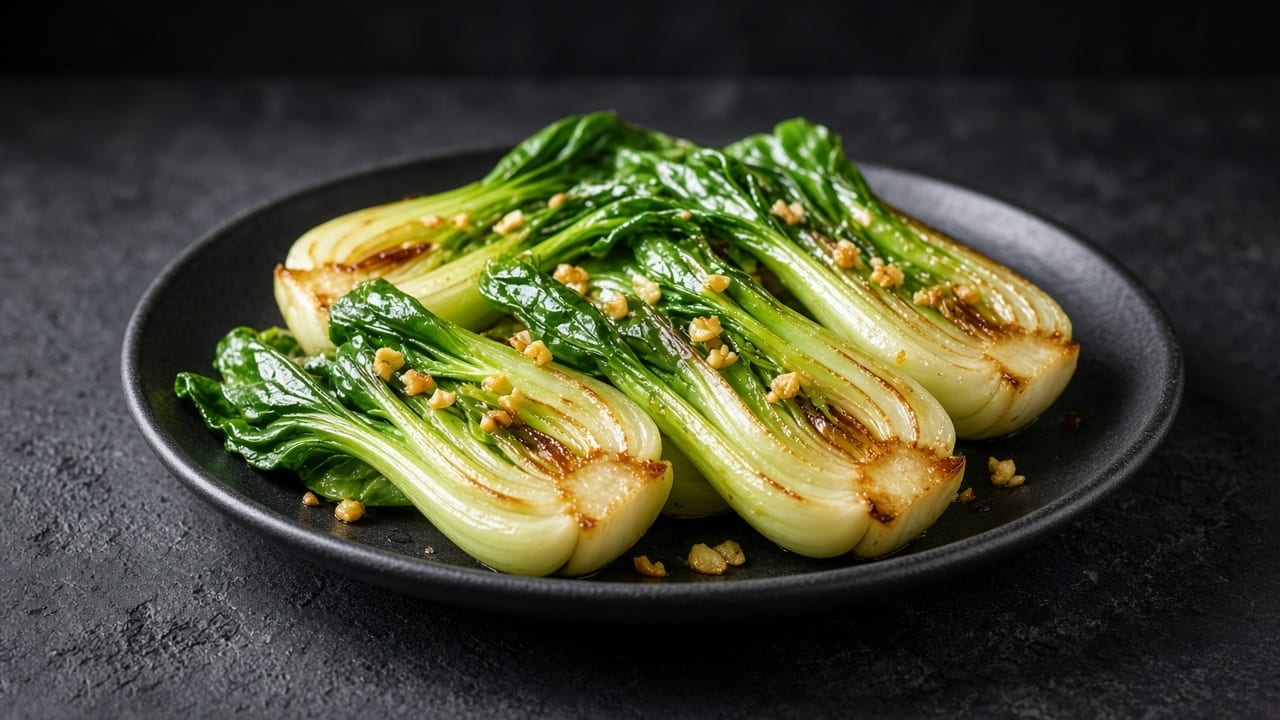

Sautéed Baby Pak Choi with Garlic
Inspired by techniques from America's Test Kitchen.
Baby pak choi is steamed briefly in its own pan with a splash of water, then finished with garlic fried quickly in a cleared hot spot so it turns fragrant without scorching. The stems stay crisp-tender and the leaves wilt just enough, in well under ten minutes of actual cooking.
Based on the listed ingredients, none of the 14 major EU allergens. Always check product labels.
Method
- 1
Mix the garlic oil. Combine 5 ml of the oil with the garlic in a small bowl and set aside.
- 2
Steam the pak choi. Heat the remaining 15 ml oil in a 30 cm non-stick frying pan over medium heat until shimmering. Add the pak choi and water and cover immediately. Cook, covered, shaking the pan occasionally, for 2 min.
- 3
Fry the garlic. Remove the lid, toss the pak choi, then push it to the sides of the pan. Add the garlic-oil mixture to the cleared centre and cook, stirring constantly, until fragrant, about 20 sec.
- 4
Finish. Stir the garlic into the pak choi, sprinkle with the salt, and keep cooking, stirring constantly, until all the water has evaporated, the stems are crisp-tender and the leaves are wilted, 1-2 min longer. Transfer to a platter and serve.
Storage
Best eaten right away while the stems are still crisp-tender. Refrigerate leftovers covered for up to 2 days and reheat in a hot pan until warmed through. Cool leftovers in a shallow container and refrigerate within 2 hours (within 1 hour on a day above 32°C).
EU nutrition claims
- Low saturated fat: 0.4 g saturated fat per 100 g, 6.1% of energy (limits ≤ 1.5 g and ≤ 10%)
- Low sugars: 1.3 g sugars per 100 g (limit ≤ 5 g)
- Source of fibre: 1.7 g fibre per 100 kcal (needs ≥ 1.5 g)
Per 100 g of the finished dish, worked out from the nutrition per serving and the lowest likely cooked weight (about 89 g a serving), so the true values are, if anything, lower. Thresholds from the Annex to EU Regulation (EC) No 1924/2006. How we decide
Free sugars
0 g per serving
0 % of the 50 g daily maximum · 0 % of the ideal 25 g
Free sugars under 50 g a day, ideally about 25 g, based on WHO free-sugar guidance (not endorsed by WHO). The share shown is the share of one serving. WHO
Equipment
- small bowl
- 30 cm non-stick frying pan with a lid
- tongs or a spatula
- salad spinner, or a clean tea towel, for drying the pak choi
Nutrition per serving (estimated values)
| Per serving | Amount |
|---|---|
| Energy | 59 kcal |
| Protein | 1.6 g |
| Carbohydrate | 2.7 g |
| of which sugars | 1.2 g |
| of which free sugars | 0 g |
| Fat | 5.2 g |
| of which saturates | 0.4 g |
| Fibre | 1 g |
| Salt | 0.53 g |
Protein per 100 kcal
2.7 g High Protein needs ≥ 5 g (20% of energy)
Calculated from USDA FoodData Central ingredient values