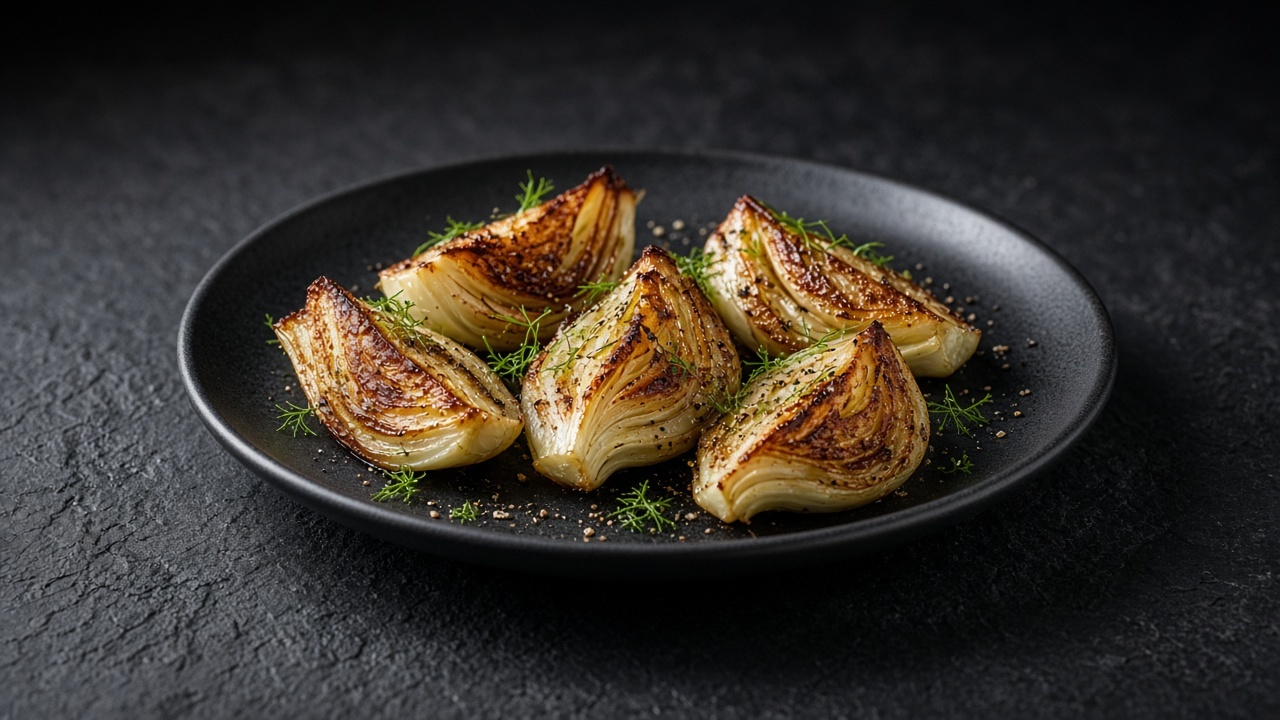

Roasted Fennel Wedges
Inspired by techniques from America's Test Kitchen.
Fennel wedges are tossed with oil and a little salted water, then roasted covered until tender and uncovered until both cut sides turn deep golden brown. The core is left in place so each wedge holds together, and the reserved fronds go back on at the end for a fresh, anise-sweet lift.
Based on the listed ingredients, none of the 14 major EU allergens. Always check product labels.
Method
- 1
Heat the oven. Set an oven rack to the lower-middle position and heat the oven to 232 °C (210 °C fan). Lightly grease a rimmed baking tray.
- 2
Cut the fennel. Trim the fennel bulbs lightly at the base and discard the stalks, keeping the core intact. Cut each bulb lengthwise through the core into 8 wedges.
- 3
Coat the wedges. Whisk most of the water with the salt in a large bowl until the salt dissolves. Add the fennel wedges and toss gently to coat. Drizzle with the oil, sprinkle with the pepper and toss gently again.
- 4
Roast covered. Arrange the wedges cut side down along the two longer sides of the prepared tray. Drizzle any remaining water from the bowl evenly over the wedges. Cover the tray tightly with foil and roast for 20 minutes.
- 5
Roast uncovered and flip. Remove the foil and keep roasting until the side touching the tray is browned, 5-8 minutes more, rotating the tray halfway through. Flip each wedge onto its second cut side and continue roasting until that side is browned too, 3-5 minutes more.
- 6
Serve. Transfer the fennel to a plate and scatter with the reserved fronds before serving.
Storage
Best served hot from the oven. Leftovers can be kept in an airtight container in the fridge for up to 3 days and reheated in a hot oven or a dry frying pan until warmed through.
EU nutrition claims
- High fibre: 3.4 g fibre per 100 kcal (needs ≥ 3 g)
Per 100 g of the finished dish, worked out from the nutrition per serving and the lowest likely cooked weight (about 68 g a serving), so the true values are, if anything, lower. Thresholds from the Annex to EU Regulation (EC) No 1924/2006. How we decide
Free sugars
0 g per serving
0 % of the 50 g daily maximum · 0 % of the ideal 25 g
Free sugars under 50 g a day, ideally about 25 g, based on WHO free-sugar guidance (not endorsed by WHO). The share shown is the share of one serving. WHO
Equipment
- chef's knife
- chopping board
- rimmed baking tray
- aluminium foil
- large bowl
- whisk
Nutrition per serving (estimated values)
| Per serving | Amount |
|---|---|
| Energy | 138 kcal |
| Protein | 1.9 g |
| Carbohydrate | 11.1 g |
| of which sugars | 5.9 g |
| of which free sugars | 0 g |
| Fat | 10.6 g |
| of which saturates | 1.7 g |
| Fibre | 4.7 g |
| Salt | 0.92 g |
Protein per 100 kcal
1.4 g High Protein needs ≥ 5 g (20% of energy)
Calculated from USDA FoodData Central ingredient values