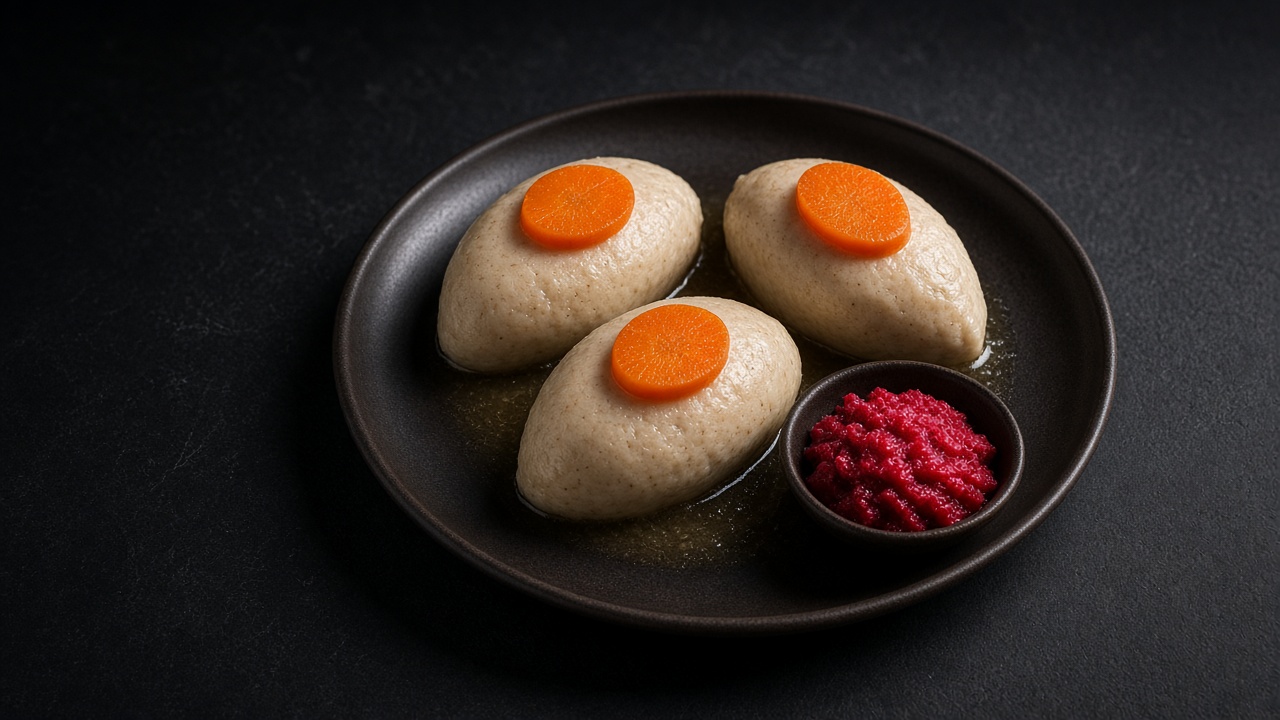
Poached White Fish Dumplings with Carrot and Beetroot Horseradish
Inspired by techniques from NYT Cooking and Serious Eats.
Delicate poached fish dumplings cooked in a fragrant vegetable broth, served chilled with sweet poached carrot and a sharp beetroot horseradish relish on the side.
Always check the labels of the products you use.
Method
- 1
Start the Broth. Put the water, sliced onion, whole carrots, celery, bay leaf, peppercorns and salt into your largest wide pot and bring to the boil. Lower the heat so it holds at a gentle simmer while you prepare the fish mixture; simmering the vegetables gently draws out their flavour without clouding the broth.
- 2
Chop the Vegetables. Pulse the chopped onion and chopped carrot in a food processor until finely chopped. This fine texture disappears into the mixture as it poaches, adding sweetness and moisture without leaving noticeable chunks.
- 3
Chop the Fish. Add the fish to the processor and pulse in short bursts, scraping down the sides once, until finely chopped but still with a little texture rather than a smooth purée. Keeping some texture is what gives the finished dumplings a light, slightly bouncy bite instead of a dense paste.
- 4
Mix the Dumpling Mixture. Tip everything into a large bowl with the eggs, matzo meal, oil, salt, sugar, white pepper, cold water and dill. Mix well with your hand for about a minute until slightly sticky and evenly combined; the matzo meal and egg bind the mixture so the dumplings hold together as they poach.
- 5
Test the Seasoning. Drop a teaspoon of the mixture into the simmering broth and poach for 4-5 minutes until firm, then taste it and adjust the pepper or dill in the remaining mixture as needed, since it's already well salted. Testing a small piece first means you can fix the seasoning before committing the whole batch.
- 6
Shape the Dumplings. With wet hands, shape the mixture into 12 ovals, each about 8 x 5 cm and roughly 90 g, wetting your hands between each one. Damp hands stop the sticky mixture clinging to your fingers and help you form a smooth, even surface.
- 7
Poach Gently. Lower the dumplings into the barely simmering broth with a slotted spoon in a single layer, cooking in two batches if the pot feels crowded. Cover and simmer very gently, with just the occasional bubble, for 25-30 minutes until firm and cooked through, reaching at least 71°C in the centre, which matters because the mixture contains egg. A rolling boil would be too rough and can break the dumplings apart.
- 8
Cool and Slice. Lift out the dumplings and the whole carrots onto a dish, spoon over a little broth, then cool before covering and chilling for at least 2 hours, or serve warm if you prefer. Once cool, slice the carrots into 5 mm coins; chilling firms up the dumplings and lets the flavours settle.
- 9
Make the Relish and Serve. Mix the grated beetroot, horseradish, cider vinegar, sugar and salt together and chill. Top each dumpling with a carrot coin and serve two per person with a spoonful of the beetroot horseradish alongside, its sharp, peppery bite cutting nicely through the mild, delicate fish.
Storage
Cool and store the dumplings in their broth, covered, in the fridge for up to 3 days, or freeze without the relish for up to 2 months. Thaw in the fridge overnight, and if serving warm, reheat gently in their broth until piping hot (74°C); otherwise serve well chilled. Cool leftovers in a shallow container and refrigerate within 2 hours (within 1 hour on a day above 32°C).
Why it's healthy
26.5 g protein for 231 kcal = 11.5 g per 100 kcal. Our High Protein label needs at least 10 g per 100 kcal. How we decide
Equipment
- food processor
- large wide pot (at least 5 litres) with lid
- large mixing bowl
- small bowl of cold water for your hands
- slotted spoon
- small frying pan
- shallow dish with lid
- instant-read probe thermometer
Nutrition per serving (estimated values)
| Per serving | Amount |
|---|---|
| Energy | 231 kcal |
| Protein | 26.5 g |
| Carbohydrate | 19.1 g |
| of which sugars | 7.3 g |
| of which free sugars | 1.3 g |
| Fat | 5 g |
| of which saturates | 0.9 g |
| Fibre | 2.6 g |
| Salt | 1.77 g |
Protein per 100 kcal
11.5 g meets the High Protein rule (≥ 10 g)
Calculated from USDA FoodData Central ingredient values