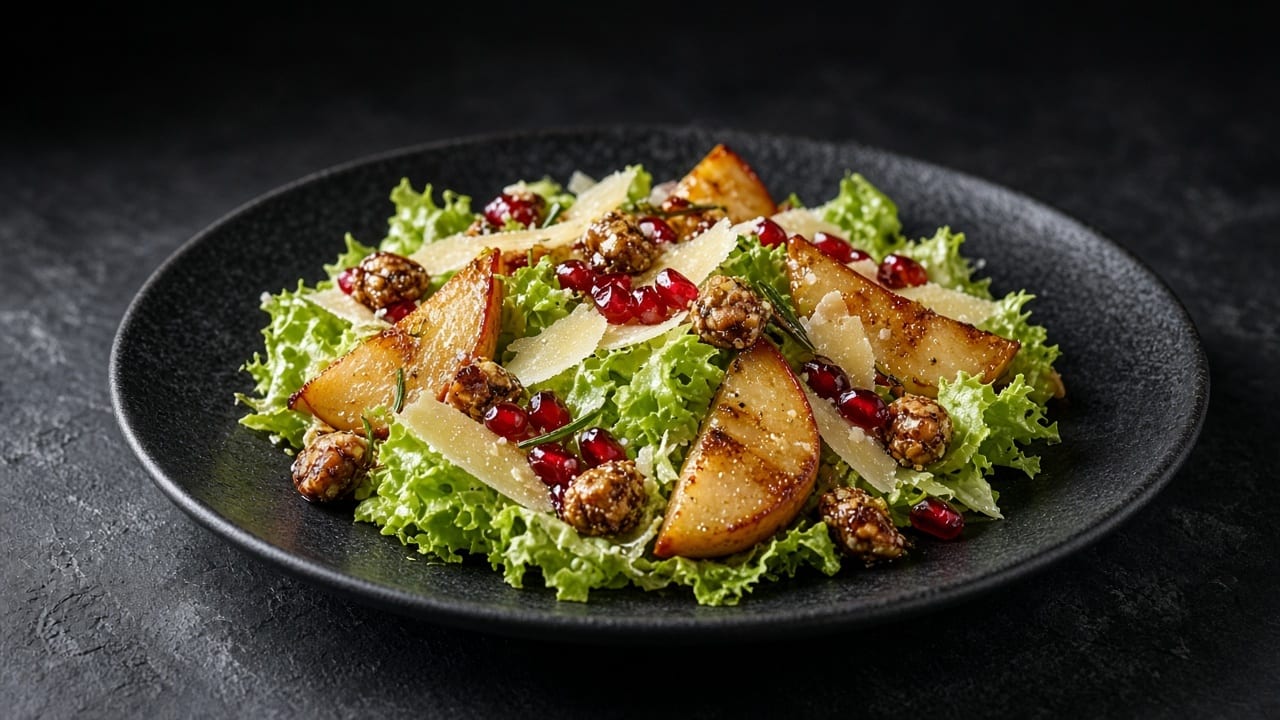

Pear Salad with Candied Hazelnuts and Pomegranate
Inspired by techniques from Serious Eats.
Seared pear quarters, bitter escarole and butterhead lettuce are tossed with a fig-and-balsamic dressing, then piled with pomegranate arils, shaved aged Gouda and sticky rosemary-candied hazelnuts. The mix of browned fruit, crunchy nuts, juicy arils and salty cheese gives every forkful a different texture.
Always check the labels of the products you use.
Method
- 1
Candy the hazelnuts. Toast the hazelnuts in a 20 cm frying pan over medium heat, stirring occasionally, until lightly toasted and fragrant, about 3 min. Add the brown sugar, water, rosemary, cayenne pepper (if using) and salt; stir until melted and combined, about 20 sec. Cook until the mixture reduces slightly and the hazelnuts look sticky, about 2 min more. Spread onto a plate or baking tray lined with baking paper in a single layer and let cool completely, about 10 min. Keep in a sealed container until needed.
- 2
Make the dressing. In a small bowl, whisk together the balsamic vinegar, fig jam, Dijon, salt and pepper. Slowly drizzle in the olive oil while whisking constantly, until emulsified.
- 3
Sear the pears. Heat the neutral oil in a large frying pan over medium-high heat until shimmering. Add the pear quarters cut side down and cook until browned on all cut sides, 2-3 min per side. Transfer to a chopping board and let cool slightly, about 3 min.
- 4
Assemble. While the pears cool, toss the escarole and butterhead lettuce with the dressing in a large bowl. Top with the pomegranate seeds, shaved Gouda and candied hazelnuts. Thinly slice the pears and arrange them over the top. Serve right away.
Storage
Best served right away, as the pears and dressed leaves soften on standing. The candied hazelnuts can be made ahead and kept in a sealed container at room temperature, and the dressing keeps covered in the fridge for a few days.
EU nutrition claims
- Source of fibre: 1.7 g fibre per 100 kcal (needs ≥ 1.5 g)
Per 100 g of the finished dish, worked out from the nutrition per serving and the lowest likely cooked weight (about 195 g a serving), so the true values are, if anything, lower. Thresholds from the Annex to EU Regulation (EC) No 1924/2006. How we decide
Free sugars
11.3 g per serving
22.6 % of the 50 g daily maximum · 45.2 % of the ideal 25 g
Free sugars under 50 g a day, ideally about 25 g, based on WHO free-sugar guidance (not endorsed by WHO). The share shown is the share of one serving. WHO
Equipment
- 20 cm frying pan
- plate or baking tray lined with baking paper
- small bowl and whisk
- large frying pan
- chopping board
- large salad bowl
- cheese shaver or vegetable peeler
- chef's knife
Nutrition per serving (estimated values)
| Per serving | Amount |
|---|---|
| Energy | 427 kcal |
| Protein | 8 g |
| Carbohydrate | 36 g |
| of which sugars | 24.9 g |
| of which free sugars | 11.3 g |
| Fat | 29.7 g |
| of which saturates | 5.4 g |
| Fibre | 7.1 g |
| Salt | 1.02 g |
Protein per 100 kcal
1.9 g High Protein needs ≥ 5 g (20% of energy)
Calculated from USDA FoodData Central ingredient values