 Velvet
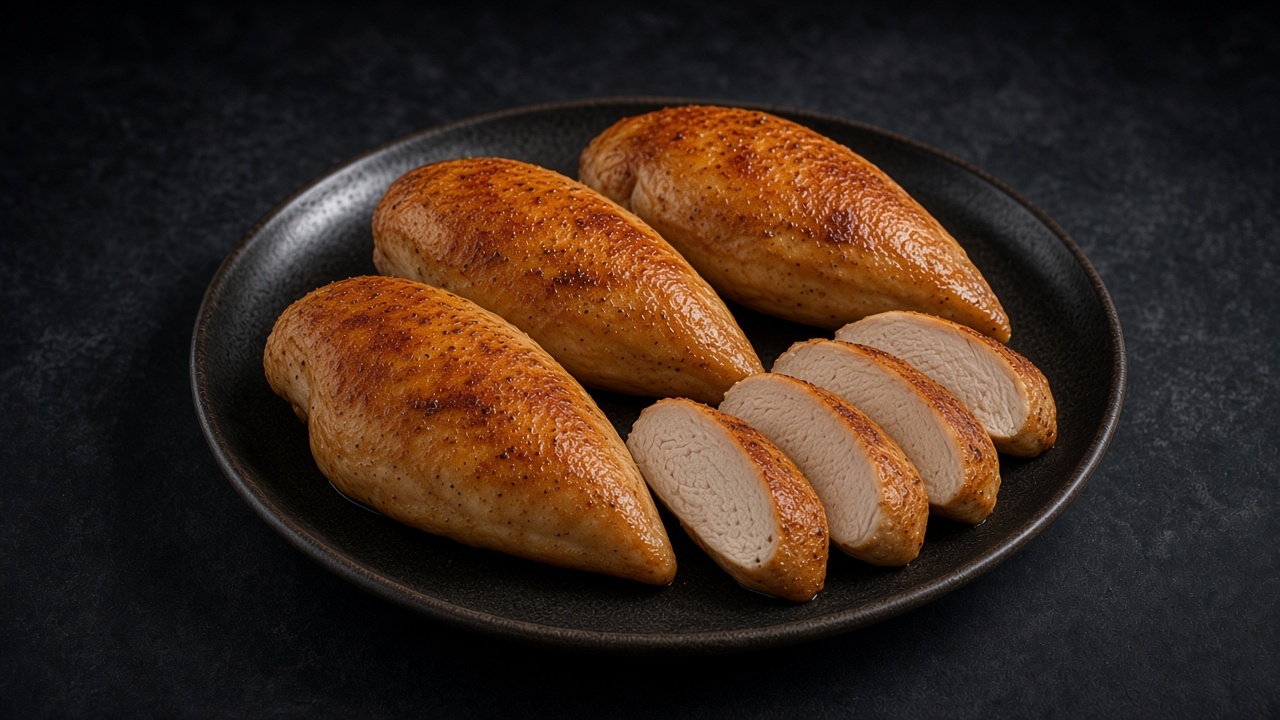
Juicy Pan-Seared Chicken Breasts
Inspired by techniques from America's Test Kitchen.
Boneless chicken breasts cooked gently in a low oven first, then seared hard for a deep golden crust. A thin coat of butter, flour and cornflour browns fast, so the outside crisps before the inside can dry out.
Always check the labels of the products you use.
Method
- 1
Salt the chicken. Heat the oven to 135 °C (115 °C fan) with a shelf in the middle. Pat the breasts dry and prick the thick part of each one 5-6 times with a fork, then sprinkle all over with the salt. The holes help the salt get inside, so the meat is seasoned through and holds on to its juices.
- 2
Cook gently in the oven. Lay the breasts smooth side up in the baking dish, cover tightly with foil and bake 30-40 min, until the thickest part reads 63-66 °C. The chicken is not cooked yet: the low oven warms it evenly so the searing can be short.
- 3
Coat. Mix the melted butter, flour, cornflour and pepper in the small bowl. Lift the breasts out of the dish, pat them dry and brush the coating over the top side.
- 4
Sear. Heat the oil in the frying pan over medium-high heat until just smoking. Add the breasts coated side down, brush the coating over the second side, and cook 3-4 min without moving until well browned. Turn and cook 3-4 min more, until the second side is golden and the thickest part reads 74 °C.
- 5
Rest and serve. Rest the chicken on a board for 5 min so the juices settle back into the meat, then slice and serve.
Storage
Refrigerate covered up to 3 days. Eat cold in salads and sandwiches, or reheat covered in a low oven until piping hot (74 °C). Cool leftovers in a shallow container and refrigerate within 2 hours (within 1 hour on a day above 32°C).
Why it's healthy
45.3 g protein for 317 kcal = 14.3 g per 100 kcal, so protein gives about 57% of the energy. High Protein needs at least 20% (5 g per 100 kcal), the EU condition. How we decide
EU nutrition claims
- Sugar-free: 0 g sugars per 100 g (limit ≤ 0.5 g)
Per 100 g of the finished dish, worked out from the nutrition per serving and the lowest likely cooked weight (about 150 g a serving), so the true values are, if anything, lower. Thresholds from the Annex to EU Regulation (EC) No 1924/2006. How we decide
Free sugars
Free sugars: 0 g per serving
0 % of the 50 g daily maximum · 0 % of the ideal 25 g
Free sugars under 50 g a day, ideally about 25 g (WHO). The share shown is the share of one serving. who.int/publications/i/item/9789241549028
Equipment
- baking dish
- foil
- 30 cm frying pan
- small bowl
- fork
- pastry brush
- tongs
- instant-read thermometer
- chopping board
- sharp knife
Nutrition per serving (estimated values)
| Per serving | Amount |
|---|---|
| Energy | 317 kcal |
| Protein | 45.3 g |
| Carbohydrate | 2.4 g |
| of which sugars | 0 g |
| of which free sugars | 0 g |
| Fat | 12.7 g |
| of which saturates | 4.8 g |
| Fibre | 0.1 g |
| Salt | 1.68 g |
Protein per 100 kcal
14.3 g meets High Protein (≥ 5 g, 20% of energy)
Calculated from USDA FoodData Central ingredient values