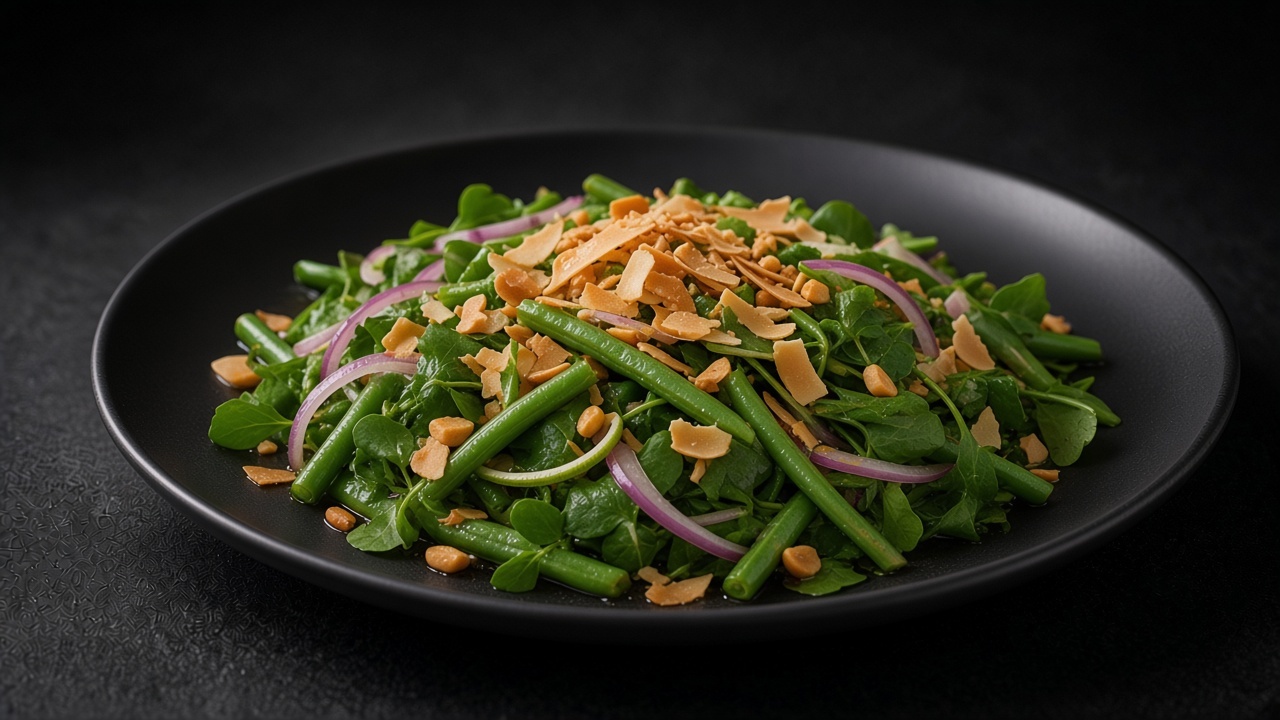

Long Bean and Watercress Salad
Inspired by techniques from Bon Appétit.
Blanched long beans and quickly wilted watercress are tossed with a salty-sweet-sour fish sauce and lime dressing, then finished with toasted coconut and chopped peanuts. The two short dips in boiling water keep the vegetables bright and crisp-tender while the dressing and crunchy toppings do all the flavour work.
Always check the labels of the products you use.
Method
- 1
Toast the coconut. Heat the oven to 180°C (160°C fan). Spread the coconut flakes on a rimmed baking tray and toast, tossing once, until golden brown, about 5 minutes. Set aside to cool.
- 2
Wilt the watercress. Bring a large saucepan of generously salted water to a boil. Drop in the watercress and cook just until wilted, about 10 seconds, then lift it out with a slotted spoon into a colander set in a bowl of ice water. Drain, then gently squeeze out the excess water.
- 3
Blanch the beans. Return the water in the saucepan to a boil. Add the long beans and cook until crisp-tender, about 4 minutes, then transfer to the ice water. Drain and pat dry with kitchen paper.
- 4
Make the dressing. In a large bowl, whisk together the fish sauce, lime juice and sugar until the sugar dissolves.
- 5
Toss and serve. Add the watercress, beans, onion and lime leaves to the dressing and toss to coat. Scatter the toasted coconut and chopped peanuts over the top and serve right away.
Storage
Best tossed and eaten right away, while the coconut and peanuts are still crunchy. Refrigerate any leftovers in an airtight container for up to 2 days; the toppings will soften. Cool leftovers in a shallow container and refrigerate within 2 hours (within 1 hour on a day above 32°C).
EU nutrition claims
- Source of protein: 3.7 g protein per 100 kcal, about 15% of energy (needs ≥ 12%)
- High fibre: 3.1 g fibre per 100 kcal (needs ≥ 3 g)
Per 100 g of the finished dish, worked out from the nutrition per serving and the lowest likely cooked weight (about 85 g a serving), so the true values are, if anything, lower. Thresholds from the Annex to EU Regulation (EC) No 1924/2006. How we decide
Free sugars
3.3 g per serving
6.6 % of the 50 g daily maximum · 13.2 % of the ideal 25 g
Free sugars under 50 g a day, ideally about 25 g, based on WHO free-sugar guidance (not endorsed by WHO). The share shown is the share of one serving. WHO
Equipment
- rimmed baking tray
- large saucepan
- slotted spoon
- colander
- large bowl for ice water
- kitchen paper
- whisk
- large mixing bowl
- chef's knife
- chopping board
Nutrition per serving (estimated values)
| Per serving | Amount |
|---|---|
| Energy | 152 kcal |
| Protein | 5.6 g |
| Carbohydrate | 15.2 g |
| of which sugars | 7.8 g |
| of which free sugars | 3.3 g |
| Fat | 9.4 g |
| of which saturates | 5 g |
| Fibre | 4.7 g |
| Salt | 1.54 g |
Protein per 100 kcal
3.7 g High Protein needs ≥ 5 g (20% of energy)
Calculated from USDA FoodData Central ingredient values