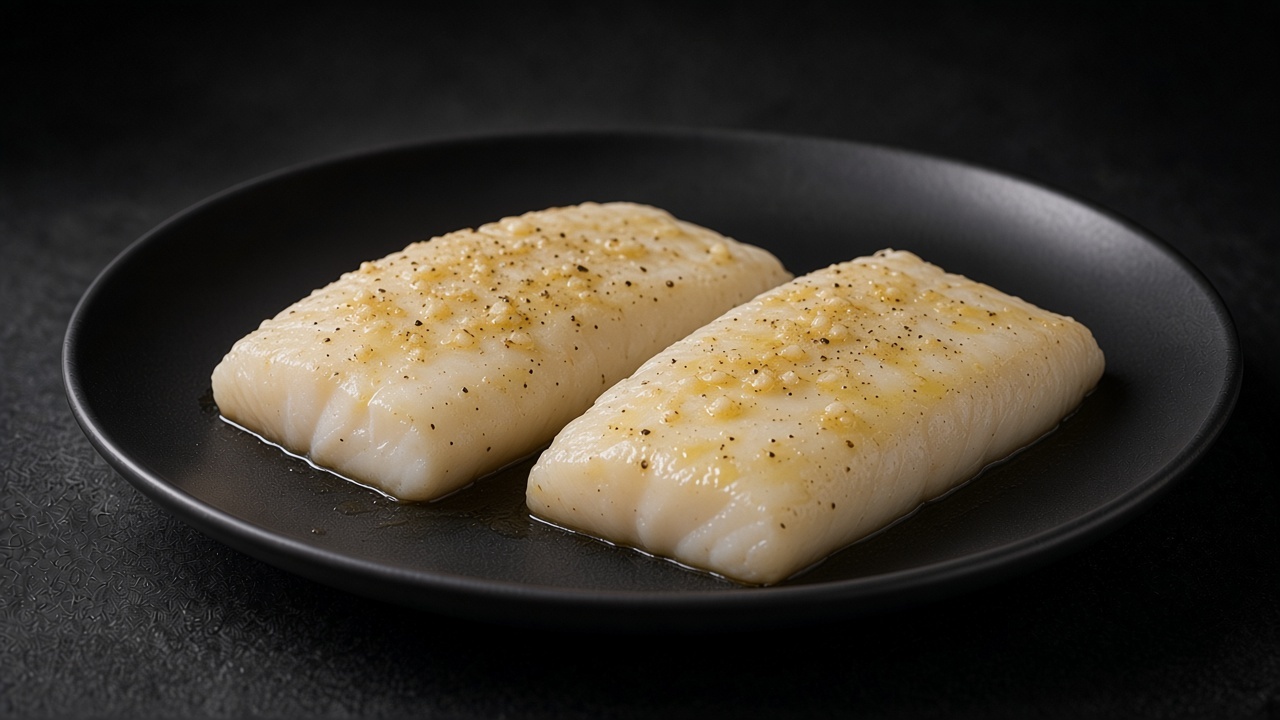

Lemon-Marinated Halibut
Inspired by techniques from Serious Eats.
Halibut fillets marinate briefly in lemon juice, olive oil and garlic before a quick roast in a hot oven, which keeps the lean, delicate flesh moist while the fillets pick up a bright citrus edge. It's a short, hands-off way to turn two fillets into dinner in under an hour.
Always check the labels of the products you use.
Method
- 1
Marinate the fish. Put the halibut, garlic, lemon juice, olive oil, salt and pepper in a large resealable bag. Move the fish around to coat it evenly. Refrigerate for 30 minutes. Preheat the oven to 200 °C (180 °C fan) while the fish marinates.
- 2
Roast. Take the fish out of the bag, shaking off most but not all of the marinade, and place it in a glass baking dish. Roast until the flesh is opaque and flakes easily, around 18 minutes.
Storage
Best eaten freshly roasted. Cool leftovers in a shallow container and refrigerate within 2 hours (within 1 hour on a day above 32°C), and eat within 2 days, reheated gently or cold.
Why this label?
42 g protein for 341 kcal = 12.3 g per 100 kcal, so protein gives about 49% of the energy. High Protein needs at least 20% (5 g per 100 kcal), the condition in the Annex to EU Regulation (EC) No 1924/2006. How we decide
EU nutrition claims
- Low saturated fat: 1.2 g saturated fat per 100 g, 7.1% of energy (limits ≤ 1.5 g and ≤ 10%)
- Sugar-free: 0.2 g sugars per 100 g (limit ≤ 0.5 g)
Per 100 g of the finished dish, worked out from the nutrition per serving and the lowest likely cooked weight (about 226 g a serving), so the true values are, if anything, lower. Thresholds from the Annex to EU Regulation (EC) No 1924/2006. How we decide
Free sugars
0.4 g per serving
0.8 % of the 50 g daily maximum · 1.6 % of the ideal 25 g
Free sugars under 50 g a day, ideally about 25 g, based on WHO free-sugar guidance (not endorsed by WHO). The share shown is the share of one serving. WHO
Equipment
- resealable plastic bag
- chef's knife
- citrus juicer
- measuring spoons
- glass baking dish
Nutrition per serving (estimated values)
| Per serving | Amount |
|---|---|
| Energy | 341 kcal |
| Protein | 42 g |
| Carbohydrate | 2.2 g |
| of which sugars | 0.4 g |
| of which free sugars | 0.4 g |
| Fat | 17.6 g |
| of which saturates | 2.7 g |
| Fibre | 0.1 g |
| Salt | 1.11 g |
Protein per 100 kcal
12.3 g meets High Protein (≥ 5 g, 20% of energy)
Calculated from USDA FoodData Central ingredient values