 Velvet
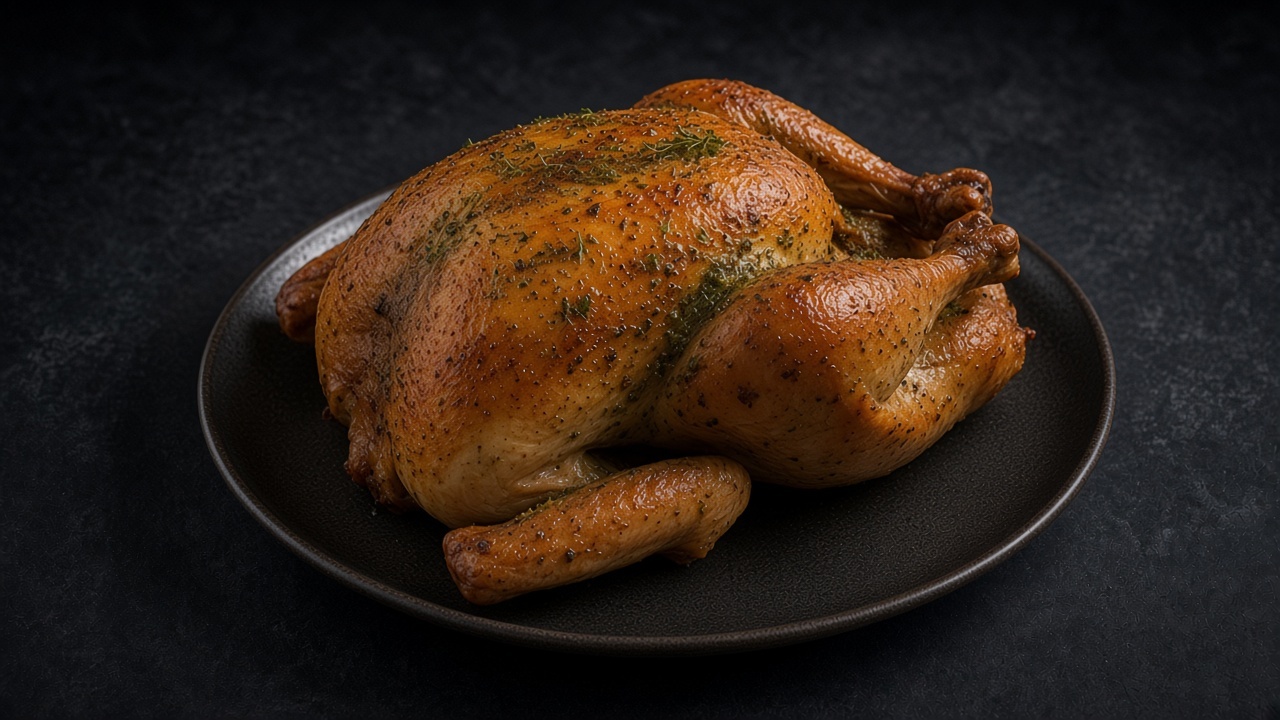
Herbed Roast Turkey
Inspired by techniques from America's Test Kitchen.
A whole turkey brined for juiciness, then seasoned with a bright paste of parsley, thyme, sage, rosemary, shallot, garlic and lemon zest spread under the skin, inside deep pockets in the breast and all over the outside. Roasted breast side down first, then turned, so the breast stays moist while the skin browns.
Always check the labels of the products you use.
Method
- 1
Brine the turkey. Dissolve the salt in the cold water in the stockpot or bucket. Add the turkey and refrigerate for 4-6 hours, no longer.
- 2
Dry the turkey. Lift the turkey out, rinse it inside and out under cool running water and pat it dry with paper towels. Set it breast side up on the wire rack over the baking tray and refrigerate, uncovered, for 30 min so the skin dries.
- 3
Make the herb paste. Put the parsley, thyme, sage, rosemary, shallot, garlic, lemon zest, salt and pepper in the food processor and pulse about ten times, 2 s each, to a coarse paste. Add the mustard and oil and pulse 10-12 times more until smooth, scraping down the sides after 5 pulses. Scrape into the small bowl.
- 4
Prepare the oven and rack. Move an oven shelf to the lowest position and heat the oven to 200 °C (180 °C fan). Line the V-rack with heavy-duty foil, poke 20-30 holes in the foil with the paring knife and set the rack in the roasting tin. Wipe any water off the tray, sit the turkey breast side up on it, tuck the wings behind the back and tuck the drumstick tips into the skin at the tail.
- 5
Season under the skin. With your hands, gently loosen the skin over the breasts, thighs and drumsticks. Spoon 1½ tbsp of the paste under the breast skin on each side, then push it with your fingers over the breast, thigh and drumstick meat.
- 6
Season the breast pockets. Cut a 4 cm vertical slit into the thickest part of each breast. From the top of the slit, swing the knife tip down inside the meat to make a 10-13 cm pocket. Put 1 tbsp paste in each pocket and rub it into a thin, even layer.
- 7
Coat the outside. Rub 1 tbsp paste inside the cavity. Turn the turkey breast side down and spread half the remaining paste over the skin, then turn it breast side up and spread on the rest, pressing so it sticks; pick up any that falls onto the tray and press it back on.
- 8
Roast breast side down. Set the turkey breast side down on the V-rack and roast for 45 min.
- 9
Turn and finish roasting. Take the tin out and close the oven door. Using clean oven gloves or a thick wad of paper towels, turn the turkey breast side up. Roast for 50-60 min more, until the thickest part of the breast reads 74 °C and the thickest part of the thigh 77-79 °C; check both sides of the bird.
- 10
Rest and carve. Move the turkey to the carving board and rest for 30 min, then carve and serve.
Storage
Refrigerate carved leftover turkey covered within 2 hours of cooking for up to 3 days, or freeze for up to 3 months. Reheat until piping hot (74 °C). Cool leftovers in a shallow container and refrigerate within 2 hours (within 1 hour on a day above 32°C).
Why it's healthy
57.5 g protein for 424 kcal = 13.6 g per 100 kcal, so protein gives about 54% of the energy. High Protein needs at least 20% (5 g per 100 kcal), the EU condition. How we decide
EU nutrition claims
- Sugar-free: 0.1 g sugars per 100 g (limit ≤ 0.5 g)
Per 100 g of the finished dish, worked out from the nutrition per serving and the lowest likely cooked weight (about 281 g a serving), so the true values are, if anything, lower. Thresholds from the Annex to EU Regulation (EC) No 1924/2006. How we decide
Free sugars
Free sugars: 0 g per serving
0 % of the 50 g daily maximum · 0 % of the ideal 25 g
Free sugars under 50 g a day, ideally about 25 g (WHO). The share shown is the share of one serving. who.int/publications/i/item/9789241549028
Equipment
- large stockpot or clean bucket (at least 12 litres)
- paper towels
- wire rack
- rimmed baking tray
- fine grater
- food processor
- rubber spatula
- small bowl
- large roasting tin
- large V-shaped roasting rack
- heavy-duty foil
- sharp paring knife
- spoon
- clean oven gloves or a wad of paper towels
- instant-read thermometer
- carving board
- carving knife
Nutrition per serving (estimated values)
| Per serving | Amount |
|---|---|
| Energy | 424 kcal |
| Protein | 57.5 g |
| Carbohydrate | 1.4 g |
| of which sugars | 0.3 g |
| of which free sugars | 0 g |
| Fat | 19.4 g |
| of which saturates | 5 g |
| Fibre | 0.5 g |
| Salt | 2.11 g |
Protein per 100 kcal
13.6 g meets High Protein (≥ 5 g, 20% of energy)
Calculated from USDA FoodData Central ingredient values