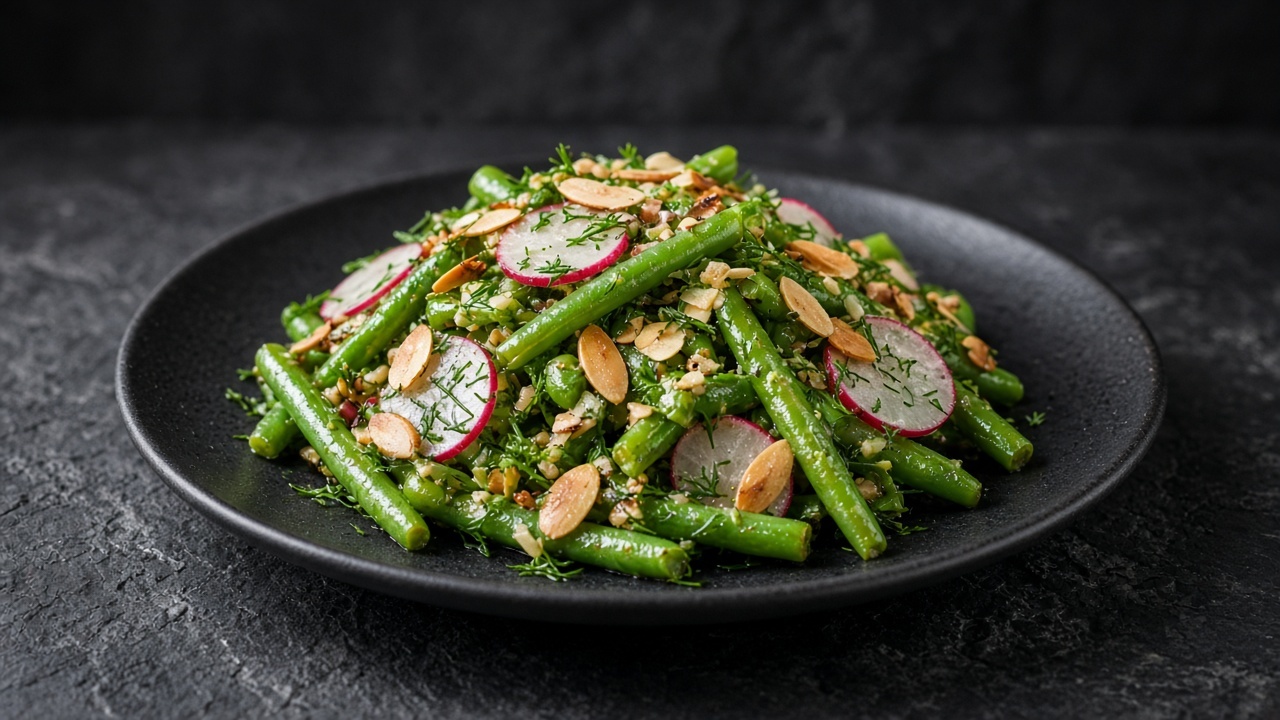

Green Bean Salad with Radish and Dill
Inspired by techniques from America's Test Kitchen.
Crisp-tender green beans are shocked in ice water to lock in their colour and crunch, then tossed with a mustard-shallot vinaigrette, sliced radishes and dill. Toasted almonds go in last so the salad keeps a bit of crunch next to the tender beans.
Always check the labels of the products you use.
Method
- 1
Blanch the beans. Bring a large saucepan of water to the boil and fill a large bowl halfway with ice and water. Add the green beans and the blanching salt to the boiling water and cook until crisp-tender, about 6 min. Drain and plunge into the ice bath to stop the cooking.
- 2
Dry the beans. Drain the cooled beans again, transfer to a salad spinner, and spin dry (or pat dry with a clean tea towel).
- 3
Make the vinaigrette. Whisk the shallot, mustard, lemon zest and juice, garlic, and the 3/4 tsp salt together in a large bowl. Slowly whisk in the olive oil until it's fully incorporated.
- 4
Dress and rest. Add the radishes, dill and green beans to the vinaigrette and toss to coat. Let the salad sit for 30 min, up to 2 hours, stirring occasionally.
- 5
Finish. Stir the toasted almonds into the salad. Season with more salt and pepper to taste and serve.
Storage
The blanched, dried green beans can be refrigerated for up to 2 days before dressing. Once dressed, the salad is best eaten the same day. Cool leftovers in a shallow container and refrigerate within 2 hours (within 1 hour on a day above 32°C).
EU nutrition claims
- Low saturated fat: 0.9 g saturated fat per 100 g, 7.7% of energy (limits ≤ 1.5 g and ≤ 10%)
- Low sugars: 3.7 g sugars per 100 g (limit ≤ 5 g)
- High fibre: 3.2 g fibre per 100 kcal (needs ≥ 3 g)
Per 100 g of the finished dish, worked out from the nutrition per serving and the lowest likely cooked weight (about 136 g a serving), so the true values are, if anything, lower. Thresholds from the Annex to EU Regulation (EC) No 1924/2006. How we decide
Free sugars
0.1 g per serving
0.2 % of the 50 g daily maximum · 0.4 % of the ideal 25 g
Free sugars under 50 g a day, ideally about 25 g, based on WHO free-sugar guidance (not endorsed by WHO). The share shown is the share of one serving. WHO
Equipment
- large saucepan
- large bowl for ice water
- salad spinner or clean tea towels
- whisk
- large mixing bowl
- chef's knife
- chopping board
- fine grater
Nutrition per serving (estimated values)
| Per serving | Amount |
|---|---|
| Energy | 140 kcal |
| Protein | 3.7 g |
| Carbohydrate | 11.7 g |
| of which sugars | 5 g |
| of which free sugars | 0.1 g |
| Fat | 10 g |
| of which saturates | 1.2 g |
| Fibre | 4.5 g |
| Salt | 0.82 g |
Protein per 100 kcal
2.6 g High Protein needs ≥ 5 g (20% of energy)
Calculated from USDA FoodData Central ingredient values