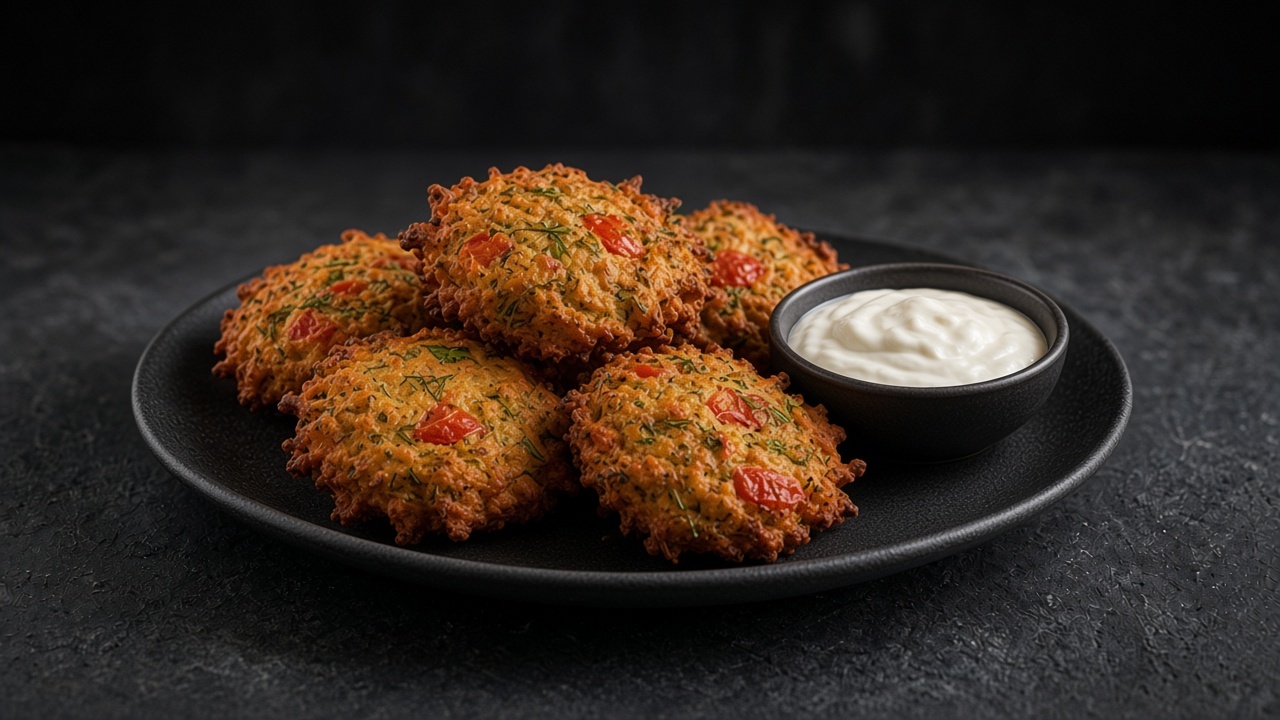

Greek Tomato Fritters with Feta and Herbs
Inspired by techniques from Serious Eats.
Santorini-style tomato fritters made with grated and diced tomato, onion, sheep's milk feta, parsley, dill and dried herbs, bound with a little flour and egg. They are fried until deep golden and crisp, and served hot with thick yoghurt for dipping.
Always check the labels of the products you use.
Method
- 1
Prepare the tomatoes. Roughly chop 225 g (about 2) of the tomatoes and pulse briefly in a blender or food processor until just combined, or grate them on the large holes of a box grater over a bowl, cut side against the blades. Finely chop any skin left over and add to a large bowl. Dice the remaining tomato into 5 mm pieces and add to the bowl; you should have about 360 ml.
- 2
Make the batter. Add the onion, feta, parsley, dill, thyme, oregano, egg, salt and pepper and stir. Break the feta into blueberry-sized pieces with the back of a spoon. Add the flour 30 g at a time until the batter is loose but not runny: it should sit on a spoon and barely hold its shape, like a loose tuna mayonnaise.
- 3
Heat the oil. Line a rimmed baking tray with a double layer of kitchen paper. Pour the oil into a 25 cm cast-iron frying pan or deep casserole (it should be 2.5-4 cm deep) and heat over medium-high heat to 175 °C on a thermometer, then turn the heat to medium.
- 4
Fry. Using a 60 ml scoop, gently drop 5 portions of batter into the oil, spaced apart. After 10 sec, nudge each one underneath with a fork so it doesn't stick. Fry for 3-5 min per side, keeping the oil between 150 and 175 °C, until deep golden outside and yellow-orange inside.
- 5
Drain and repeat. Lift onto the lined tray with a slotted spoon, letting the oil drip back, sprinkle lightly with salt and leave for at least 2 min. Bring the oil back to 175 °C and fry the rest in batches of 5. Serve straight away, with yoghurt for dipping if you like.
Storage
Best eaten hot. Refrigerate leftovers for up to 2 days and reheat in a hot oven until piping hot. Cool leftovers in a shallow container and refrigerate within 2 hours (within 1 hour on a day above 32°C).
EU nutrition claims
- Source of protein: 3.1 g protein per 100 kcal, about 12% of energy (needs ≥ 12%)
- Low sugars: 2.8 g sugars per 100 g (limit ≤ 5 g)
Per 100 g of the finished dish, worked out from the nutrition per serving and the lowest likely cooked weight (about 87 g a serving), so the true values are, if anything, lower. Thresholds from the Annex to EU Regulation (EC) No 1924/2006. How we decide
Free sugars
0 g per serving
0 % of the 50 g daily maximum · 0 % of the ideal 25 g
Free sugars under 50 g a day, ideally about 25 g, based on WHO free-sugar guidance (not endorsed by WHO). The share shown is the share of one serving. WHO
Equipment
- box grater or food processor
- large bowl
- chopping board
- sharp knife
- large spoon
- 25 cm cast-iron frying pan or deep casserole
- deep-fry or instant-read thermometer
- 60 ml measuring scoop
- fork
- slotted spoon
- rimmed baking tray
- kitchen paper
Nutrition per serving Calculated from USDA FoodData Central
| Per serving | Amount |
|---|---|
| Energy | 206 kcal |
| Protein | 6.3 g |
| Carbohydrate | 17.4 g |
| of which sugars | 2.4 g |
| of which free sugars | 0 g |
| Fat | 12.7 g |
| of which saturates | 3.5 g |
| Fibre | 1.8 g |
| Salt | 1.13 g |
Protein per 100 kcal
3.1 g High Protein needs ≥ 5 g (20% of energy)
Calculated from USDA FoodData Central ingredient values