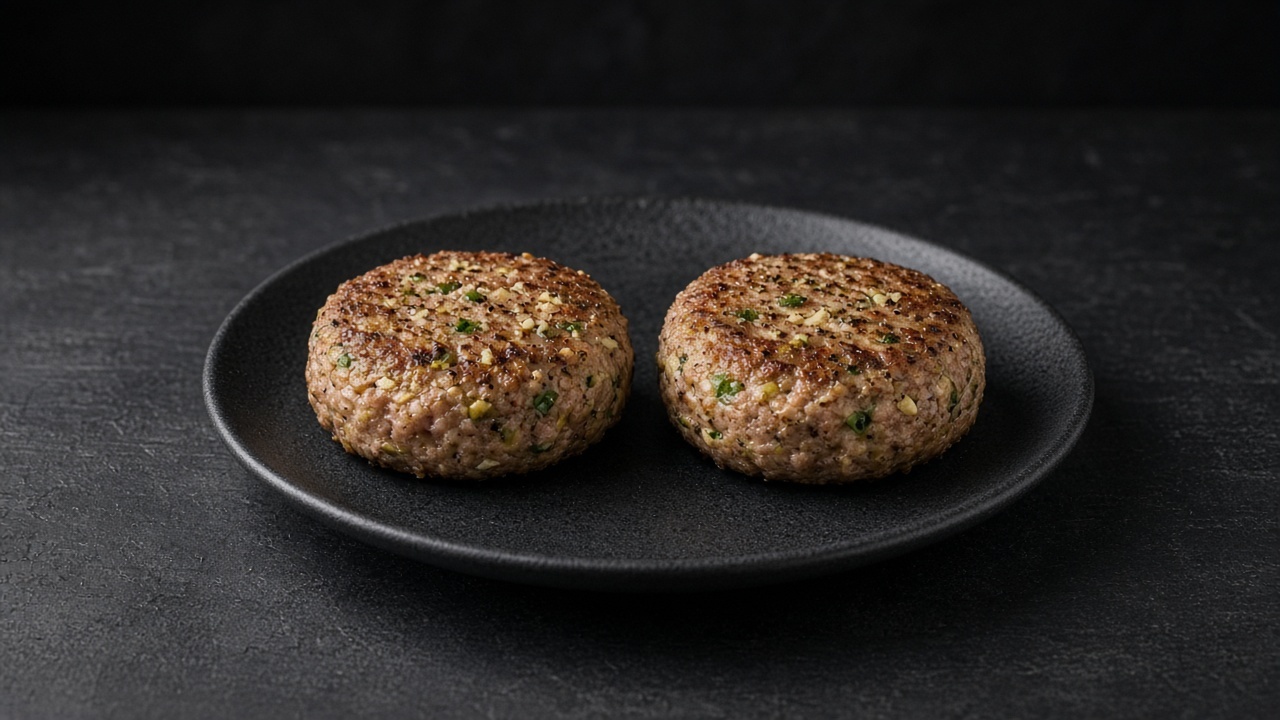

Ginger Spring Onion Tuna Burgers
Inspired by techniques from Bon Appétit.
Fresh tuna is chilled hard and ground coarse at home, so the patties stay tender and meaty rather than dense like a shop-bought fish burger. Spring onions, ginger, garlic and a touch of sesame oil season the fish itself, with just enough mayonnaise to bind it.
Always check the labels of the products you use.
Method
- 1
Chill the fish and the grinder. Spread the tuna cubes in a single layer on a rimmed baking tray, cover with cling film and freeze until very cold - firm, but still giving slightly when pressed with a finger - about 15 min. Meanwhile, chill the grinder attachment (dies included) or the food processor bowl and blade in the freezer for at least 15 min. Nest a bowl in a larger bowl of ice beneath where the ground fish will come out, to keep it cold as you work.
- 2
Grind the fish. Combine the tuna, spring onions, ginger and garlic in a large bowl. Grind the mixture in batches through the chilled coarse die with the mixer on medium speed, gently pressing it through (or pulse to the same coarse texture in the chilled food processor).
- 3
Season the mixture. Add the mayonnaise, grapeseed or rapeseed oil and sesame oil to the ground tuna. Mix gently, just until combined.
- 4
Form and cook the patties. Shape the mixture into four patties about 1.3 cm thick. Season both sides with the salt and pepper. Barbecue or pan-fry over medium heat until just cooked through, 3-4 min per side.
Storage
Refrigerate cooked patties in an airtight container for up to 2 days and reheat gently in a frying pan. Cool leftovers in a shallow container and refrigerate within 2 hours (within 1 hour on a day above 32°C).
Why this label?
34.9 g protein for 259 kcal = 13.5 g per 100 kcal, so protein gives about 54% of the energy. High Protein needs at least 20% (5 g per 100 kcal), the condition in the Annex to EU Regulation (EC) No 1924/2006. How we decide
EU nutrition claims
- Low saturated fat: 1.1 g saturated fat per 100 g, 5.6% of energy (limits ≤ 1.5 g and ≤ 10%)
- Sugar-free: 0.1 g sugars per 100 g (limit ≤ 0.5 g)
Per 100 g of the finished dish, worked out from the nutrition per serving and the lowest likely cooked weight (about 141 g a serving), so the true values are, if anything, lower. Thresholds from the Annex to EU Regulation (EC) No 1924/2006. How we decide
Free sugars
0 g per serving
0 % of the 50 g daily maximum · 0 % of the ideal 25 g
Free sugars under 50 g a day, ideally about 25 g, based on WHO free-sugar guidance (not endorsed by WHO). The share shown is the share of one serving. WHO
Equipment
- rimmed baking tray
- cling film
- stand mixer with grinding attachment or food processor
- large bowl
- bowl set in a larger bowl of ice
- barbecue or large frying pan
- thermometer
Nutrition per serving (estimated values)
| Per serving | Amount |
|---|---|
| Energy | 259 kcal |
| Protein | 34.9 g |
| Carbohydrate | 1.5 g |
| of which sugars | 0.2 g |
| of which free sugars | 0 g |
| Fat | 11.7 g |
| of which saturates | 1.6 g |
| Fibre | 0.3 g |
| Salt | 1 g |
Protein per 100 kcal
13.5 g meets High Protein (≥ 5 g, 20% of energy)
Calculated from USDA FoodData Central ingredient values