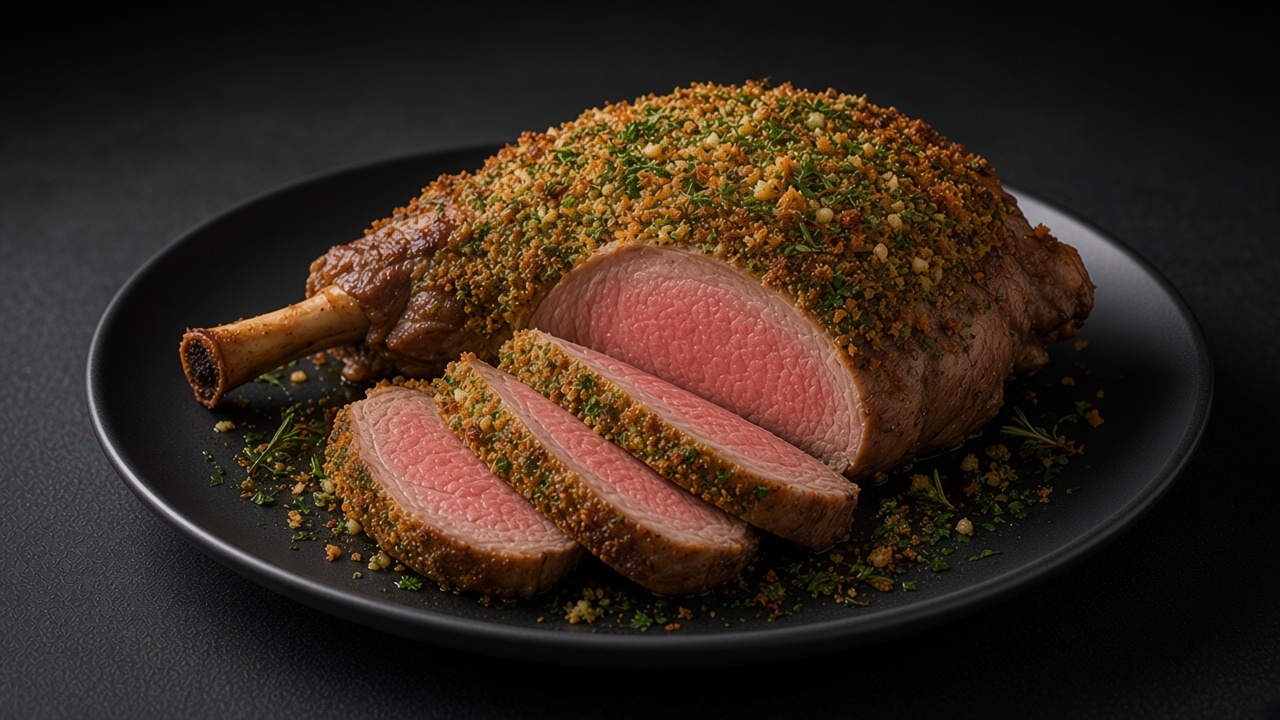

Roast Leg of Lamb with Garlic-Herb Crust
Inspired by techniques from America's Test Kitchen.
A whole leg of lamb is studded with garlic and rosemary, roasted hot for colour, then finished low under a thick layer of garlicky parsley-and-bread-crumb paste brushed on with mustard. The crust toasts into a crisp, savoury shell while the meat underneath stays rosy.
Always check the labels of the products you use.
Method
- 1
Season and start the roast. Set an oven rack in the lower-middle position and heat the oven to 230 °C (210 °C fan). Using a paring knife, cut 2.5 cm-deep slits all over the lamb and tuck a garlic sliver and a few rosemary leaves into each one. Rub the lamb all over with the olive oil and season with the salt and pepper.
- 2
First roast. Set the lamb meaty side down on a wire rack over a rimmed baking tray. Roast for 15 minutes, then flip and roast for 15 minutes more.
- 3
Make the crust. Meanwhile, pulse the bread, minced garlic, oil and parsley in a food processor until coarsely ground. Stir in the minced rosemary.
- 4
Crust and finish roasting. Lower the oven to 165 °C (150 °C fan). Take the lamb out and brush the meaty side with the mustard. Press as much of the bread-crumb mixture as will stick into the mustard in an even layer - you'll likely have some left over. Return to the oven and continue roasting until an instant-read thermometer reads 54-57 °C for medium, 30-45 minutes more.
- 5
Rest and carve. Transfer the lamb to a chopping board, tent loosely with foil and let it rest for 15-20 minutes. Slice and serve.
Storage
Refrigerate leftover lamb within 2 hours and eat within 3-4 days, or freeze for up to 3 months. The crumb crust softens on reheating, so leftover slices are good served cold or warmed gently. Cool leftovers in a shallow container and refrigerate within 2 hours (within 1 hour on a day above 32°C).
Why this label?
64.2 g protein for 944 kcal = 6.8 g per 100 kcal, so protein gives about 27% of the energy. High Protein needs at least 20% (5 g per 100 kcal), the condition in the Annex to EU Regulation (EC) No 1924/2006. How we decide
EU nutrition claims
- Low sugars: 0.6 g sugars per 100 g (limit ≤ 5 g)
Per 100 g of the finished dish, worked out from the nutrition per serving and the lowest likely cooked weight (about 238 g a serving), so the true values are, if anything, lower. Thresholds from the Annex to EU Regulation (EC) No 1924/2006. How we decide
Free sugars
0 g per serving
0 % of the 50 g daily maximum · 0 % of the ideal 25 g
Free sugars under 50 g a day, ideally about 25 g, based on WHO free-sugar guidance (not endorsed by WHO). The share shown is the share of one serving. WHO
Equipment
- paring knife
- food processor
- basting brush
- wire rack
- rimmed baking tray
- instant-read thermometer
- chopping board
- aluminium foil
Nutrition per serving (estimated values)
| Per serving | Amount |
|---|---|
| Energy | 944 kcal |
| Protein | 64.2 g |
| Carbohydrate | 13.4 g |
| of which sugars | 1.4 g |
| of which free sugars | 0 g |
| Fat | 68.9 g |
| of which saturates | 26.9 g |
| Fibre | 2.9 g |
| Salt | 2 g |
Protein per 100 kcal
6.8 g meets High Protein (≥ 5 g, 20% of energy)
Calculated from USDA FoodData Central ingredient values