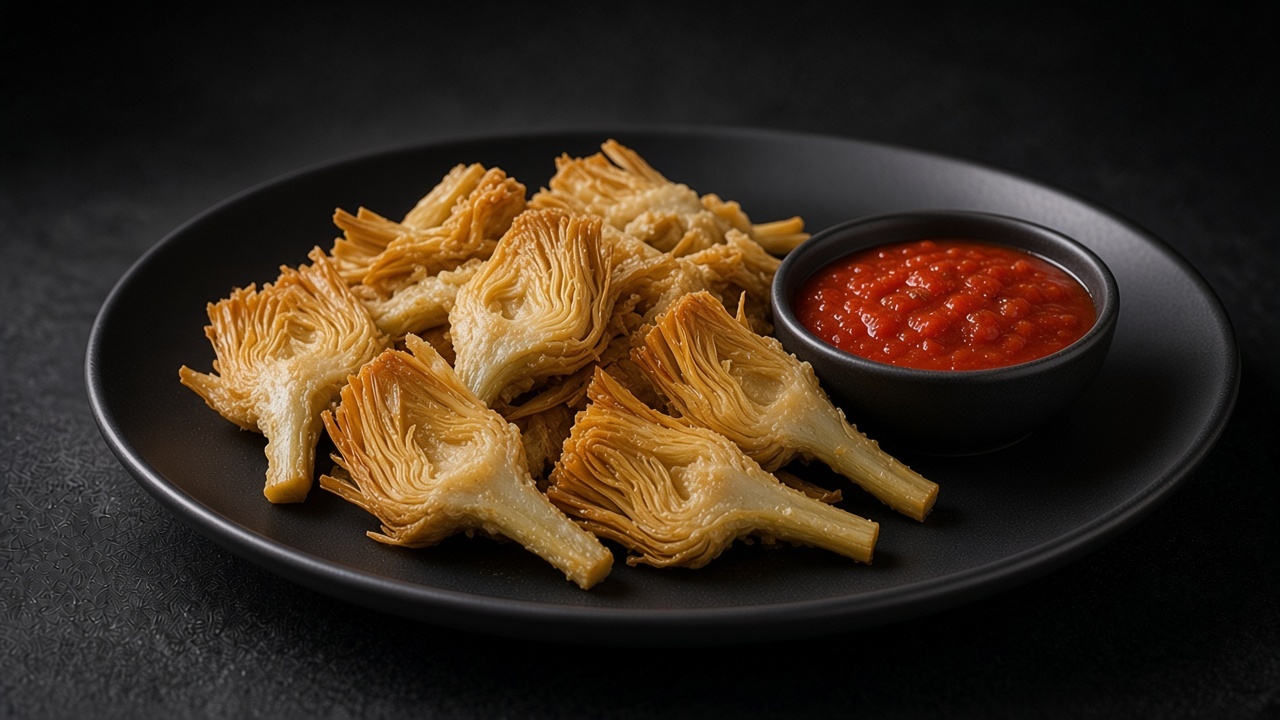

Fried Artichokes with Marinara
Inspired by techniques from America's Test Kitchen.
Frozen artichoke hearts get tossed in a seasoned flour-and-cornflour coating and fried until deeply golden and crisp, then served with a quick garlicky marinara for dipping. The light coating stays crackly rather than doughy, so the artichoke's tender, slightly tangy centre still comes through.
Always check the labels of the products you use.
Method
- 1
Simmer the marinara. Warm the oil and garlic in a small saucepan over medium heat, stirring often, until fragrant but not browned, about 2 min. Stir in the tomatoes and salt and simmer until slightly thickened, about 5 min. Stir in the Parmesan and sugar, then cover and set aside off the heat to stay warm.
- 2
Coat the artichokes. Whisk the flour, cornflour, granulated garlic, salt, baking powder and pepper together in a large bowl. Add the artichoke hearts and toss with your hands until evenly coated.
- 3
Heat the oil. Set a wire rack over a rimmed baking tray and line it with a triple layer of kitchen paper. Heat the oil in a Dutch oven over medium-high heat to 190 °C.
- 4
Fry in two batches. Shake the excess coating off half the artichokes and lower them carefully into the hot oil. Stir right away with a spider skimmer or slotted spoon to break up any clumps. Fry until golden brown, 5-7 min, adjusting the burner as needed to hold the oil around 177 °C.
- 5
Finish and serve. Lift the fried artichokes onto the prepared rack. Bring the oil back up to 190 °C and fry the second batch the same way. Serve immediately with the warm marinara for dipping.
Storage
The fried artichokes are crisp only straight from the fryer and are best eaten immediately; a few minutes in a hot oven can refresh leftovers but won't fully restore the crunch. The marinara keeps separately in an airtight container in the fridge for up to 4 days. Cool leftovers in a shallow container and refrigerate within 2 hours (within 1 hour on a day above 32°C).
EU nutrition claims
- Low saturated fat: 1.3 g saturated fat per 100 g, 7.4% of energy (limits ≤ 1.5 g and ≤ 10%)
- Low sugars: 1.9 g sugars per 100 g (limit ≤ 5 g)
- Source of fibre: 2.4 g fibre per 100 kcal (needs ≥ 1.5 g)
Per 100 g of the finished dish, worked out from the nutrition per serving and the lowest likely cooked weight (about 242 g a serving), so the true values are, if anything, lower. Thresholds from the Annex to EU Regulation (EC) No 1924/2006. How we decide
Free sugars
0.1 g per serving
0.2 % of the 50 g daily maximum · 0.4 % of the ideal 25 g
Free sugars under 50 g a day, ideally about 25 g, based on WHO free-sugar guidance (not endorsed by WHO). The share shown is the share of one serving. WHO
Equipment
- small saucepan
- large mixing bowl
- whisk
- wire rack
- rimmed baking tray
- kitchen paper
- Dutch oven
- deep-fry thermometer
- spider skimmer or slotted spoon
Nutrition per serving (estimated values)
| Per serving | Amount |
|---|---|
| Energy | 390 kcal |
| Protein | 10 g |
| Carbohydrate | 39.5 g |
| of which sugars | 4.7 g |
| of which free sugars | 0.1 g |
| Fat | 23.7 g |
| of which saturates | 3.2 g |
| Fibre | 9.2 g |
| Salt | 2.6 g |
Protein per 100 kcal
2.6 g High Protein needs ≥ 5 g (20% of energy)
Calculated from USDA FoodData Central ingredient values