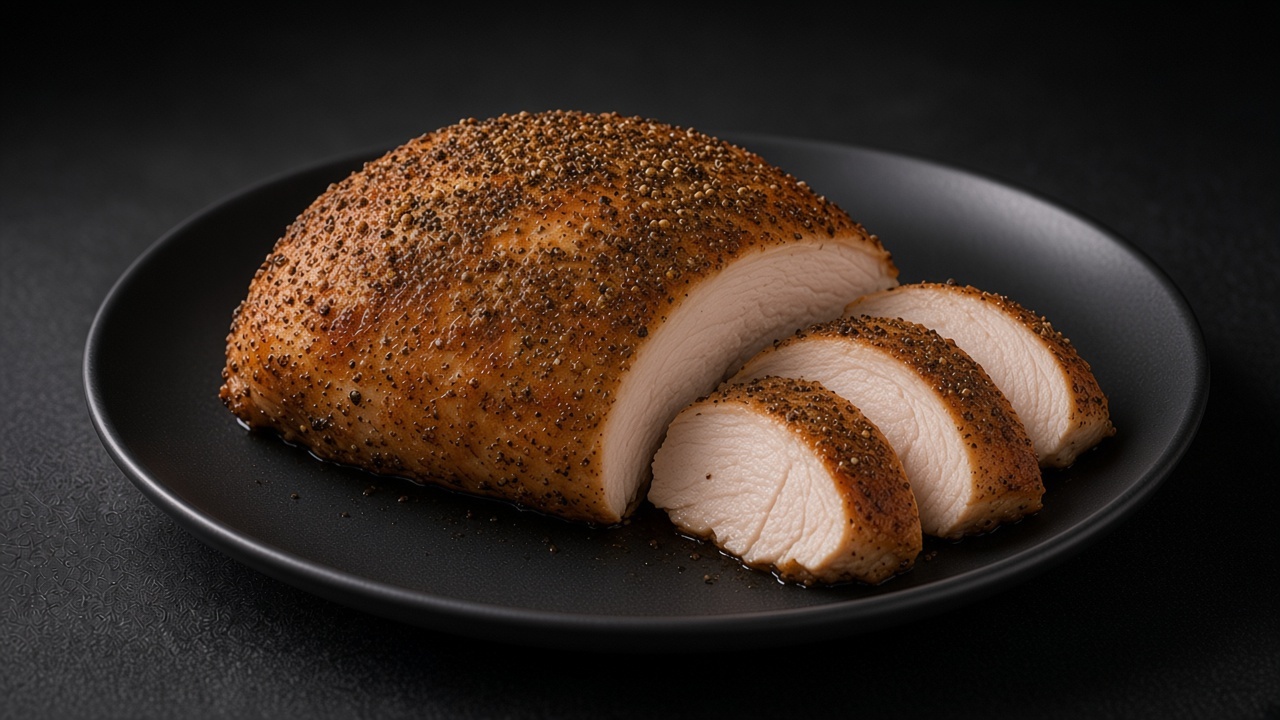

Dry-Rubbed Turkey Breast
Inspired by techniques from Bon Appétit.
A whole bone-in turkey breast is dry-brined under a coarse mix of toasted-smelling coriander, fennel and pepper, then roasted hot to brown the skin before finishing low and slow. A long, loose rest lets gentle carryover heat take the meat the rest of the way through.
Based on the listed ingredients, none of the 14 major EU allergens. Always check product labels.
Method
- 1
Grind the spices. Coarsely grind the coriander seeds, fennel seeds and peppercorns in a spice mill or with a mortar and pestle (or chop them fine with a chef's knife).
- 2
Mix the dry brine. In a bowl, rub the salt and brown sugar together with your fingers until combined, then stir in the ground spices.
- 3
Brine the turkey. Set the turkey breast on a wire rack over a rimmed baking tray. Sprinkle the dry brine all over both sides, patting it on to help it stick - you won't need all of it, and some will fall onto the tray. Chill uncovered for at least 12 hours and up to 2 days.
- 4
Temper at room temperature. Lift the turkey off the rack and rinse the tray and rack if any liquid has collected. Line the tray with 3 layers of foil and set the rack back in with the turkey on top. Let it sit at room temperature for up to 2 hours.
- 5
Start hot. Set an oven rack in the middle and heat the oven to 230 °C (210 °C fan). Pour the water into the tray. Roast, rotating the tray halfway through, until the skin is mostly golden brown all over, about 30 minutes.
- 6
Finish low and slow. Lower the oven to 150 °C (130 °C fan) and keep roasting, topping up the tray with a little more water as needed so it doesn't run dry, until an instant-read thermometer in the thickest part of the breast (not touching bone) reads 66 °C - the temperature will keep climbing as the turkey rests - about 50 to 70 minutes longer. The skin should be deep golden brown and crisp.
- 7
Rest and carve. Transfer the turkey to a chopping board and let it rest for at least 30 minutes and up to 1 hour before slicing. Check the thickest part again with the thermometer before serving.
Storage
Carve off what you need and let the rest cool before wrapping. Refrigerate leftover turkey within 2 hours and eat within 3-4 days, or freeze for up to 2 months. Cool leftovers in a shallow container and refrigerate within 2 hours (within 1 hour on a day above 32°C).
Why this label?
55.9 g protein for 405 kcal = 13.8 g per 100 kcal, so protein gives about 55% of the energy. High Protein needs at least 20% (5 g per 100 kcal), the condition in the Annex to EU Regulation (EC) No 1924/2006. How we decide
EU nutrition claims
- Sugar-free: 0.4 g sugars per 100 g (limit ≤ 0.5 g)
Per 100 g of the finished dish, worked out from the nutrition per serving and the lowest likely cooked weight (about 115 g a serving), so the true values are, if anything, lower. Thresholds from the Annex to EU Regulation (EC) No 1924/2006. How we decide
Free sugars
0.5 g per serving
1 % of the 50 g daily maximum · 2 % of the ideal 25 g
Free sugars under 50 g a day, ideally about 25 g, based on WHO free-sugar guidance (not endorsed by WHO). The share shown is the share of one serving. WHO
Equipment
- spice mill or mortar and pestle (or a chef's knife)
- medium bowl
- wire rack
- rimmed baking tray
- aluminium foil
- instant-read thermometer
- chopping board
Nutrition per serving (estimated values)
| Per serving | Amount |
|---|---|
| Energy | 405 kcal |
| Protein | 55.9 g |
| Carbohydrate | 1 g |
| of which sugars | 0.5 g |
| of which free sugars | 0.5 g |
| Fat | 18 g |
| of which saturates | 4.9 g |
| Fibre | 0.3 g |
| Salt | 2.8 g |
Protein per 100 kcal
13.8 g meets High Protein (≥ 5 g, 20% of energy)
Calculated from USDA FoodData Central ingredient values