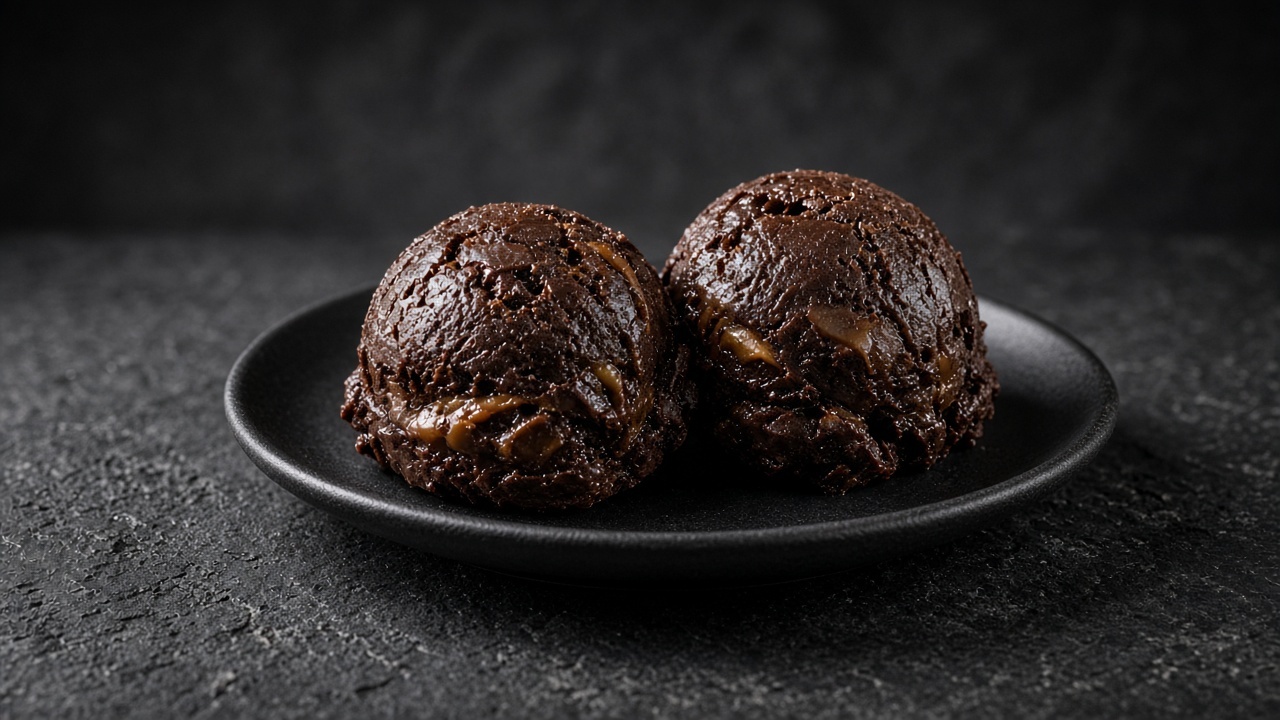

Dark Chocolate Caramel Custard Ice Cream
Inspired by techniques from Bon Appétit.
A rich egg-yolk custard loaded with melted dark chocolate and cocoa powder gets a swirl of dark caramel whisked in before churning, giving the finished ice cream extra depth and a faint bittersweet edge. Chilling the base for two days and freezing the churned ice cream for several more lets the flavour round out and the texture turn properly scoopable.
Always check the labels of the products you use.
Method
- 1
Melt the chocolate. Put the chopped chocolate in a medium heatproof bowl and set it over a saucepan of barely simmering water, without letting the bowl touch the water. Stir until melted and smooth, then set aside to cool slightly.
- 2
Heat the milk and cocoa. Whisk the milk and cocoa powder together in a medium heavy saucepan over medium heat until the mixture just begins to boil; set aside.
- 3
Make the custard base. Beat the egg yolks and 88 g of the sugar with an electric mixer until very thick ribbons form, about 2 minutes. Whisking constantly, gradually pour in the hot milk mixture, then return everything to the saucepan, add the melted chocolate and whisk to blend.
- 4
Cook the custard. Cook over low heat, stirring, until slightly thickened and an instant-read thermometer reads 79°C, about 5 minutes; don't let it go much above that or the egg yolks will scramble. Pour the custard into a large bowl set over a bowl of ice water and stir until cool.
- 5
Make the caramel. Bring the remaining 75 g sugar and the water to a boil in a small, deep heavy saucepan over medium-high heat, stirring until the sugar dissolves. Boil without stirring, occasionally swirling the pan and brushing down the sides with a wet pastry brush, until a dark amber caramel forms, about 5 minutes.
- 6
Finish the base. Off the heat, gradually whisk in the cream; it will bubble up vigorously. Whisk the caramel into the cooled chocolate custard, then strain into a container. Cover and chill for 2 days.
- 7
Churn and freeze. Churn the custard in an ice cream machine according to the manufacturer's instructions. Transfer to a container and freeze for at least 3 days before eating for the best texture.
Storage
Chill the strained custard for up to 2 days before churning, then keep the churned ice cream frozen in an airtight container; it's best after at least 3 days in the freezer to firm up, and can be made up to 3 days ahead. Cool leftovers in a shallow container and refrigerate within 2 hours (within 1 hour on a day above 32°C).
EU nutrition claims
- Low salt: 0.16 g salt per 100 g (limit ≤ 0.3 g)
Per 100 g of the finished dish, worked out from the nutrition per serving and the lowest likely cooked weight (about 62 g a serving), so the true values are, if anything, lower. Thresholds from the Annex to EU Regulation (EC) No 1924/2006. How we decide
Free sugars
20.3 g per serving
40.6 % of the 50 g daily maximum · 81.2 % of the ideal 25 g
Free sugars under 50 g a day, ideally about 25 g, based on WHO free-sugar guidance (not endorsed by WHO). The share shown is the share of one serving. WHO
Equipment
- medium heatproof bowl
- saucepan (for a double boiler)
- medium heavy saucepan
- electric mixer
- instant-read thermometer
- fine strainer
- large bowl and ice bath
- small, deep heavy saucepan
- pastry brush
- ice cream machine
- airtight container
Nutrition per serving (estimated values)
| Per serving | Amount |
|---|---|
| Energy | 342 kcal |
| Protein | 6.9 g |
| Carbohydrate | 37.3 g |
| of which sugars | 29.8 g |
| of which free sugars | 20.3 g |
| Fat | 19.3 g |
| of which saturates | 10.5 g |
| Fibre | 3.9 g |
| Salt | 0.1 g |
Protein per 100 kcal
2 g High Protein needs ≥ 5 g (20% of energy)
Calculated from USDA FoodData Central ingredient values