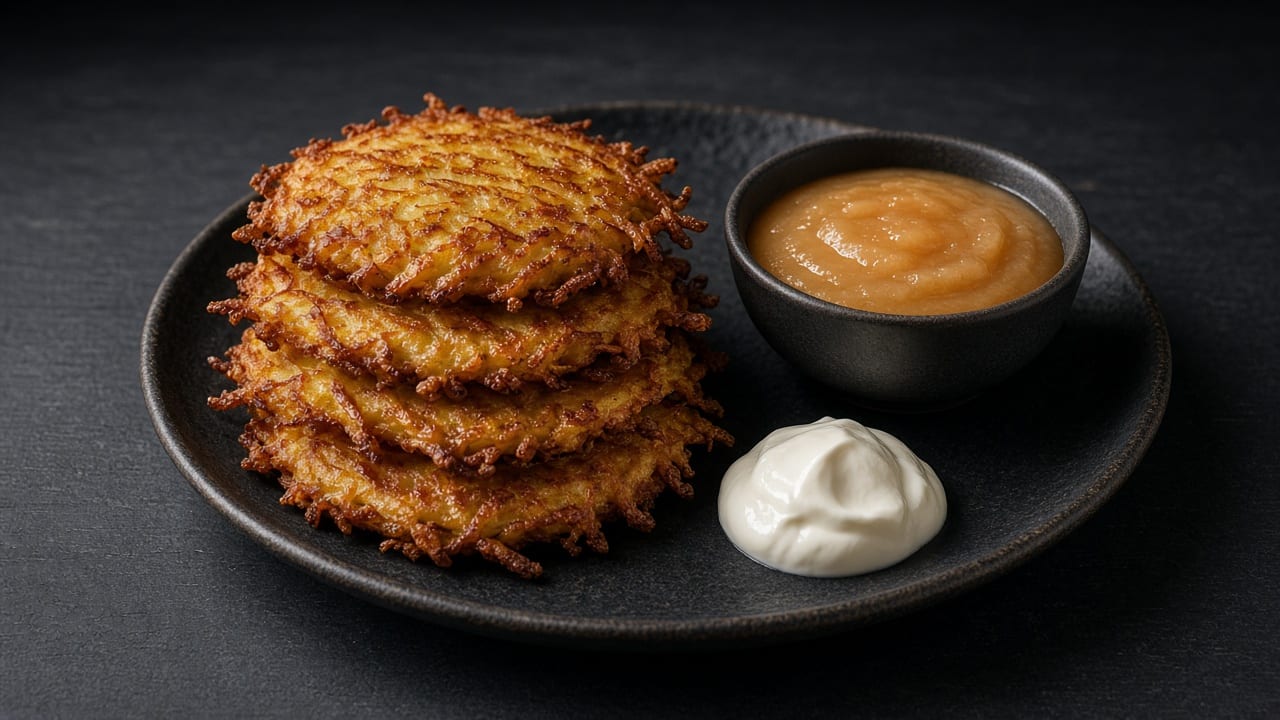
Crispy Potato Latkes
Inspired by techniques from NYT Cooking and America's Test Kitchen.
Coarsely grated potato and onion are wrung dry, bound with their own starch and egg, then fried in hot oil until deeply golden and crisp at the edges, served with apple sauce and soured cream.
Always check the labels of the products you use.
Method
- 1
Grate and salt. Coarsely grate the potatoes and onion, then toss them with the salt in a large bowl. Salting draws out moisture early, which makes the next step - wringing them dry - far more effective.
- 2
Wring out and save starch. Working in two batches, wring the grated mixture firmly in a clean tea towel over a jug to extract as much liquid as possible. Let the collected liquid stand for 5 minutes, then pour off the watery top layer and keep the thick white starch settled at the bottom. This starch acts as a natural binder, so the latkes hold together without needing much flour.
- 3
Mix the batter. Combine the wrung-out potato and onion with the reserved starch, beaten eggs, flour and pepper, stirring just until combined. The egg and starch together give enough structure to hold the shreds in a pancake shape once they hit the hot oil.
- 4
Heat the oil. Preheat the oven to 100°C to keep cooked batches warm, then heat about 5 mm of oil in a large frying pan to roughly 180°C - a dropped shred of potato should sizzle immediately. Getting the oil properly hot before the first batch goes in is what gives latkes their crisp, lacy edges rather than a soggy one.
- 5
Fry in batches. Drop in scant 4-tablespoon (60 ml) mounds of the mixture, flatten each to about 1 cm, and fry for 3-4 minutes a side until deep golden and lacy at the edges. Drain on a wire rack set in the warm oven while you fry the rest, topping up the oil as needed between batches.
- 6
Serve warm. Serve the latkes hot, with apple sauce and soured cream alongside for dipping. The cool, slightly sharp apple sauce balances the rich, crisp pancakes well.
Storage
Best eaten fresh, but leftovers keep in the fridge for up to 2 days or in the freezer for up to 1 month, laid flat between sheets of baking paper. Reheat in a hot oven or dry pan until piping hot (74°C) to restore some crispness; avoid the microwave, which leaves them soft. Cool leftovers in a shallow container and refrigerate within 2 hours (within 1 hour on a day above 32°C).
Equipment
- box grater or food processor with grating disc
- clean tea towel
- large bowl
- jug
- large heavy frying pan (30 cm)
- deep-frying or probe thermometer
- wire rack set over a baking tray
- thin metal spatula
Nutrition per serving (estimated values)
| Per serving | Amount |
|---|---|
| Energy | 441 kcal |
| Protein | 9.3 g |
| Carbohydrate | 50.3 g |
| of which sugars | 7.1 g |
| of which free sugars | 0 g |
| Fat | 23.5 g |
| of which saturates | 5 g |
| Fibre | 5.7 g |
| Salt | 1.24 g |
Protein per 100 kcal
2.1 g High Protein needs ≥ 10 g
Calculated from USDA FoodData Central ingredient values