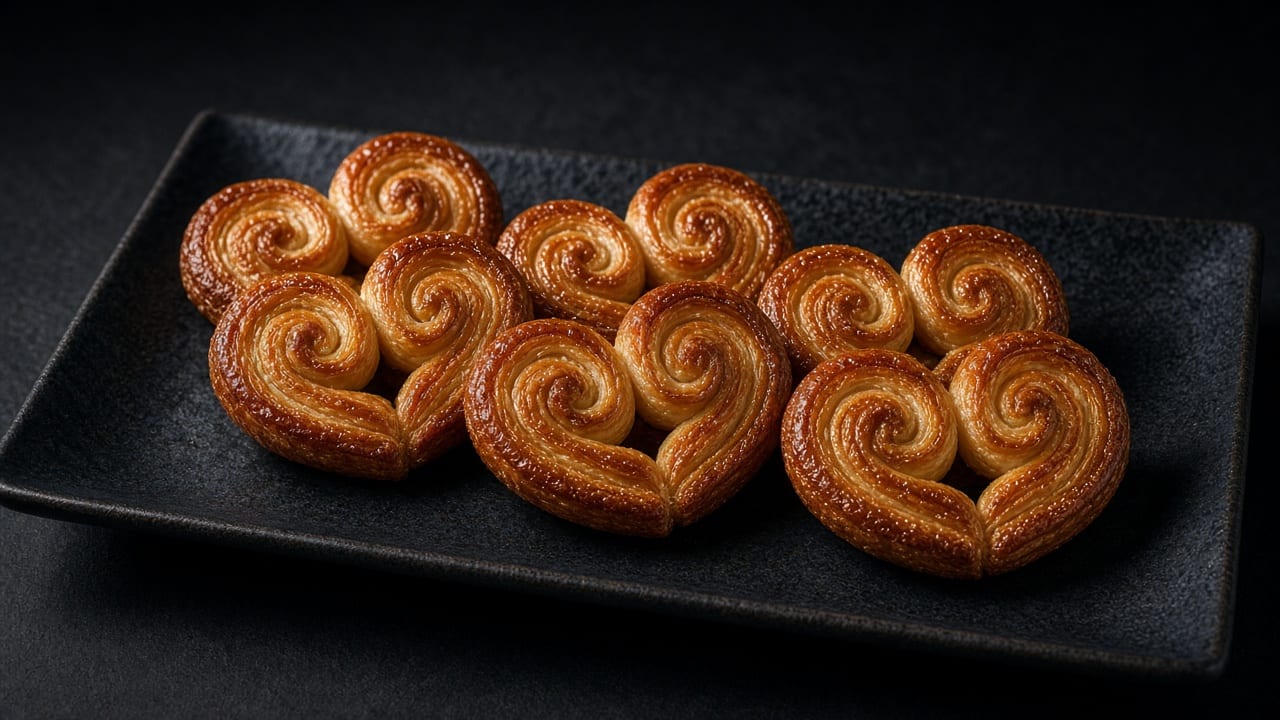
Crisp Caramelised Sugar Palmiers
Inspired by techniques from America's Test Kitchen and King Arthur Baking.
Shop-bought all-butter puff pastry rolled in sugar, folded into scrolls and baked until crisp, flaky and caramelised.
Always check the labels of the products you use.
Method
- 1
Sugar the pastry. Mix the sugar with the salt. Sprinkle 3 tbsp over the worktop, lay the pastry on top and sprinkle another 3 tbsp over it.
- 2
Roll. Roll the pastry to a rectangle about 28 x 35 cm and 2 mm thick, pressing the sugar into both sides and scattering more underneath if it starts to stick. Trim the ragged edges with the knife.
- 3
Fold. Fold each short end 2 cm toward the centre, scatter over a little sugar and keep folding until the two folds meet in the middle. Fold one half on top of the other to make a log, wrap it in cling film and chill for 30 min so it slices cleanly.
- 4
Heat the oven. Heat the oven to 190 °C (170 °C fan) with shelves in the upper and lower thirds, and line the trays with baking paper.
- 5
Slice. Cut the log into 20 slices 1 cm thick. Press each cut side into the sugar left in the bowl and space the slices 7 cm apart, as they spread.
- 6
Bake. Bake for 12-14 min, until the edges are light golden. Flip each palmier with the fish slice, swap the trays between shelves and turn them, then bake for 5-8 min more until deep golden and glazed. Watch closely, as the sugar can burn in under a minute.
- 7
Cool. Leave on the trays for 30 min; they crisp as they cool.
Storage
Keep in an airtight tin at room temperature for up to 3 days, or freeze the unsliced log for up to 1 month and bake from frozen, adding 2-3 min.
Equipment
- 2 baking trays
- baking paper
- rolling pin
- sharp knife
- cling film
- fish slice
- wire rack
- small bowl
Nutrition per serving (estimated values)
| Per serving | Amount |
|---|---|
| Energy | 227 kcal |
| Protein | 2.3 g |
| Carbohydrate | 27.4 g |
| of which sugars | 13.2 g |
| of which free sugars | 13.2 g |
| Fat | 12.2 g |
| of which saturates | 3.1 g |
| Fibre | 0.5 g |
| Salt | 0.24 g |
Protein per 100 kcal
1 g High Protein needs ≥ 10 g
Calculated from USDA FoodData Central ingredient values