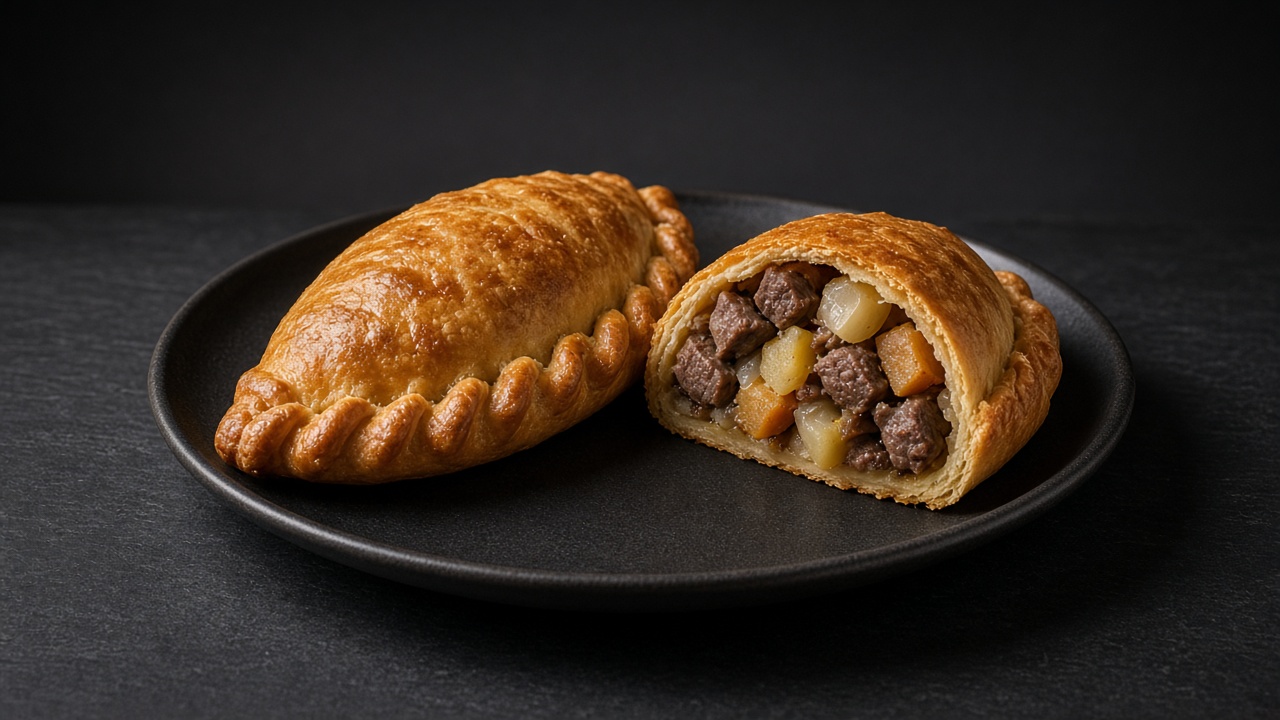
Cornish Pasty
Inspired by techniques from King Arthur Baking and America's Test Kitchen.
Golden, hand-crimped pasties of flaky all-butter pastry packed with tender beef, potato, swede and onion that bake into their own peppery gravy.
Always check the labels of the products you use.
Method
- 1
Make the pastry. Whisk the flour and salt together, then rub or pulse in the cold butter until only pea-size pieces remain. Beat the egg with the water, add it and mix just until the dough holds together, adding up to 15 ml more water if it looks dry. Knead very briefly, flatten into a disc, wrap and chill for 1 hour. The egg makes the pastry strong enough to hold a heavy filling, while the chilling relaxes the gluten so it rolls without shrinking.
- 2
Season the filling. In a bowl, toss the raw beef, potato, swede and onion with the thyme, flour, salt and pepper until every piece is coated. Nothing is cooked in advance. During the bake the flour combines with the juices the meat and vegetables release and turns them into a light gravy.
- 3
Roll and fill. Heat the oven to 200 °C (180 °C fan). Divide the pastry into 6 pieces of about 135 g and roll each one into a 20 cm round about 4 mm thick, using a plate as a guide. Pile about 190 g of filling onto one half of each round, keeping a clear border, then brush the edge with water.
- 4
Seal and crimp. Fold the bare half over the filling to make a half-moon and press the edges firmly together. Working along the curve, fold and twist the edge over itself to make a rope-like crimp. A tight crimp keeps the gravy in and gives the pasty its traditional look.
- 5
Glaze and chill. Set the pasties on the lined tray, cut a small steam hole in the top of each and brush them all over with the egg wash. Chill for 15 minutes. Cold pastry holds its shape better in the oven and comes out flakier.
- 6
Bake in two stages. Bake for 15 minutes at 200 °C (180 °C fan), then turn the oven down to 180 °C (160 °C fan) and bake 30-35 minutes more, until the pastry is a deep golden brown. Push a thermometer through the steam hole; the filling must read at least 71 °C, and a skewer should slide easily through the potato. The hot start sets and colours the crust, and the lower heat then gives the beef and swede time to cook through.
- 7
Rest and serve. Move the pasties to a wire rack and leave them for 10 minutes before eating. The gravy inside is extremely hot straight from the oven, and a short rest lets it thicken a little.
Storage
Keep cooled pasties covered in the fridge for up to 3 days and reheat at 180 °C (160 °C fan) for 20-25 minutes, until piping hot (74 °C). Unbaked pasties can be frozen on a tray and then bagged for up to 1 month; glaze and bake from frozen at 180 °C (160 °C fan) for about 60 minutes. Cool leftovers in a shallow container and refrigerate within 2 hours (within 1 hour on a day above 32°C).
Equipment
- large bowl or food processor
- cling film
- rolling pin
- 20 cm plate or cardboard template
- large baking tray lined with baking paper
- pastry brush
- instant-read thermometer
- wire rack
Nutrition per serving (estimated values)
| Per serving | Amount |
|---|---|
| Energy | 800 kcal |
| Protein | 28.9 g |
| Carbohydrate | 73.7 g |
| of which sugars | 3.3 g |
| of which free sugars | 0 g |
| Fat | 43.6 g |
| of which saturates | 24.1 g |
| Fibre | 4.5 g |
| Salt | 1.93 g |
Protein per 100 kcal
3.6 g High Protein needs ≥ 10 g
Calculated from USDA FoodData Central ingredient values