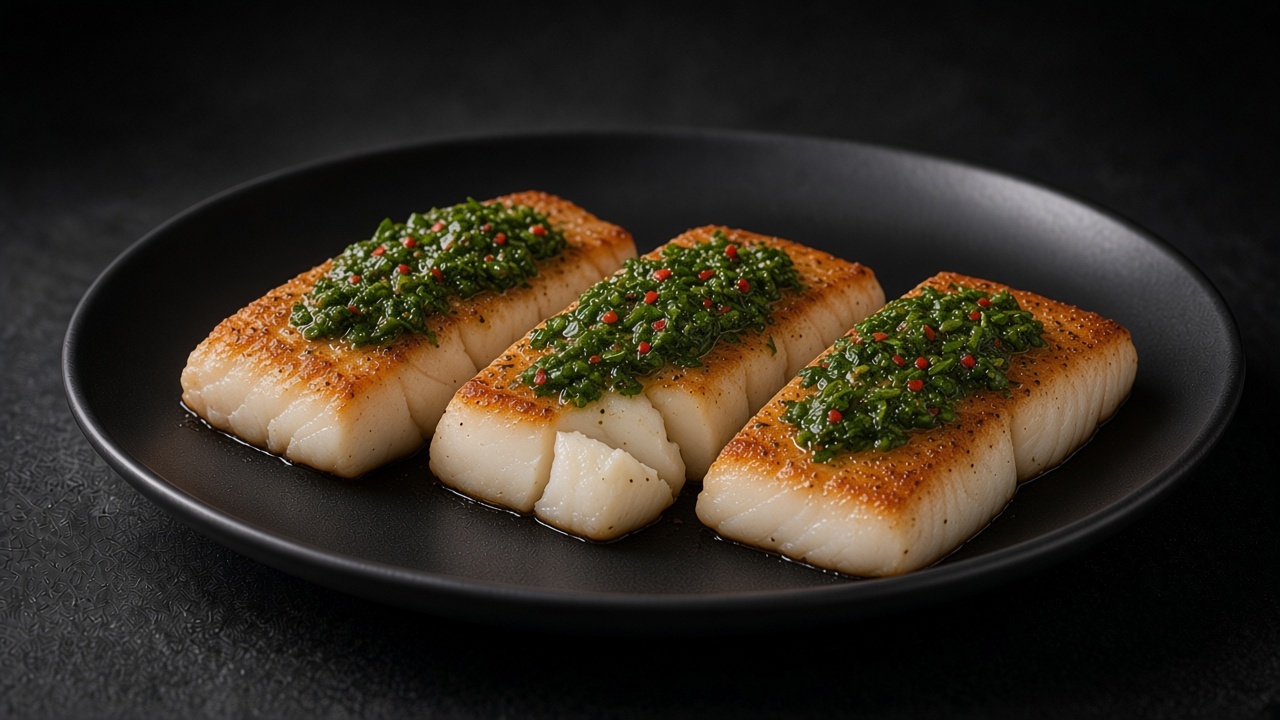

Pan-Roasted Cod with Coriander Chimichurri
Inspired by techniques from America's Test Kitchen.
Thick cod fillets are seared on the hob until browned, then finished in a hot oven and served with a bright, herby chimichurri built from parsley, coriander and garlic. Searing first and roasting second gives a crust on the fish without overcooking the delicate flesh inside.
Always check the labels of the products you use.
Method
- 1
Make the chimichurri. Combine the hot water, red wine vinegar and dried oregano in a bowl; let stand 5 minutes. Stir in the parsley, coriander, garlic, salt and red pepper flakes. Whisk in the olive oil until incorporated and set aside.
- 2
Season the cod. Adjust the oven rack to the middle position and heat the oven to 220 °C (200 °C fan). Pat the cod fillets dry with kitchen paper and sprinkle with the salt and pepper.
- 3
Sear one side. Heat the avocado oil in the ovenproof non-stick frying pan over medium-high heat until just smoking. Lay the fillets in the frying pan and press gently with a spatula for 20-30 seconds for even contact. Cook until browned on the first side, 1-2 minutes.
- 4
Flip and roast. Using two spatulas, flip the fillets, then transfer the frying pan to the oven. Roast until the fish flakes apart when gently prodded with a paring knife and registers 57 °C, 7-10 minutes. Transfer the cod to a platter and serve with the chimichurri.
Storage
Best eaten freshly roasted. Cool leftover cod in a shallow container and refrigerate within 2 hours (within 1 hour on a day above 32°C).
Why this label?
36.1 g protein for 326 kcal = 11.1 g per 100 kcal, so protein gives about 44% of the energy. High Protein needs at least 20% (5 g per 100 kcal), the condition in the Annex to EU Regulation (EC) No 1924/2006. How we decide
EU nutrition claims
- Low saturated fat: 1.3 g saturated fat per 100 g, 7.2% of energy (limits ≤ 1.5 g and ≤ 10%)
- Sugar-free: 0 g sugars per 100 g (limit ≤ 0.5 g)
Per 100 g of the finished dish, worked out from the nutrition per serving and the lowest likely cooked weight (about 201 g a serving), so the true values are, if anything, lower. Thresholds from the Annex to EU Regulation (EC) No 1924/2006. How we decide
Free sugars
0 g per serving
0 % of the 50 g daily maximum · 0 % of the ideal 25 g
Free sugars under 50 g a day, ideally about 25 g, based on WHO free-sugar guidance (not endorsed by WHO). The share shown is the share of one serving. WHO
Equipment
- mixing bowl
- whisk
- chef's knife
- 30 cm ovenproof non-stick frying pan
- two fish spatulas
- instant-read thermometer
- kitchen paper
Nutrition per serving (estimated values)
| Per serving | Amount |
|---|---|
| Energy | 326 kcal |
| Protein | 36.1 g |
| Carbohydrate | 1.7 g |
| of which sugars | 0.1 g |
| of which free sugars | 0 g |
| Fat | 18.7 g |
| of which saturates | 2.6 g |
| Fibre | 0.6 g |
| Salt | 1.74 g |
Protein per 100 kcal
11.1 g meets High Protein (≥ 5 g, 20% of energy)
Calculated from USDA FoodData Central ingredient values