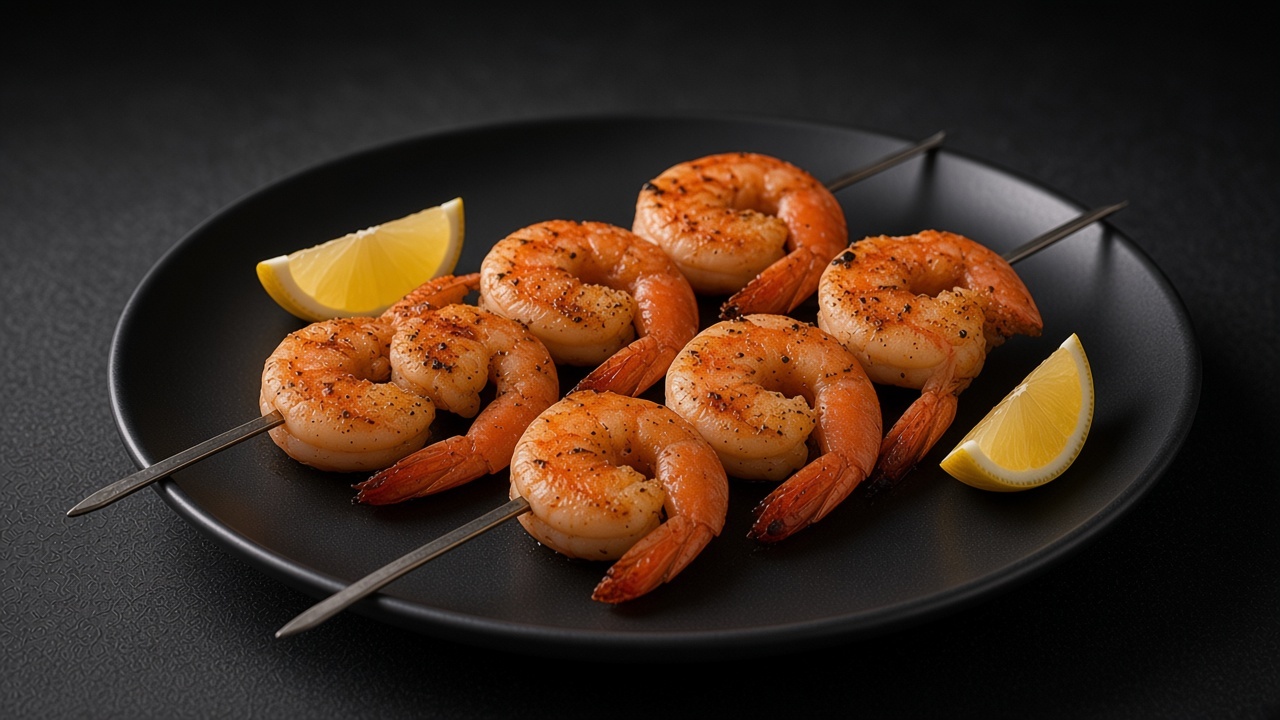

Grilled Prawns with Lemon
Inspired by techniques from America's Test Kitchen.
Large prawns are briefly brined in cold salted, sugared water, then grilled shell-on over a very hot gas fire until the shells char and the flesh turns bright pink. The short brine firms the flesh and seasons it through, so the prawns stay juicy even over blazing-hot direct heat.
Always check the labels of the products you use.
Method
- 1
Brine the prawns. Stir the very cold water with the fine salt and sugar in a large bowl until completely dissolved. Add the prawns, shell-on, and refrigerate for 30 minutes.
- 2
Shell and devein. Drain the prawns. Snip the shells open along the back with scissors and pull out the vein if you want to devein them, then toss the prawns with the olive oil in a bowl to coat.
- 3
Heat the grill. Turn all the burners on a gas barbecue to high, close the lid and let it heat until very hot, about 15 minutes. Scrape the grate clean with a wire brush and leave the burners on high.
- 4
Skewer the prawns. Thread the prawns onto pairs of parallel skewers so each batch lies flat and turns together as one piece.
- 5
Grill and serve. Grill the prawns covered, turning the skewers once, until the shells are barely charred and the flesh is bright pink and opaque throughout, 4-6 minutes. Serve hot or at room temperature with the lemon wedges.
Storage
Best served hot off the grill, or within about an hour at room temperature. Refrigerate leftovers covered for up to 2 days and eat cold or reheat gently. Cool leftovers in a shallow container and refrigerate within 2 hours (within 1 hour on a day above 32°C).
Why this label?
20.2 g protein for 138 kcal = 14.6 g per 100 kcal, so protein gives about 59% of the energy. High Protein needs at least 20% (5 g per 100 kcal), the condition in the Annex to EU Regulation (EC) No 1924/2006. How we decide
EU nutrition claims
- Low fat: 1.7 g fat per 100 g (limit ≤ 3 g)
- Low saturated fat: 0.2 g saturated fat per 100 g, 5.2% of energy (limits ≤ 1.5 g and ≤ 10%)
- Low sugars: 0.6 g sugars per 100 g (limit ≤ 5 g)
Per 100 g of the finished dish, worked out from the nutrition per serving and the lowest likely cooked weight (about 323 g a serving), so the true values are, if anything, lower. Thresholds from the Annex to EU Regulation (EC) No 1924/2006. How we decide
Free sugars
1.7 g per serving
3.4 % of the 50 g daily maximum · 6.8 % of the ideal 25 g
Free sugars under 50 g a day, ideally about 25 g, based on WHO free-sugar guidance (not endorsed by WHO). The share shown is the share of one serving. WHO
Equipment
- large bowl
- medium bowl
- kitchen or manicure scissors
- metal skewers
- gas barbecue
- wire grill brush
- long-handled tongs
Nutrition per serving (estimated values)
| Per serving | Amount |
|---|---|
| Energy | 138 kcal |
| Protein | 20.2 g |
| Carbohydrate | 2.3 g |
| of which sugars | 1.8 g |
| of which free sugars | 1.7 g |
| Fat | 5.5 g |
| of which saturates | 0.8 g |
| Fibre | 0.2 g |
| Salt | 1.27 g |
Protein per 100 kcal
14.6 g meets High Protein (≥ 5 g, 20% of energy)
Calculated from USDA FoodData Central ingredient values