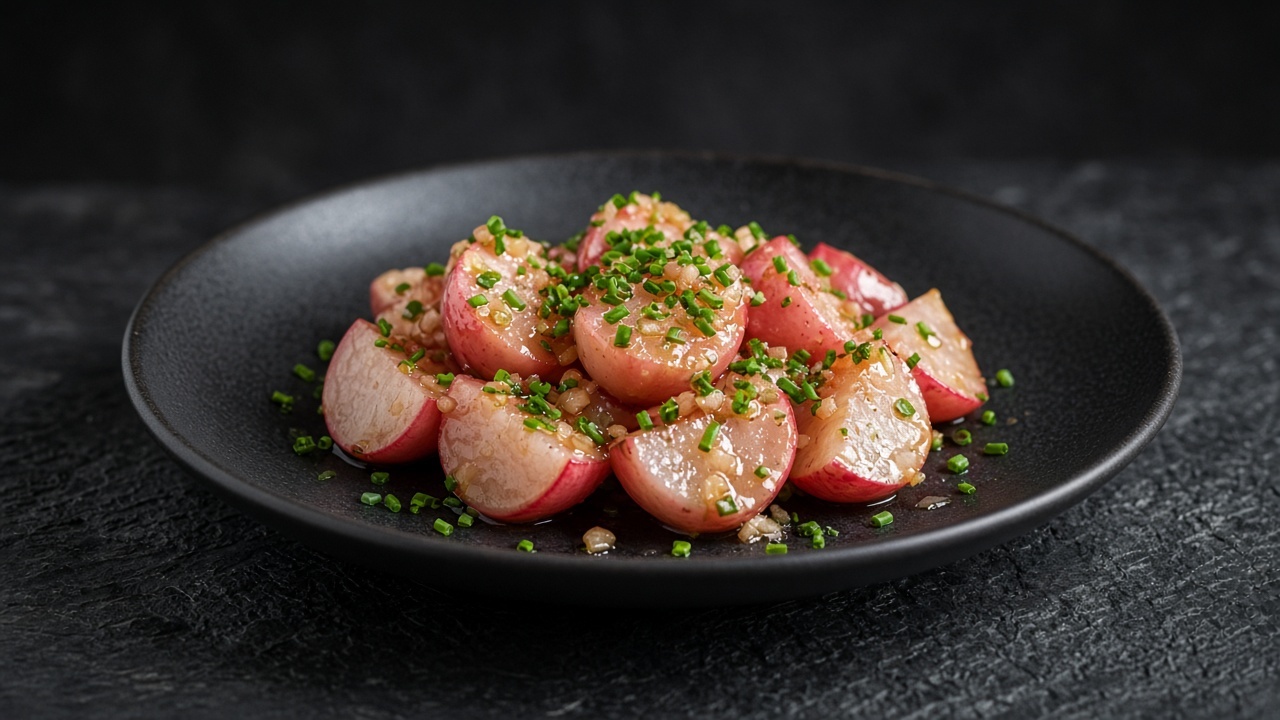

Braised Radishes with Shallot and Chives
Inspired by techniques from America's Test Kitchen.
Radishes simmered in butter, shallot and a little chicken broth lose their raw bite and turn tender while the liquid cooks down to a light glaze. A scattering of fresh chives at the end keeps the dish bright instead of flat.
Always check the labels of the products you use.
Method
- 1
Soften the shallot. Melt the butter in a 30 cm frying pan over medium-high heat. Add the shallot and salt and cook until softened, 2-3 min.
- 2
Braise the radishes. Add the radishes and chicken broth, cover, and cook until the radishes are tender, about 10 min, stirring halfway through.
- 3
Finish. Uncover and keep cooking until the liquid thickens slightly, about 1 min longer. Stir in the chives, season with salt and pepper to taste, and serve.
Storage
Best eaten right away. Refrigerate leftovers covered for up to 3 days and reheat gently in a pan until piping hot. Cool leftovers in a shallow container and refrigerate within 2 hours (within 1 hour on a day above 32°C).
EU nutrition claims
- Low fat: 2.4 g fat per 100 g (limit ≤ 3 g)
- Low sugars: 2.5 g sugars per 100 g (limit ≤ 5 g)
- High fibre: 4.2 g fibre per 100 kcal (needs ≥ 3 g)
Per 100 g of the finished dish, worked out from the nutrition per serving and the lowest likely cooked weight (about 125 g a serving), so the true values are, if anything, lower. Thresholds from the Annex to EU Regulation (EC) No 1924/2006. How we decide
Free sugars
0 g per serving
0 % of the 50 g daily maximum · 0 % of the ideal 25 g
Free sugars under 50 g a day, ideally about 25 g, based on WHO free-sugar guidance (not endorsed by WHO). The share shown is the share of one serving. WHO
Equipment
- chef's knife
- 30 cm frying pan with a lid
- wooden spoon
Nutrition per serving (estimated values)
| Per serving | Amount |
|---|---|
| Energy | 53 kcal |
| Protein | 1.2 g |
| Carbohydrate | 5.9 g |
| of which sugars | 3.1 g |
| of which free sugars | 0 g |
| Fat | 3 g |
| of which saturates | 1.8 g |
| Fibre | 2.2 g |
| Salt | 0.9 g |
Protein per 100 kcal
2.3 g High Protein needs ≥ 5 g (20% of energy)
Calculated from USDA FoodData Central ingredient values