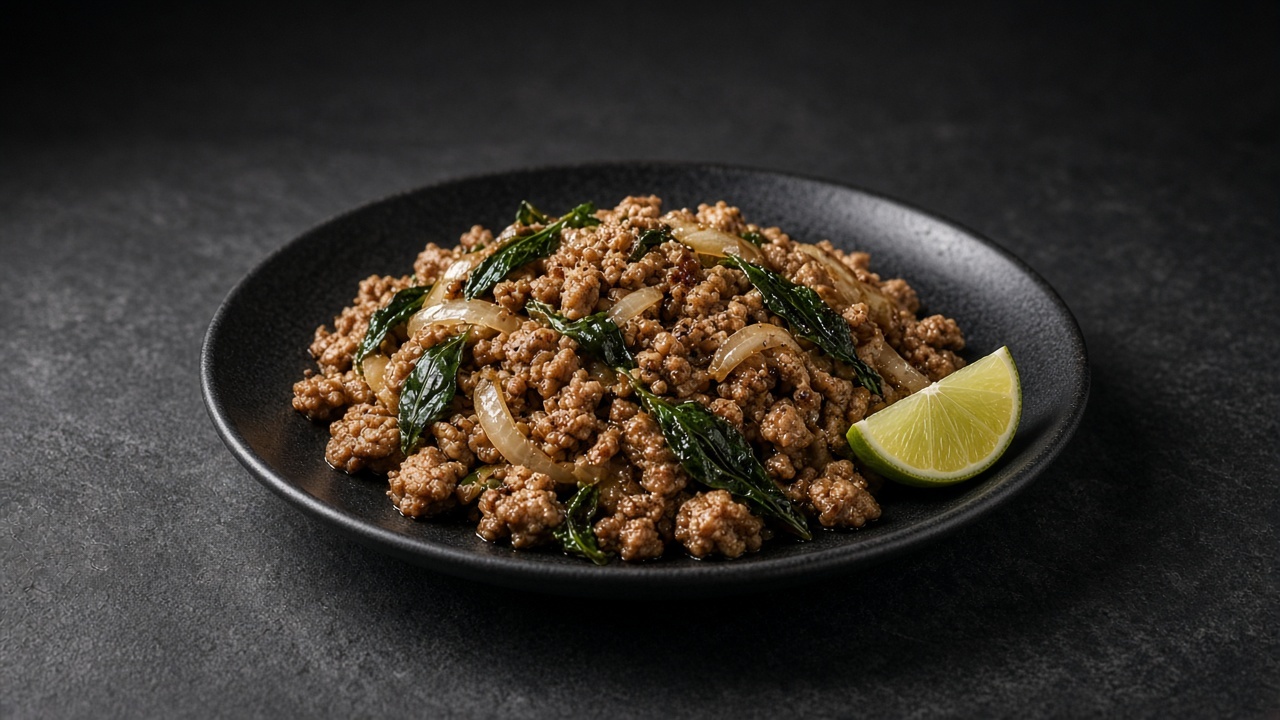

Basil Chicken Stir-Fry
Inspired by techniques from Bon Appétit.
Chicken mince is tenderised with a little bicarbonate of soda, browned hard in a wide frying pan, then coated in a sweet-salty-spicy sauce built from oyster sauce, chilli paste and fish sauce. A big pile of basil wilted in at the very end turns it fragrant and green, in the spirit of Thai basil chicken.
Always check the labels of the products you use.
Method
- 1
Tenderise the chicken. In a medium bowl, vigorously stir the chicken mince with 1 tbsp of the oil, the bicarbonate of soda, fine salt and water until the mixture turns smooth, pale and starts to cling to the side of the bowl. Set aside.
- 2
Mix the stir-fry sauce. In a small bowl, stir together the oyster sauce, chilli paste, fish sauce and brown sugar. Set aside.
- 3
Cook the shallots. Heat the remaining 3 tbsp oil in a large cast-iron or non-stick frying pan over medium-high heat. Cook the shallots, stirring occasionally with a wooden spoon, until softened and golden in spots, about 4 min.
- 4
Brown the chicken and add the sauce. Add the chicken mixture and spread into an even layer. Cook undisturbed until it just starts to set, about 4 min, then break it up into small pieces with the spoon. Pour in the sauce mixture and cook, stirring often, until most of the liquid has evaporated and the sauce clings to the meat and the chicken reaches 74 °C.
- 5
Wilt the basil and serve. Add the basil to the pan (it will look like a lot) and let it wilt slightly. Remove the pan from the heat and toss until the basil is completely wilted. Taste and add a little more salt if needed. Serve with steamed rice and the lime wedges for squeezing over.
Storage
Leftovers keep in the fridge for up to 3 days; reheat in a hot pan or microwave until steaming. Cool leftovers in a shallow container and refrigerate within 2 hours (within 1 hour on a day above 32°C).
Why this label?
22.7 g protein for 344 kcal = 6.6 g per 100 kcal, so protein gives about 26% of the energy. High Protein needs at least 20% (5 g per 100 kcal), the condition in the Annex to EU Regulation (EC) No 1924/2006. How we decide
EU nutrition claims
- Low sugars: 2.9 g sugars per 100 g (limit ≤ 5 g)
Per 100 g of the finished dish, worked out from the nutrition per serving and the lowest likely cooked weight (about 198 g a serving), so the true values are, if anything, lower. Thresholds from the Annex to EU Regulation (EC) No 1924/2006. How we decide
Free sugars
2.2 g per serving
4.4 % of the 50 g daily maximum · 8.8 % of the ideal 25 g
Free sugars under 50 g a day, ideally about 25 g, based on WHO free-sugar guidance (not endorsed by WHO). The share shown is the share of one serving. WHO
Equipment
- medium bowl
- small bowl
- large cast-iron or non-stick frying pan
- wooden spoon or heatproof rubber spatula
- instant-read thermometer
Nutrition per serving (estimated values)
| Per serving | Amount |
|---|---|
| Energy | 344 kcal |
| Protein | 22.7 g |
| Carbohydrate | 13 g |
| of which sugars | 5.8 g |
| of which free sugars | 2.2 g |
| Fat | 23.4 g |
| of which saturates | 3.7 g |
| Fibre | 2.2 g |
| Salt | 2.93 g |
Protein per 100 kcal
6.6 g meets High Protein (≥ 5 g, 20% of energy)
Calculated from USDA FoodData Central ingredient values