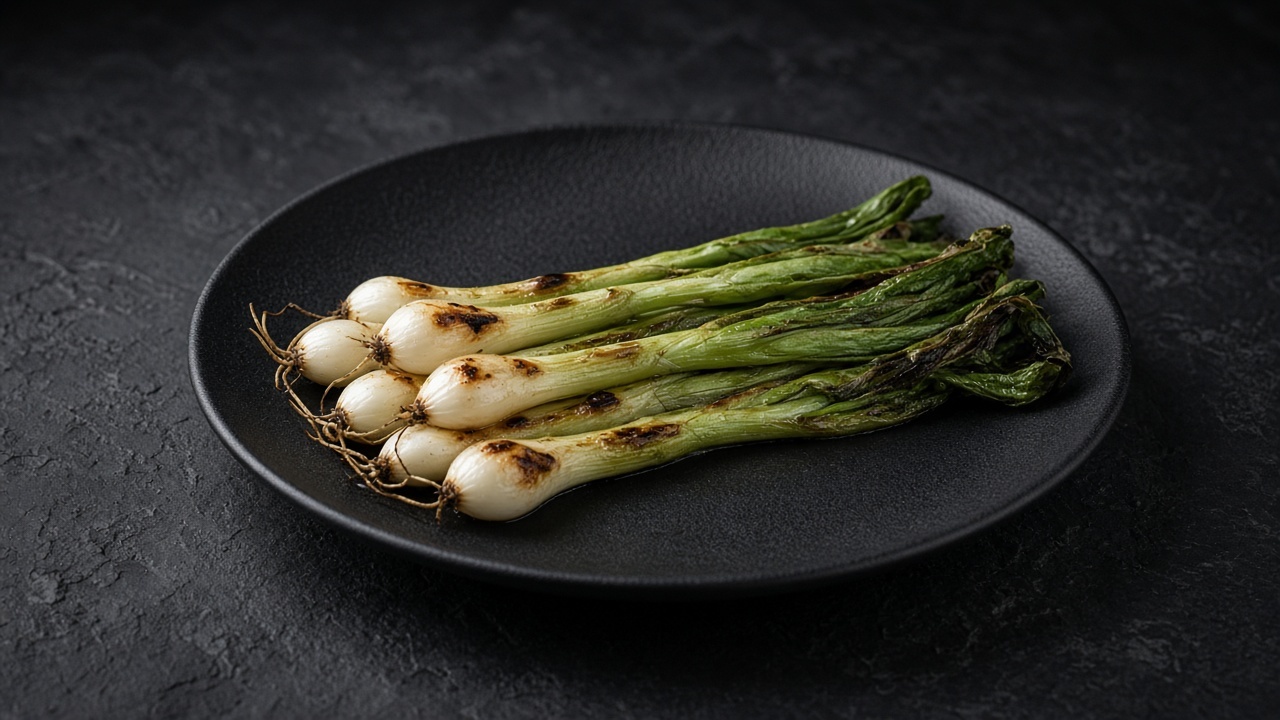

Barbecued Spring Onions
Inspired by techniques from America's Test Kitchen.
Whole spring onions are tossed with oil and salt, charred hard and fast over a hot barbecue, then wrapped tightly in baking paper and foil so they steam in their own heat until silky. The wrap-and-rest step is what turns quickly charred spring onions into something soft enough to eat whole.
Based on the listed ingredients, none of the 14 major EU allergens. Always check product labels.
Method
- 1
Light the barbecue. For charcoal: open the bottom vent fully and light a chimney starter filled with briquettes. Once the top coals are partly covered in ash, pour them evenly over the barbecue, set the grate in place, cover and open the lid vent fully; heat until hot, about 5 min. For gas: turn all burners to high, cover and heat until hot, about 15 min, then leave all burners on high.
- 2
Toss the spring onions. Toss the spring onions with the olive oil and salt in a large bowl. Clean and oil the cooking grate.
- 3
Barbecue. Arrange the spring onions on the barbecue perpendicular to the grate. Cook, covered if using gas, until lightly charred on both sides, 2-3 min per side.
- 4
Wrap and rest. Lay a sheet of baking paper on the work surface and transfer the spring onions to the centre, parallel to the edge of the work surface. Fold the sides of the baking paper inward over the spring onions, fold the bottom half up and over, then roll the baking paper tightly around them. Wrap the packet tightly in foil and let it rest until the spring onions have softened, about 25 min.
- 5
Serve. Unwrap and serve the spring onions warm.
Storage
Best eaten warm, soon after unwrapping. Leftovers keep in an airtight container in the fridge for up to 2 days.
EU nutrition claims
- Source of fibre: 2.6 g fibre per 100 kcal (needs ≥ 1.5 g)
Per 100 g of the finished dish, worked out from the nutrition per serving and the lowest likely cooked weight (about 39 g a serving), so the true values are, if anything, lower. Thresholds from the Annex to EU Regulation (EC) No 1924/2006. How we decide
Free sugars
0 g per serving
0 % of the 50 g daily maximum · 0 % of the ideal 25 g
Free sugars under 50 g a day, ideally about 25 g, based on WHO free-sugar guidance (not endorsed by WHO). The share shown is the share of one serving. WHO
Equipment
- charcoal or gas barbecue
- chimney starter (for charcoal)
- tongs
- large bowl
- 40 x 30 cm sheet of baking paper
- aluminium foil
Nutrition per serving (estimated values)
| Per serving | Amount |
|---|---|
| Energy | 88 kcal |
| Protein | 1.6 g |
| Carbohydrate | 6.6 g |
| of which sugars | 2.1 g |
| of which free sugars | 0 g |
| Fat | 6.9 g |
| of which saturates | 1 g |
| Fibre | 2.3 g |
| Salt | 0.76 g |
Protein per 100 kcal
1.8 g High Protein needs ≥ 5 g (20% of energy)
Calculated from USDA FoodData Central ingredient values