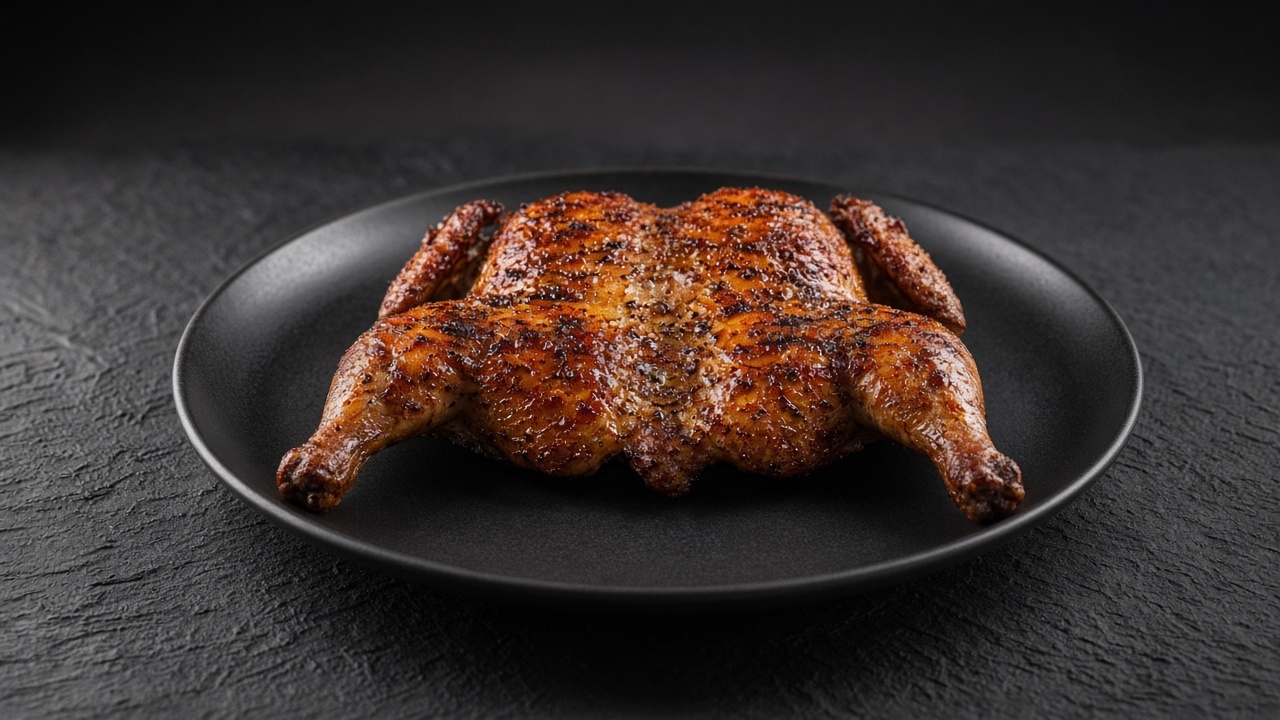

Barbecued Butterflied Chicken
Inspired by techniques from Serious Eats.
A whole chicken is butterflied flat, seasoned with nothing but salt and pepper, then barbecued over a two-zone fire so it starts gently on the cool side and finishes with crisp skin over the hot side. Flattening the bird and skewering it to hold its shape lets it cook evenly without flare-ups or a dry breast.
Based on the listed ingredients, none of the 14 major EU allergens. Always check product labels.
Method
- 1
Spatchcock the chicken. Pat the chicken dry and set it breast side down on a chopping board. Using kitchen shears, cut along both sides of the backbone and remove it. Flip the chicken breast side up and press down firmly on the breastbone until it lies flat. Thread a skewer horizontally through one thigh, both breast halves and out the other thigh to hold the shape, then tuck the wingtips behind the back. Season generously all over with the fine salt and pepper.
- 2
Light a two-zone fire. Light a full chimney of charcoal. When it's covered in grey ash, pour it out over one half of the charcoal grate (or turn half the burners of a gas barbecue to high). Set the grate in place, cover and let heat for 5 minutes, then scrub and oil it.
- 3
Start over the cooler side. Place the chicken skin side up on the cooler side of the barbecue, with the legs pointing toward the hotter side. Cover, keeping the lid vents open and positioned over the chicken. Cook until an instant-read thermometer in the thickest part of the breast reads 43 °C.
- 4
Flip and crisp over the hot side. Flip the chicken skin side down onto the hotter side of the barbecue, with the breast now pointing toward the cooler side (on a gas barbecue, drop that burner to medium-low). Press down firmly with a spatula for good contact with the grate. Cover and cook until the skin is crisp and the breast reaches 63-66 °C, about 10 minutes more, sliding the chicken to the cooler side if the skin threatens to burn before it's at temperature.
- 5
Rest and carve. Transfer the chicken to a chopping board and rest for 5-10 minutes before carving and serving.
Storage
Refrigerate leftover chicken in an airtight container for up to 3-4 days, or freeze for up to 4 months. Cool leftovers in a shallow container and refrigerate within 2 hours (within 1 hour on a day above 32°C).
Why this label?
53.5 g protein for 619 kcal = 8.6 g per 100 kcal, so protein gives about 35% of the energy. High Protein needs at least 20% (5 g per 100 kcal), the condition in the Annex to EU Regulation (EC) No 1924/2006. How we decide
EU nutrition claims
- Sugar-free: 0 g sugars per 100 g (limit ≤ 0.5 g)
Per 100 g of the finished dish, worked out from the nutrition per serving and the lowest likely cooked weight (about 180 g a serving), so the true values are, if anything, lower. Thresholds from the Annex to EU Regulation (EC) No 1924/2006. How we decide
Free sugars
0 g per serving
0 % of the 50 g daily maximum · 0 % of the ideal 25 g
Free sugars under 50 g a day, ideally about 25 g, based on WHO free-sugar guidance (not endorsed by WHO). The share shown is the share of one serving. WHO
Equipment
- kitchen shears
- chef's knife
- chopping board
- metal or wooden skewer
- charcoal barbecue and chimney starter (or gas barbecue)
- grill brush
- kitchen paper
- wide spatula
- tongs
- instant-read thermometer
Nutrition per serving (estimated values)
| Per serving | Amount |
|---|---|
| Energy | 619 kcal |
| Protein | 53.5 g |
| Carbohydrate | 0.3 g |
| of which sugars | 0 g |
| of which free sugars | 0 g |
| Fat | 43.3 g |
| of which saturates | 12.4 g |
| Fibre | 0.1 g |
| Salt | 2.68 g |
Protein per 100 kcal
8.6 g meets High Protein (≥ 5 g, 20% of energy)
Calculated from USDA FoodData Central ingredient values