 Velvet
All-Butter Shortcrust Pastry
Inspired by techniques from America's Test Kitchen.
A tender, flaky all-butter pastry made in seconds in a food processor: flour, a little sugar and salt, chilled butter pulsed to coarse crumbs, then just enough ice water to bring it together. Makes one 23 cm pie or tart case.
Always check the labels of the products you use.
Method
- 1
Mix the dry ingredients. Put the flour, sugar and salt in the food processor and process for 3 s.
- 2
Cut in the butter. Scatter the chilled butter pieces over the flour. Pulse in 1-second bursts, about 8 times, until the mixture looks like coarse crumbs.
- 3
Add the water. Pour the ice water evenly over the mixture and process for about 10 s, until small balls of dough form and almost no dry flour remains.
- 4
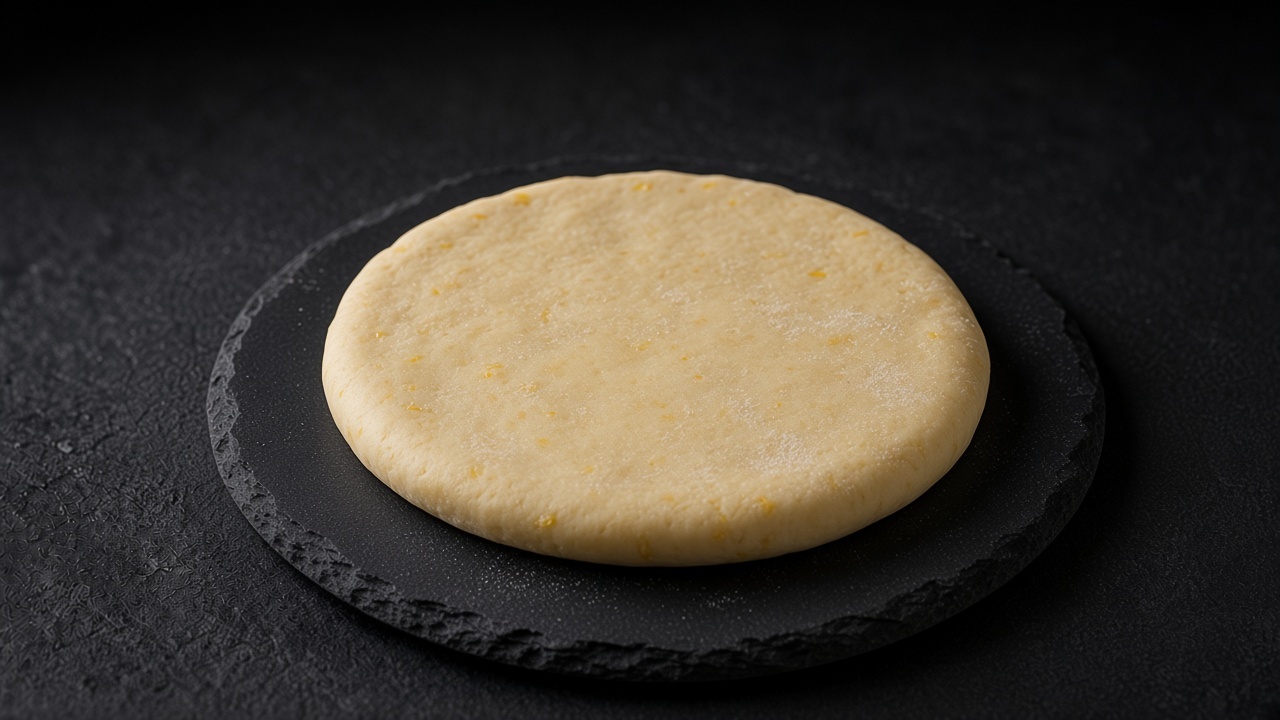
Shape a disc. Take the blade out carefully, tip the dough onto the work surface and press it together into a 15 cm disc, smoothing any cracks at the edge. Wrap it in cling film or baking paper.
- 5
Chill. Refrigerate for at least 2 hours, or up to 2 days, before rolling it out for your pie or tart.
Storage
Keep the wrapped dough in the fridge for up to 2 days, or freeze it in a freezer bag for up to 1 month and thaw overnight in the fridge before rolling.
EU nutrition claims
- Low sugars: 3.2 g sugars per 100 g (limit ≤ 5 g)
Per 100 g of the finished dish, worked out from the nutrition per serving and the lowest likely cooked weight (about 49 g a serving), so the true values are, if anything, lower. Thresholds from the Annex to EU Regulation (EC) No 1924/2006. How we decide
Free sugars
Free sugars: 1.6 g per serving
3.2 % of the 50 g daily maximum · 6.4 % of the ideal 25 g
Free sugars under 50 g a day, ideally about 25 g (WHO). The share shown is the share of one serving. who.int/publications/i/item/9789241549028
Equipment
- food processor
- kitchen scale
- measuring jug
- small knife
- cling film or baking paper
Nutrition per serving (estimated values)
| Per serving | Amount |
|---|---|
| Energy | 255 kcal |
| Protein | 2.9 g |
| Carbohydrate | 21.9 g |
| of which sugars | 1.6 g |
| of which free sugars | 1.6 g |
| Fat | 17.5 g |
| of which saturates | 10.8 g |
| Fibre | 0.7 g |
| Salt | 0.37 g |
Protein per 100 kcal
1.1 g High Protein needs ≥ 5 g (20% of energy)
Calculated from USDA FoodData Central ingredient values