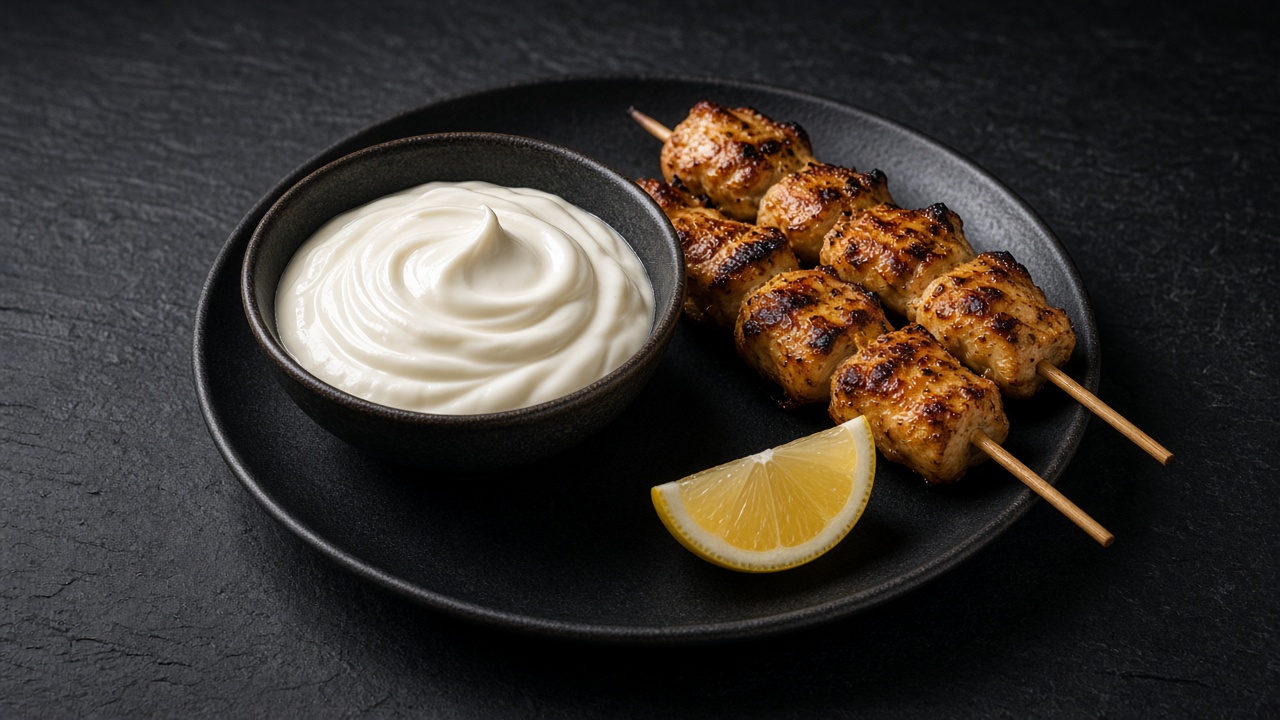
Whipped Garlic Toum
Inspired by techniques from Serious Eats and NYT Cooking.
Garlic, salt and lemon blended to a paste, then whipped with oil added very slowly, alternating with lemon and ice water, into a thick, snowy garlic cream.
None of the 14 major EU allergens. Always check the labels of the products you use.
Method
- 1
Remove the sprouts. Halve each garlic clove lengthwise and lift out any green shoot with the tip of the knife. The shoot carries a bitter, burning edge that only gets louder once the sauce is whipped.
- 2
Make the garlic paste. Pulse the garlic with the salt until finely minced, scraping the bowl down a couple of times. Add 2 tbsp lemon juice and blend until the paste looks smooth and slightly fluffy; this base is what holds the oil later.
- 3
Emulsify slowly. With the motor running, dribble in 60 ml oil in the thinnest possible stream, then 1 tbsp of the remaining lemon juice. Carry on in the same rhythm, alternating 60 ml oil with 1 tbsp lemon juice or ice water, for about 8-10 min in all. Garlic acts as the emulsifier, so it can only take on oil a little at a time.
- 4
Check the texture. Once all the oil and liquid are in, the toum should be pale, thick and fluffy, much like mayonnaise. Taste for salt and lemon, scrape it into the container and chill.
- 5
Serve it cold. Bring the toum to the table straight from the fridge with grilled chicken skewers, shawarma or roasted vegetables. A little goes a long way.
Storage
Keep in an airtight container in the fridge for up to 1 week. Do not freeze, as the emulsion splits when thawed. Cool leftovers in a shallow container and refrigerate within 2 hours (within 1 hour on a day above 32°C).
Equipment
- paring knife
- food processor
- flexible spatula
- airtight container
Nutrition per serving (estimated values)
| Per serving | Amount |
|---|---|
| Energy | 126 kcal |
| Protein | 0.2 g |
| Carbohydrate | 1.1 g |
| of which sugars | 0.1 g |
| of which free sugars | 0.1 g |
| Fat | 13.8 g |
| of which saturates | 1 g |
| Fibre | 0.1 g |
| Salt | 0.12 g |
Protein per 100 kcal
0.2 g High Protein needs ≥ 10 g
Calculated from USDA FoodData Central ingredient values